Apple is stepping up its game across three fronts: an all-new smart home suite co-developed with LG, a revamped MacBook Pro with OLED display, and stricter Full Disk Access permissions in macOS. Here’s what’s unfolding—and what it means for users.
LG Takes Center Stage in Apple’s Smart Home Push
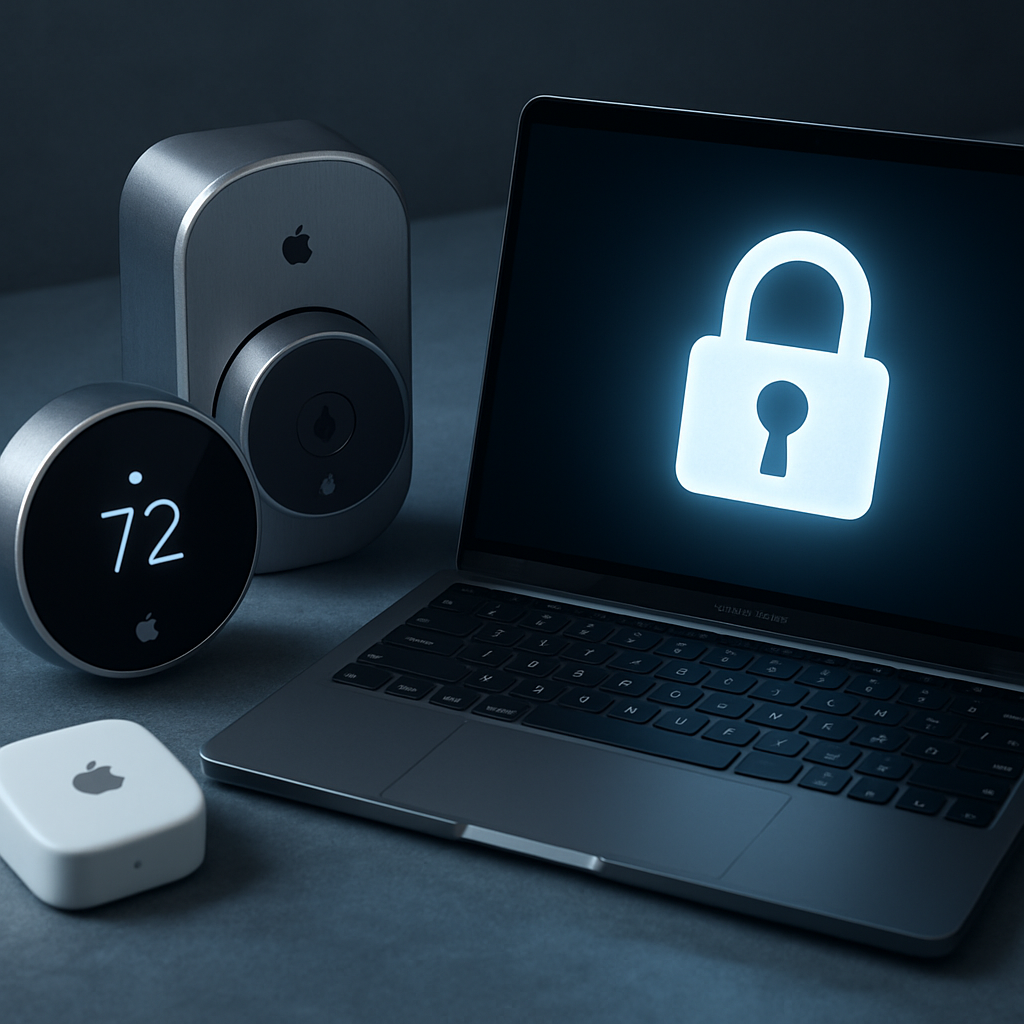
Leaked images and regulatory filings reveal that Apple is working with LG to create an entire lineup of home accessories—sold under the LG brand—that integrate deeply with Apple’s ecosystem. The lineup appears to include a smart deadbolt lock, thermostat, temperature sensor, video doorbell, indoor and outdoor cameras, and a floodlight camera. These were discovered via FCC documents and assets revealed by leaker pdfu.
The smart deadbolt boasts features such as a keypad that rotates to open, customizable lighting, audio alarms, sound volume settings, automatic unlocking, and support for both mechanical keys and master codes. The thermostat offers a circular “Far Sight” display, adjustable calibration, humidity readings, and support for Thread, dual-band Wi-Fi, and Bluetooth. A standalone sensor measures temperature (and humidity), attaches via a magnetic backing or adhesive plate, and includes low-battery alerts. Notably, the smart accessories carry LG branding rather than Apple’s own name, though Apple appears to have had heavy involvement in their hardware design and HomeKit or Matter integration.
Apple is expected to unveil its new home hub—alongside updated HomePod and Apple TV models—on October 13. While the LG accessories are likely to be showcased then, their release is anticipated several months after announcement. Pricing and availability remain undisclosed.
MacBook Pro OLED: Lighter, Touch-Ready, No Notch
Apple is also preparing a significant refresh for its MacBook Pro line. The next model, said to feature an OLED display with touch input and ditching the notch in favor of Dynamic Island, will reportedly be much lighter than current models. According to multiple reports, internal components are being miniaturized and reconfigured to shed weight—especially from the 16″ variant, which currently tops out at around 4.8 pounds. Even so, reported processers will stick with the M5 Pro and M5 Max chips; the shift to M6 is expected later. macOS is also being updated (via Golden Gate and 27.2) to support these design changes.
The OLED screen is likely to deliver stronger contrast, deeper blacks, and overall improved visual fidelity. Touch support suggests Apple is increasingly serious about crossing over elements of the iPad experience into Macs. Together with the lighter chassis and Dynamic Island interface tweaks, this points toward a substantial redesign not seen since previous MacBook Pro generations.
Reining In Full Disk Access: macOS Tightens Security
Apple is introducing tighter restrictions on Full Disk Access permissions in macOS—an issue that lets apps access most of what’s stored on a user’s start-up drive (files, messages, email, etc.). The change targets how apps request and are granted this level of access. Developers will now need explicit user action to obtain FDA, especially given concerns that AI-powered agents may misuse such broad permissions.
The move builds on company comments that some developers have abused FDA, using it to collect more data than users may expect or understand. Backup apps and EDR (endpoint detection and response) tools may be impacted, with speculation around how the permissions system will adapt to workflows in enterprise, content creation, or security roles. Details on exactly how fine-grained control will be implemented are still emerging.
These developments—smarter homes, lighter laptops, tighter privacy—aren’t isolated. They reflect Apple’s evolving priorities as it faces demands for better hardware, stronger ecosystems, and more responsible AI. The home accessories show Apple partnering rather than building everything itself, including balancing branding, design, and privacy expectations. The MacBook Pro overhaul lifts a decades-old hardware category into something more modern and portable without sacrificing performance. And the Full Disk Access changes show a recognition that security needs to catch up to capabilities—especially as more apps claim deep access amid AI’s expansion. What to watch: how Apple prices and times these launches, how smoothly the security changes roll out, and whether consumer trust holds steady, especially around LG’s role in smart home gear.