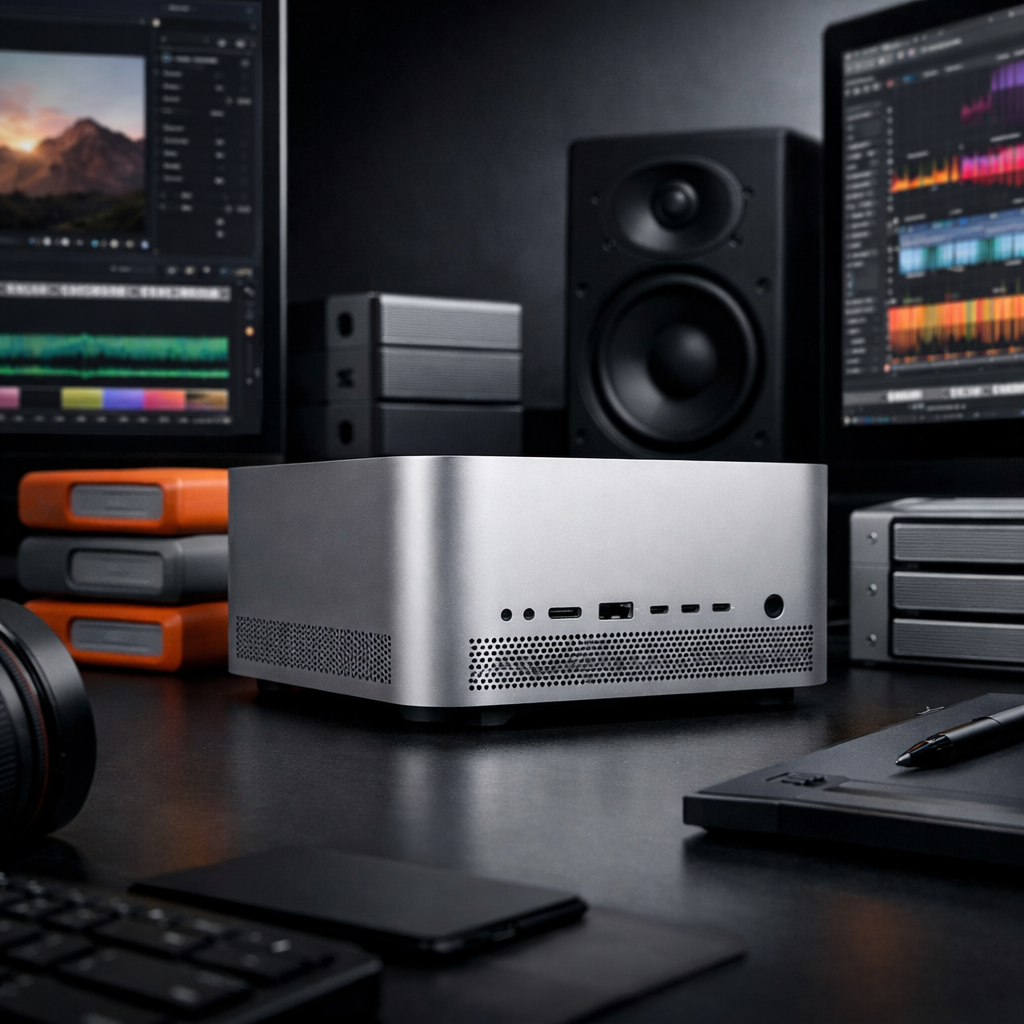
Apple’s latest Mac mini arrives with a chip that earns its upgrades—but its entry-level storage holds it back. The 2026 Mac mini, powered by the new M6 silicon, delivers strong gains in CPU, GPU, and AI performance over its predecessor. But the starting configuration’s 256GB SSD is a tight fit, especially now that Apple Intelligence and modern applications are crowding storage needs.
Stronger Core with the M6 Chip
The headline upgrade in this refresh is foregrounded by Apple’s first 2-nanometer desktop chip. The M6 features a 12-core CPU split into two “super” cores, four performance cores, and six efficiency cores. Graphics are also upgraded to 12 cores—up from ten in the last generation—and each GPU core now includes Neural Accelerators. The Neural Engine has doubled to two 16-core units. What this means: AI and graphics workloads get substantial boosts, with local compute for things like Photos or LM Studio significantly more responsive. Unified memory starts at 16GB, with options up to 32GB, and bandwidth has jumped from around 120GB/s in the M4 base to ~153GB/s (and up to 170GB/s) on higher-memory models.
Ports, Display Support, and Connectivity
The shell and overall design remain familiar: compact form factor, same port layout, including three Thunderbolt 4 ports, HDMI, front USB-C ports, and a rear power switch tucked away under the corner. Key updates include 2.5Gb Ethernet as standard, with a 10Gb option, and Wi-Fi 7, Bluetooth 6, and Thread all onboard—good moves for future-proofing. On the display front, the M6 Mac mini can drive up to three external screens. That includes high-clock-rate 4K displays and even 6K output via Thunderbolt.
Storage, Pricing, and What You Get
The base model starts at $899 for 16GB RAM, 256GB SSD, and 2.5Gb Ethernet—$300 more than the similarly sized M4 model launched. RAM upgrades cost under $200 each step (24GB or 32GB). Storage costs escalate: from 256GB to 512GB is +$200, 1TB adds ~$500, and 2TB more. The 256GB drive, besides being small, is notably slower than larger SSDs: read/write speeds are around 3,150 MB/s, whereas the 512GB version jumps to roughly 6,300 MB/s. Apple has also done away with the slotted SSD—users can no longer upgrade storage later.
Performance in Practice
In single-core tests, the M6’s new configuration offers gains over the M4 in the range of 20-40%, depending on the benchmark. For multi-core, those gains stretch higher as workloads scale. GPU performance, especially with AI acceleration, also sees strong improvements. However, because the base SSD both caps capacity and bandwidth, users buying the entry-level model will feel constraints when loading large AI models, working with pro video, or juggling many apps.
Summing up, the M6 Mac mini is a genuine upgrade in core performance, graphics, AI readiness, and connectivity. But its launch with a 256GB base SSD—non-upgradable—at a substantially higher price hits buyers who want value. For many, spending the extra $200-$300 to get 512GB is not optional—it’s necessary to get a machine that stays usable over time.
Analytical Take-Away: Apple has clearly focused on pushing AI and GPU capabilities forward with the M6 Mac mini, and for power users this chip delivers. But the decision to stick with such limited and slower base storage in the lowest-cost model undercuts much of the appeal. If you’re buying new, consider investing in 512GB or more. If you own an M4 Mac mini, the gains are real—but may not justify the cost unless your workflows demand faster AI, graphics, or storage.