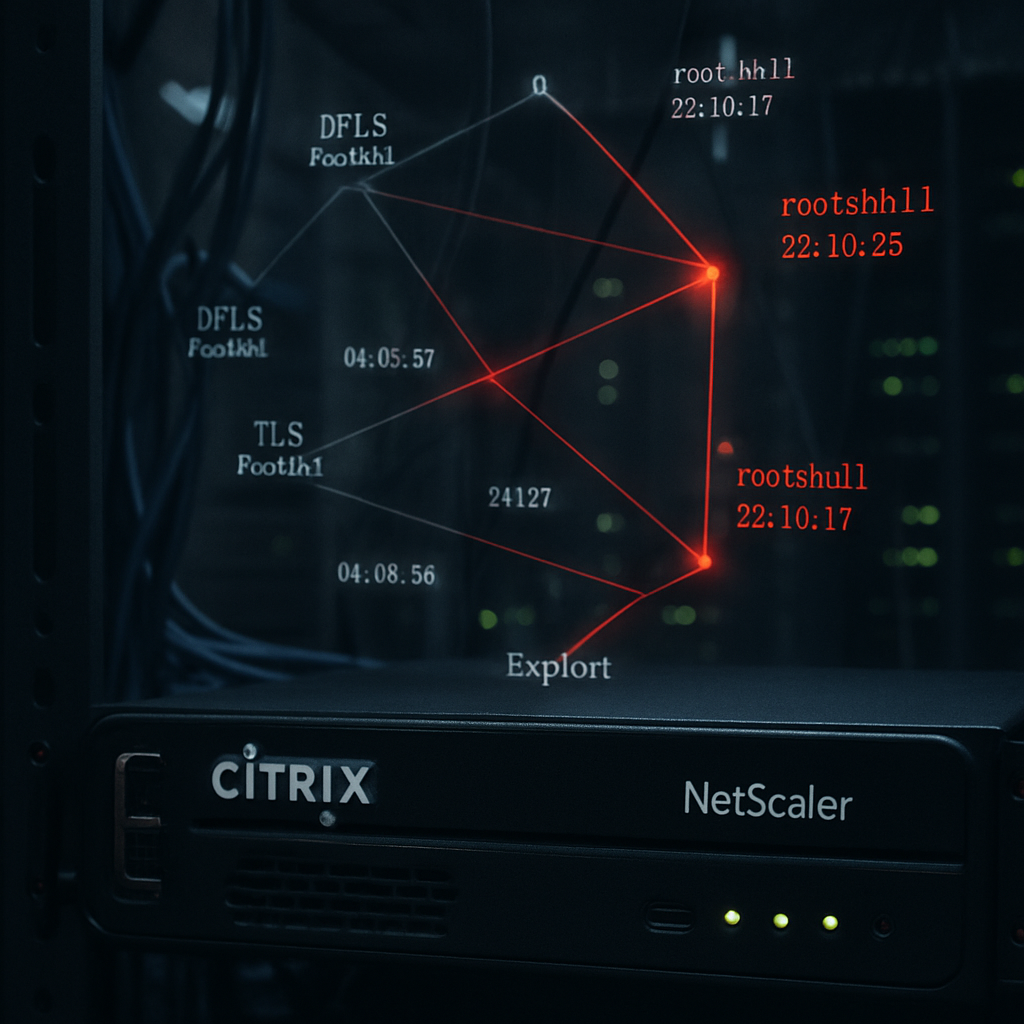
Citrix’s NetScaler appliances have been hit by a serious new exploit, allowing attackers to take root access and quietly deploy two custom tools—WHIPSHOT and SLAPSHOT—according to recent findings from security researchers. The flaw, identified as CVE-2026-88772, undermines authentication and triggers memory corruption in the packet processing engine of NetScaler ADC and Gateway devices. Zero-day exploitation has already been seen in North America and Europe across sectors like government, finance, legal, education, and tech.
Root Cause: DTLS Parsing Bug Leads to Heap Overflow
At the heart of the issue is a vulnerability in how NetScaler’s NSPPE module handles DTLS (Datagram Transport Layer Security) during its pre‐authentication handshake. When fed malformed or fragmented DTLS record headers, the module experiences a heap overflow, enabling attackers to run arbitrary shellcode with full root privileges on the FreeBSD platform powering NetScaler. The bug is rated high-severity, with a Common Vulnerability Scoring System (CVSS) score of 9.5.
WHIPSHOT & SLAPSHOT: New Tools, New Techniques
After gaining root access, threat actors install a web shell—WHIPSHOT—that can decode Base64 commands hidden within HTTP headers. Then, they use SLAPSHOT, a Python-based reverse tunneling tool, to send internal traffic through a proxy for reconnaissance, credential harvesting, and possible lateral movement. To blend in, the attackers disguise WHIPSHOT and SLAPSHOT using deceptive file extensions (.deb,.sig) and configure web server responses such that requests for image or icon files actually trigger PHP web shell execution.
The installer modifies httpd.confso that files with certain extensions are processed as PHP scripts, creating.sig files in the “/netscaler/gui/vpn/scripts/linux/” directory. HTTP requests ending in “.ico” under “/vpn/media/” are routed to matching.sig files. In some logs, GET requests to nonexistent.sig files resulted in long processing times and large response sizes—suggesting unseen shells are still there.
With persistence, the attackers alter permissions of /bin/shand reboot the NetScaler appliance to maintain control. The web shells also self-clean if inactive for 10 minutes, removing ports and lock files to reduce forensic evidence.
Scope & Timeline
Researchers from Mandiant and Google’s Threat Intelligence Group observed these exploits starting in September 2026. Target industries include government, financial services, education, technology, and legal/professional services. GreyNoise noted mass reconnaissance tied to CVE-2026-88771 and CVE-2026-88772 beginning September 28, followed later by widespread exploitation by multiple threat actors intent on deploying web shells and malware for botnet enlistment and access brokering.
This campaign highlights a broader pattern: edge devices—such as VPN gateways, firewalls, and application delivery controllers—are prime targets because they’re internet-exposed, often outside endpoint detection, and hold credentials or network access that help attackers move deeper into systems.
Citrix has issued patches for the vulnerabilities, and organizations with NetScaler ADC or Gateway systems are strongly urged to update immediately, audit configurations—especially any.deb/.sig mappings or mod_php invocations—and scan for any signs of web shells or unusual inbound DTLS behavior.
Why this matters: the exploit chain in CVE-2026-88772 shows how memory handling flaws, even seemingly obscure ones in DTLS parsing, can provide full control to attackers. Watch for how this evolves—whether more edge-device exploits reveal similar advantages, and how detection tools adapt to inspect web traffic headers and image file request routes. Network defense may need to move upstream, closer to the traffic ingress, to catch these kinds of chains before root is already in hand.