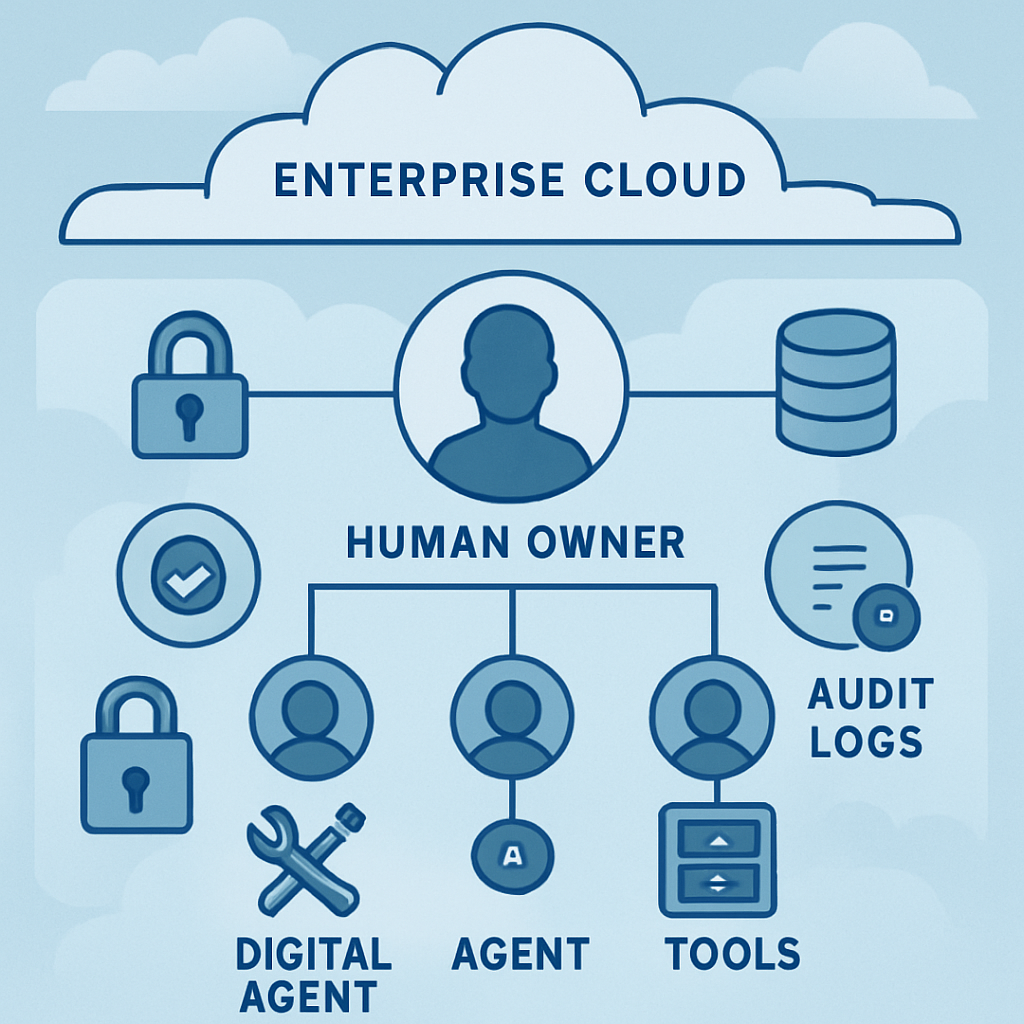
AI agents—automated software that log in, invoke tools, and perform actions with delegated authority—are now operating across enterprise systems. Managing these agents’ identities and access safely is more complex than with human users. A practical Identity and Access Management (IAM) framework for AI agents treats each as a non-human identity: with a human owner, a defined purpose, scoped authorization, an expiration, and continuous monitoring. Standard IAM platforms capture what’s configured, but often miss what the agents actually do.
Why Conventional IAM Fails for Autonomous Agents
Traditional systems are built for defining access intent—who should have access—and configuring roles or permissions accordingly. They work well for human users whose workflows are well understood. But AI agents act autonomously, stitching together multiple tools, APIs, and tasks dynamically—behavior that static permissions and static policies can’t contain reliably. An agent might be granted broad API access, then use it in ways never intended by the role definitions.
Agent identities tend to bypass human-oriented governance. They’re often spun up by automation tools, development pipelines, or embedded within applications, rather than existing in HR-triggered lifecycle processes. This creates gaps: agents without clear ownership, credentials that live on far too long, unbounded permission inheritance, agents that are never properly registered with the main identity provider, and access that never expires.
Core Components of a Strong AI Agent IAM Framework
To address these risks, an identity framework for agents must deliver three capabilities: accurately identify and credential agents, tightly restrict what they can do, and generate proof of what they actually did. First, every agent needs its own identity (not shared or borrowed from a human), with short-lived credentials and an owner responsible for its lifecycle. Delegation should preserve distinction between agent’s identity and any user authority it borrows.
Second, authorization must be fine-grained. Policies should enforce least privilege, tools allowlist only needed APIs or functions, restrict data sources, and require additional approval for high-risk actions. In short, the framework should limit each agent’s “blast radius.”
Third, auditability: beyond simply logging what permissions an agent has, the system must record tool usage, data access, task chains, and other runtime behavior. Behavioral monitoring is key—standard auth logs often miss misuse of valid credentials or privilege escalation tactics.
Evaluating and Building vs Buying vs Extending IAM
When choosing or building the right framework, companies must assess: traceability from agent to human owner, credential management (prefer short-lived federated identities over static secrets), preservation of agent identity when performing delegated actions, how comprehensively states and identities are discovered, observability into runtime actions, speed of revocation, and strength of audit evidence.
For many firms, extending existing IAM systems is a logical starting point—lifecycle, policy, and governance workflows are already there. Tools like SailPoint and Saviynt are examples of platforms that now incorporate non-human or agent identity functionality. Building new components becomes necessary when runtime tool enforcement or identity discovery falls outside the IAM vendor’s capabilities. Some environments end up combining extensions, custom builds, and third-party observability layers for full coverage.
Phased Adoption and the Road Forward
Agencies and enterprises moving to agent governance often do so in stages. In early phases, agents are inventoried, given owners, and granted temporary roles reviewed manually. Later, credential rotation, provisioning, and revocation become automated and event driven. The most mature setups correlate what agents were supposed to do with what they actually did—across tools, APIs, and infrastructure—and generate real audit trails.
Looking ahead, agent-to-agent delegation across systems is creating chains of authority that weren’t directly approved. Machine-readable policies, verifiable credentials, and constrained delegation are being explored to manage that complexity. Another emerging idea is continuous authorization, where trust isn’t static but adapts based on what agents are actually doing, what data they access, and changes in context.
For enterprises deploying AI agents, IAM isn’t just about defining intent—it’s about observing execution. Visibility into what agents truly did, and the ability to quickly revoke or restrict access, will distinguish robust security from exposed risk.
Why It Matters & What to Watch
This shift matters because AI agents are blurring lines in authorization: today’s decision-makers must assume misconfiguration is possible and focus on what happens at runtime—not just what’s allowed. As regulations and compliance standards evolve, auditability and behavioral evidence will become non-negotiable. What to watch: new tool integrations for agent discovery, standards for agent credentials, advances in telemetry collection, and real support from IAM vendors for continuous authorization and agent-to-agent trust chains. Enterprises that stay proactive here will avoid surprises as AI agents become part of the everyday tech stack.