Phishing detection is getting more complex. Many threats embed themselves in links that look innocent at first but reveal their true danger only after dynamic behavior—making static analysis alone insufficient for accurate threat detection.
The Pitfalls of Static Inspection
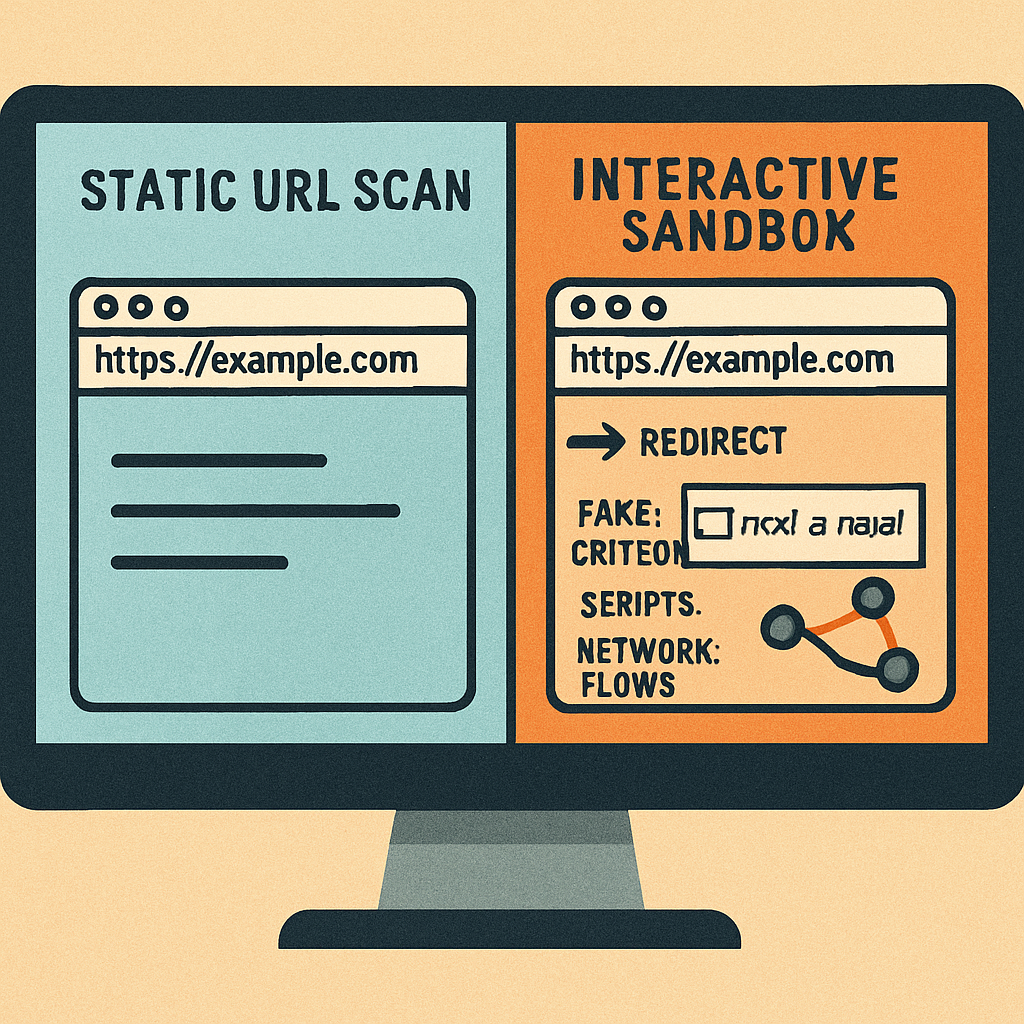
Static analysis tools scan URLs, domains, scripts, or files without executing them. They catch obvious issues but often miss what happens once a user interacts with a webpage. In many phishing setups, the initial page appears benign. After loading, the site may run scripts, redirect to other domains, or even generate credential-stealing login forms. Static tools might never see this, leaving analysts with partial information. That gap between what’s visible at first glance and what actually happens afterward is known as the visibility gap.
Sandboxes change the game by executing suspicious content in a controlled, isolated environment. They enable analysts to see the chain of events—redirects, user-triggered actions, side-loaded scripts—that static scans won’t show. This dynamic visibility is especially vital when phishing attacks hide behind interactivity, redirects, or environmental checks inside the browser.
How Phishing Is Evolving in 2026
Attackers are using increasingly sophisticated methods to evade detection. A recent report covering threat activity in the first half of 2026 spotted drastic rises in phishing tactics like fake CAPTCHAs, browser fingerprinting, and device-code based phishing. Between the first and second quarter of 2026, use of custom fake CAPTCHAs soared by more than 400%. At the same time, actors are leaning heavily on legitimate services—such as trusted cloud or infrastructure providers—to hide their malicious intent. These developments make reputation-based detection and static tools less reliable.
For security teams, this means staying updated on attack trends isn’t just good practice—it’s essential for measuring whether your tools are keeping up. Tools that might’ve sufficed a year ago can now be gaps in your phishing defense.
Interactive Sandboxing in Practice
While automated sandboxing tools execute content in a safe space, they often miss threat behaviors that emerge only through interaction. An interactive sandbox gives security professionals greater control: they can follow redirects, click through prompts, enter CAPTCHAs, or open files—basically, replicate a victim’s journey in a safe environment. The visibility from this process isn’t just a yes/no verdict on whether something is malicious—it’s rich behavioral detail that supports better detection rules, threat hunting, and faster investigation.
Picture this scenario: an email arrives with a link. The domain seems clean. The page looks innocuous. But when opened app-style in a sandbox, it redirects, prompts the user, and finally morphs into a fake login page designed to harvest credentials. With behavior logs in hand—redirect chains, contacted domains, loaded scripts—analysts can identify the threat with greater precision.
Where Sandboxing Fits into a Holistic Defense
Sandboxing is a tool, not a standalone solution. Email filters, SIEMs, endpoint security, and threat intelligence are still vital layers. But when those tools flag something suspicious yet leave analysts guessing why, that’s where sandboxing adds immense value. Especially for SOCs and MSSPs regularly wrestling with complex, dynamic phishing campaigns, having the ability to interact with suspicious URLs and files in an isolated environment makes a big difference.
Evaluators should look for sandboxes that support both URL and file analysis, allow interactive user behaviors, produce detailed evidence (scripts, domains, redirects), and integrate smoothly into existing stacks, including threat intelligence, SOAR, SIEM, and email security workflows.
Why it matters: The cryptic nature of modern phishing—scripts that deliver only after clicks and CAPTCHAs, hidden redirects, and stealthy infrastructure—demands that defenders see what was previously invisible. Sandboxing+ interaction helps move from “something suspicious happened” to “we know how, when, where, and by whom.”
Ultimately, phishing detection needs to go beyond static signals. Every link flagged should lead to a full investigation of behavior—because what happens after the click often holds the key.
Analytical angle: Visibility beyond static artifacts is becoming the critical frontier in email security. For organizations reliant on legacy or surface-level monitoring tools, investing in interactive sandboxing isn’t optional—it’s urgent. Watch for sandbox platforms that can adapt to evolving phishing methods and that integrate threat intel and SIEM workflows. Those will become key differentiators in how SOCs and MSSPs manage risk.