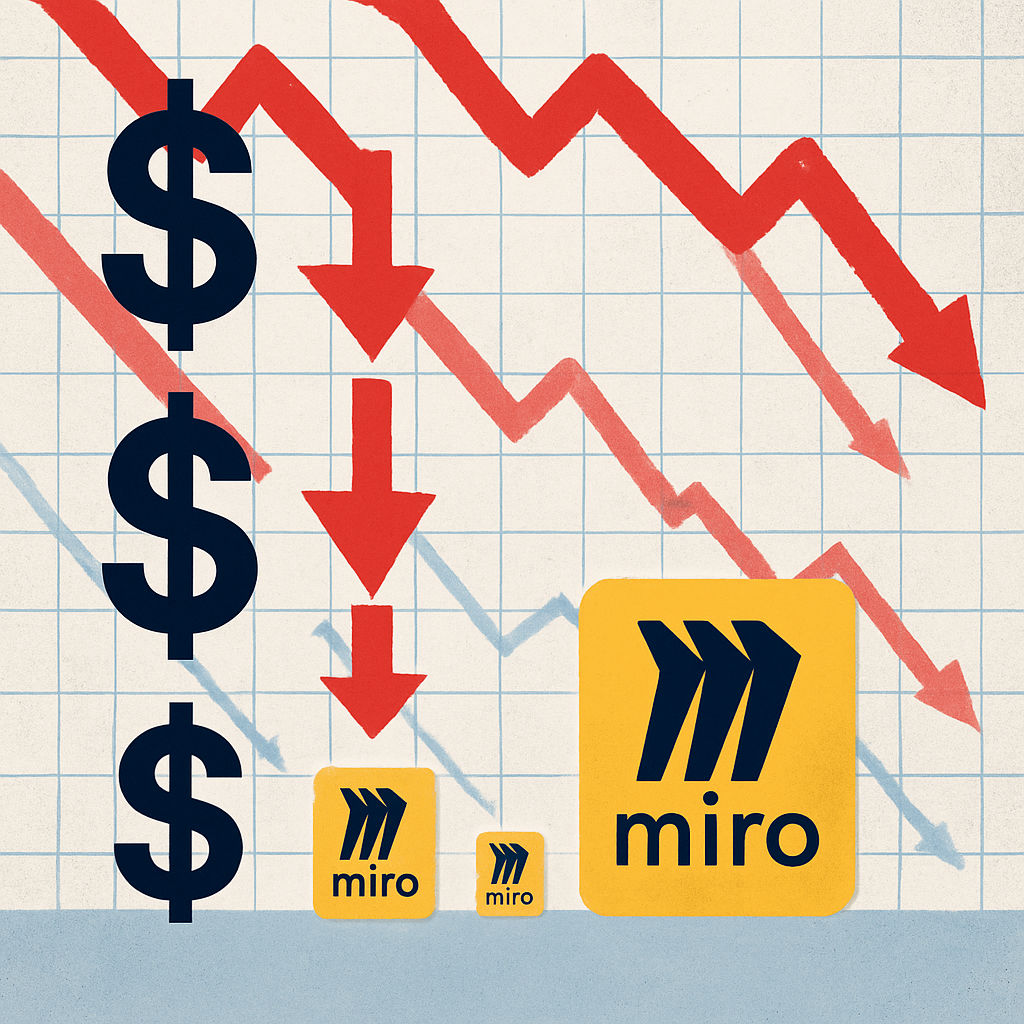
Italian acquirer Bending Spoonshas struck a deal to take over workplace collaboration platform Mirofor $1.36 billion in cash, with an equity value pegged at $1.79 billion. That price tag represents a dramatic fall from Miro’s $17.5 billion valuation in late 2021.
From Remote Work Darling to Market Reset
Miro began life in 2011 under the name RealtimeBoard, offering digital whiteboarding that became especially compelling when remote work surged during the COVID-19 pandemic. The platform expanded rapidly, integrating with over 250 apps and forming partnerships with major players like Atlassian, Cisco, Microsoft, and Zoom. It also opened its platform for third-party integrations and customization.
By 2022, Miro had leapt from approximately 5 million users to about 30 million in just two years. Its paying customer base surged by 550% during that period—factors that helped drive its sky-high valuation at the time.
Changing Business Realities
Today, the numbers tell a different story. Miro now serves over 100 million total users, 4 million of whom are paying customers. It brings in roughly $600 million annually in recurring revenue, with enterprises accounting for about 90% of that income. The company also has net cash totaling around $435 million and is profitable.
Despite this sustained performance, the sharp decline in valuation underscores how much investor expectations for SaaS growth have cooled since the pandemic boom. Growth rates that seemed achievable in 2021 have given way to more conservative forecasts.
Miro has also faced competitive pressures from Canva, Figma, Microsoft, and the push by companies toward suite-based tools rather than standalone collaboration platforms. Operationally, the company reduced headcount twice—cutting 119 roles in early 2023 and about 275 more in late 2024.
Bending Spoons’ Acquisitive Momentum
Bending Spoons isn’t new to snapping up prominent SaaS names at sharp discounts. Just last month, it acquired Airtable—similarly affected by post-pandemic cooling—at about $1.28 billion.
The strategy appears to revolve around acquiring recognizable software businesses that once enjoyed elevated valuations, but have matured into slower-growing yet still significant and profitable entities with solid recurring revenue.
What stands out is that Miro didn’t seem cash-strapped or desperate. It had financial strength and operational stability. Yet its board and investors opted to accept a greatly reduced valuation—raising questions about the likelihood of comparable exits or IPOs in today’s SaaS environment.
Analysis:This acquisition highlights how much the software landscape has shifted. Miro’s acquisition isn’t a failure story—it still has massive enterprise revenue, users, and profit—but its valuation fall reflects investor caution in post-pandemic times. For companies that once thrived on explosive growth projections, the path forward increasingly favors sustainable income, profitability, and execution over sky-high multiples. Keep an eye on how other once-premium SaaS firms negotiate exits or funding in this new climate. Expect more deals where buyers acquire strong, stable businesses at meaningful discounts.