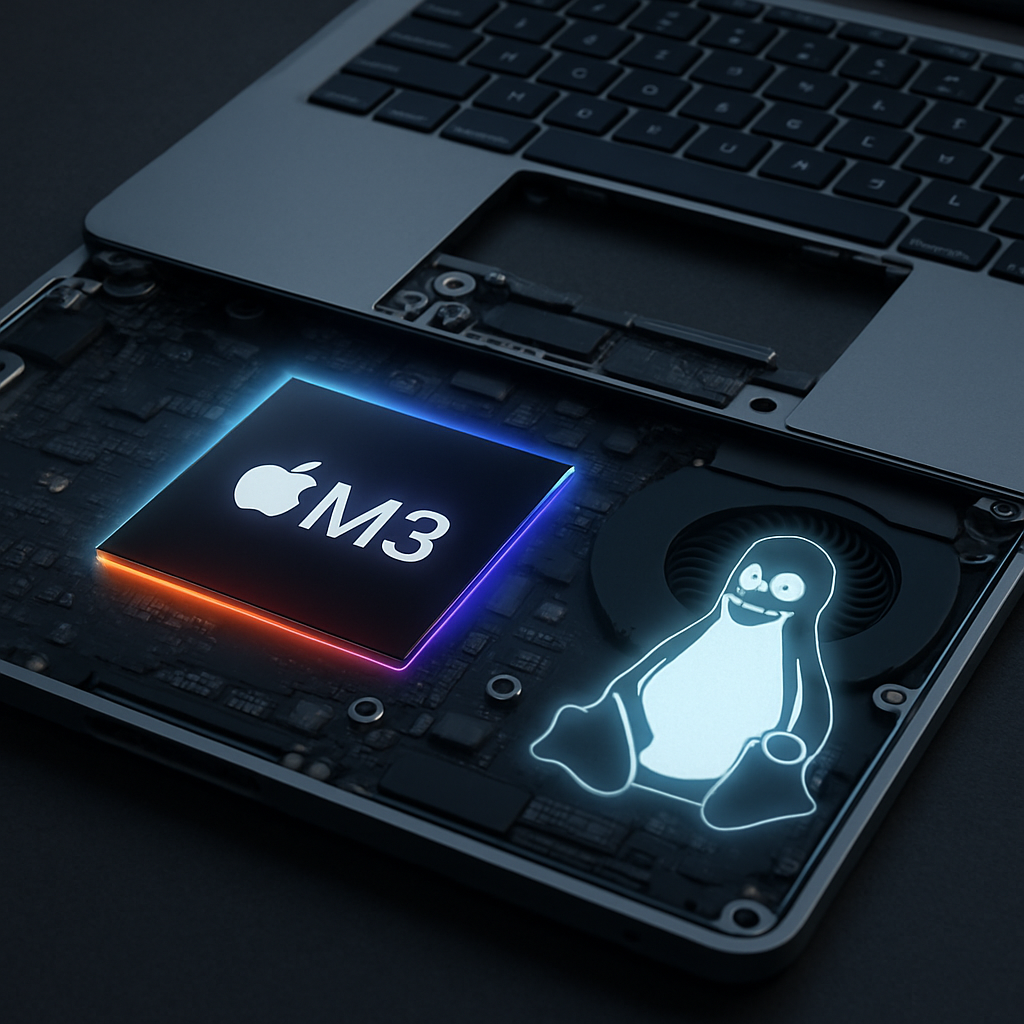
The Asahi Linux project has officially added support for Apple’s latest M3 series chips—the M3, M3 Pro, and M3 Max—bringing Linux compatibility to a new generation of Apple Silicon Macs. M3 Ultra, however, is not yet supported, leaving some users still waiting.
What’s Working, What’s Not
Most core functionality from M1 and M2 Macs now also operates “just works” on the M3 family. That includes support for webcams, internal microphones, USB ports (up to the USB 3.0 10Gb/s cap), Wi-Fi, Bluetooth, and hardware-accelerated video decoding. These developments enable much of the day-to-day experience to run smoothly for users installing Linux on M3, M3 Pro, or M3 Max systems.
There are still gaps. Full DCP (Display Co-Processor) support is not yet available, which means GPU performance and graphics pipeline tasks are limited. Sleep mode doesn’t function correctly due to firmware limitations in the framebuffer—something that hinges on enabling full DCP. Also, HDMI is disabled until that support is completed. These areas are expected to receive updates in the near future.
Which Macs Are Covered, and What Comes Next
The new compatibility extends beyond earlier M1 and M2 Macs to include hardware equipped with M3, M3 Pro, and M3 Max systems on chip. Devices running M3 Ultra—for example, some Mac Studio units—are not yet compatible with the latest release. This reflects the added complexity involved in enabling full functionalities like GPU acceleration and power states on the larger, more powerful silicon.
Looking ahead, the Asahi Linux team is already turning its sights toward supporting even newer generations, including the M4 and M5 chips. Further refinements are coming, particularly around display support, power management, and graphics performance.
Asahi Linux’s milestone for M3 marks a major step in expanding Linux’s reach on Apple Silicon. For open-source developers, system tinkerers, and users depending on Linux workflows, this opens up new hardware choices. The missing pieces—DCP, sleep, HDMI—are significant, but the core functionality ready now already represents a useful and mostly polished offering. Going forward, observing how quickly the remaining features are brought online—especially for M3 Ultra and future chips—will be the key for broader adoption and real usability across the board.