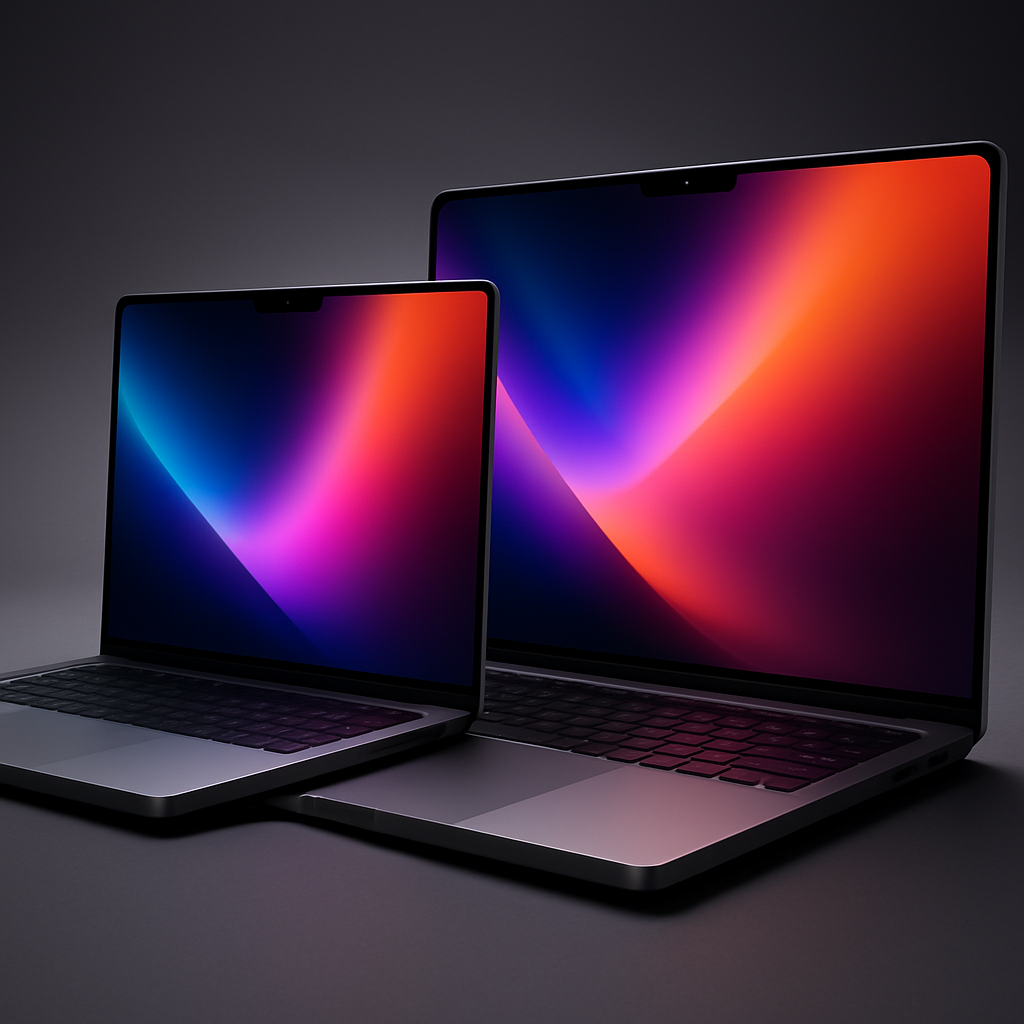
New reports suggest Apple’s upcoming MacBook Ultra—believed to debut later this year or early 2027—will sit well above the current MacBook Pro models in terms of price. Sources indicate the existing Pro lineup with mini-LED displays will remain available through at least 2028, instead of being replaced outright by OLED-equipped Ultra versions. That gives Apple room to position Ultra as its premium tier, commanding a steep price premium.
OLED versions won’t immediately replace mini-LED
According to research firm Omdia, Apple plans to continue offering 14-inch and 16-inch mini-LED MacBook Pro models in parallel with new OLED Ultra variants. The OLED units will launch with features like touchscreen input, thinner construction, and Dynamic Island, emphasizing a clear distinction between tiers. The mini-LED models, though considered less premium, could stick around until at least 2028. That aligns with manufacturing and panel-supply timelines.
How much more expensive will Ultra be?
With current MacBook Pro models already starting at elevated prices—$1,999 for the 14-inch and $2,999 for the 16-inch with M5 Pro chips—the Ultra line is expected to begin above those points. The Ultra’s higher cost will stem from adopting OLED displays, adding touch support, and integrating upgraded design elements. Observers believe a sensible starting price for Ultra would exceed $2,999, possibly landing around or above $3,499.
One recent pricing sketch imagines existing mini-LED Pro models continuing to start near $2,499 for the 14-inch and $2,999 for the 16-inch, while Ultra variants might push starting prices even higher—perhaps in the $2,999-to-$3,499 range. The final cost depends heavily on configuration, display tech, and memory and storage tiers.
Inside Apple’s broader laptop lineup, Ultra would occupy the top tier above models like MacBook Neo and MacBook Air. In fall 2026 the roster is expected to include several Pro models (both mini-LED and OLED), with Ultra in 14- and 16-inch configurations using the M5 Pro and M5 Max chips. By spring 2027 Ultra variants will continue similarly, while Air and Neo models refresh on newer base silicon.
The timing of Ultra’s release remains uncertain. Production for OLED panels was reported to begin in mid-2026, targeting a third-quarter introduction, though memory shortages and other supply constraints could push broader availability into early 2027.
Why it matters:Apple is signal-boosting its tiered laptop strategy. By keeping current mini-LED Pros alongside new OLED Ultra models, it allows consumers to opt for premium without losing the baseline options altogether. The real test will be whether the price bump aligns with perceived value—OLED, touch, design changes—and whether buyers are willing to pay hundreds to enter Apple’s new top of the line. Pricing above $3,000 puts Ultra in rarefied territory; Apple will need to make its enhancements justify the extra cost. What to watch next: confirmed display specs, memory and storage thresholds, and of course final retail prices.