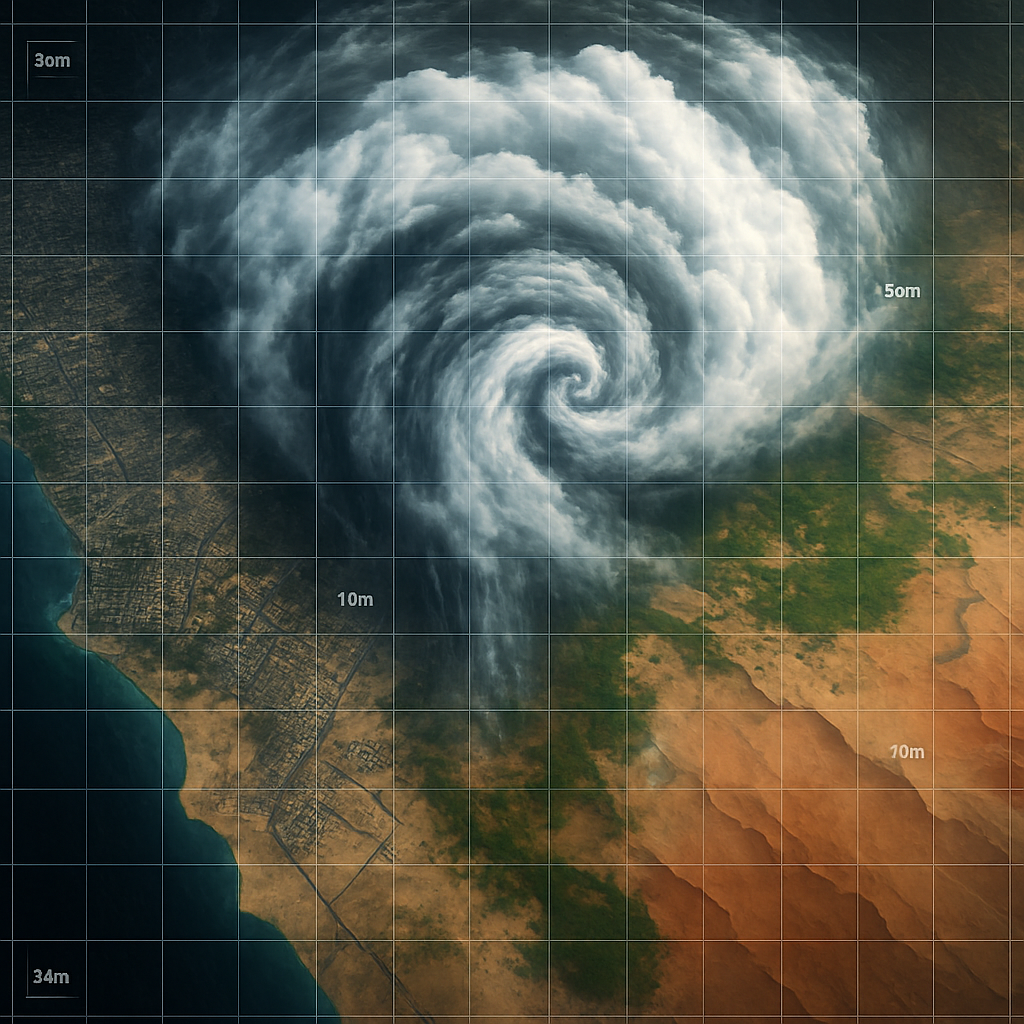
Google has unveiled WeatherNext 3, its newest AI-driven weather model that promises major gains in forecast precision. Built by Google Research and DeepMind, the model delivers sharper, more localized predictions by synthesizing live satellite imagery and reanalysis data. It’s now powering Google Search, Maps, and the Gemini app.
Sharper Spatial and Temporal Clarity
Unlike earlier models that rely on numerical weather prediction (NWP) systems and face roughly six-hour data delays, this version continuously digests real-time observations. It delivers temperature and moisture estimates with 5-kilometer resolution, surface features at 10 kilometers, and wind speed at 25 kilometers. That’s nearly a fivefold improvement over the previous WeatherNext 2 model’s grids and update intervals.
Better Rain Forecasts & Global Benefits
Precipitation forecasts are a major area of improvement. WeatherNext 3 is trained on top-tier sources like NASA’s IMERG satellite-based data and Google’s global precipitation reanalysis. For medium-range forecasts, the model shows up to 60% better performance against IMERG, 30% against MRMS, and 10% against rain gauge observations—especially for early lead times.
The improvements are particularly important for regions in Latin America, Africa, and Asia-Pacific, where reliable, high-resolution forecasts have long been sparse. In addition, WeatherNext 3 offers dedicated support for renewable energy: turbine-height wind speed projections, and high-resolution cloud and solar radiation forecasts to help solar installations plan more precisely.
Delivering on User Experience
Consumers will notice the upgrade in Google’s core tools. WeatherNext 3 feeds into Search, Maps, and Gemini, improving how forecasts appear days ahead. Most notably, precipitation forecasts for plans beyond a day out are now up to 50% more accurate—especially in places where weather prediction has had more uncertainty.
Developed in collaboration between Google Research and DeepMind, WeatherNext 3 addresses long-standing limitations of traditional weather models: latency, coarse resolution, and limited regional accuracy. Using satellite data and rapid update cycles, the system promises faster, finer-grained forecasts for both routine planning and extreme weather.
This is more than just a numerical upgrade—it’s a step toward equitable forecasting. By extending higher fidelity weather predictions globally, especially where supercomputing infrastructure is less available, WeatherNext 3 fills a forecast gap. The energy sector stands to win too, with projections fine-tuned for solar and wind generation.
What to watch now: how well WeatherNext 3 handles severe weather events in practice, its reliability beyond early forecast windows, and whether Google can schedule regular updates and transparency in its metrics. If it delivers, this model could mark a shift not just in Google’s mapping and assistant tools, but in how society prepares for and responds to climate impact.