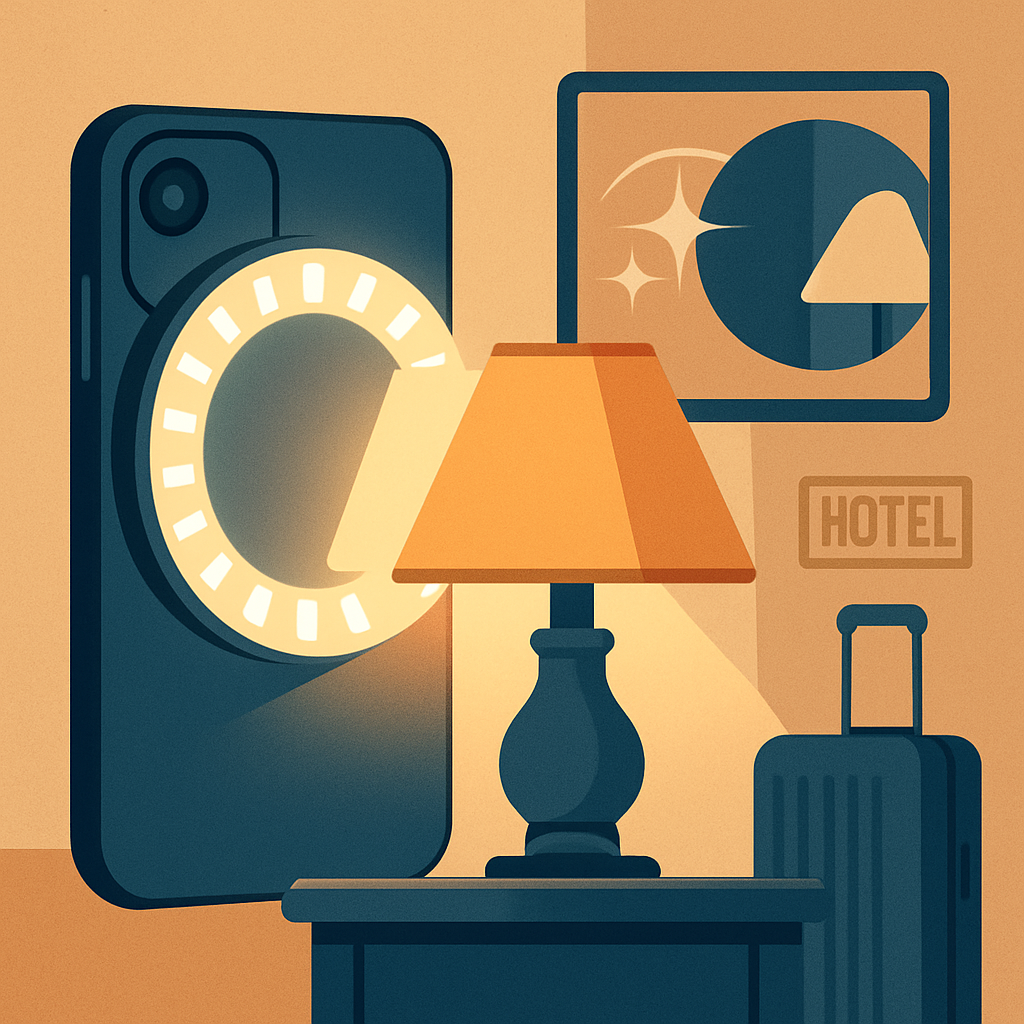
Researchers have unveiled a new smartphone accessory called SweepLED, which claims to allow travelers to detect hidden cameras in hotel rooms or short-term rentals almost instantly. The attachable device utilizes a LED-array in a phone case, computer vision, and machine learning to spot optical signatures typical of surveillance lenses in under five seconds. Such cameras are often concealed inside everyday items like clocks, power banks, or smoke detectors, making them hard to find without specialized tools.
How it works
The SweepLED prototype differs from traditional detection tools by varying how light hits suspicious objects. Rather than a fixed flashlight, the device sequences directional LEDs in a controlled pattern around a stationary phone camera. Bright reflections from glossy surfaces move with changing light angles, while those from camera lenses tend to stay relatively stable due to their lens and sensor configurations. The system records short video clips during the LED sweep, stabilizes the footage to compensate for hand motion, and compares frames with LEDs on and off. Potential lens-like reflections are tracked over a few frames, then fed into a machine-learning model to determine whether they indicate a hidden camera.
Performance and limitations
In tests, SweepLED was evaluated using 12 objects containing hidden cameras and 18 shiny but benign items. It detected about 95% of the camera-equipped objects, achieving an overall accuracy of 93.9%. The prototype also registered a false positive rate of 7.2% on non-camera objects. A full scan takes roughly 4.5 seconds, using three angles with each LED sweep lasting about 1.5 seconds.
While component costs are kept under $7—thanks to inexpensive LEDs, a standard ATmega328P microcontroller, and basic hardware—the system isn’t perfect. It struggles when a lens is behind heavily tinted, opaque, or diffusive materials, and accuracy drops off when objects are more than about 1 meter away. It also cannot substitute for a thorough physical inspection or reporting found devices to hotel staff or authorities.
SweepLED is a promising example of how modest hardware additions can boost personal privacy protection. By combining low-cost electronics with computer vision and machine learning, it could democratize access to hidden-camera detection—either built into phone cases or even integrated into future phone designs.
In a world where privacy concerns in travel are growing, SweepLED could shift the balance. What to watch: whether manufacturers adopt this design into commercial phone cases, how well it performs ‘in the wild’ outside lab settings, and whether it inspires similar tools for secured spaces. For travelers, it means one more layer of protection—quick, cheap, and surprisingly effective.