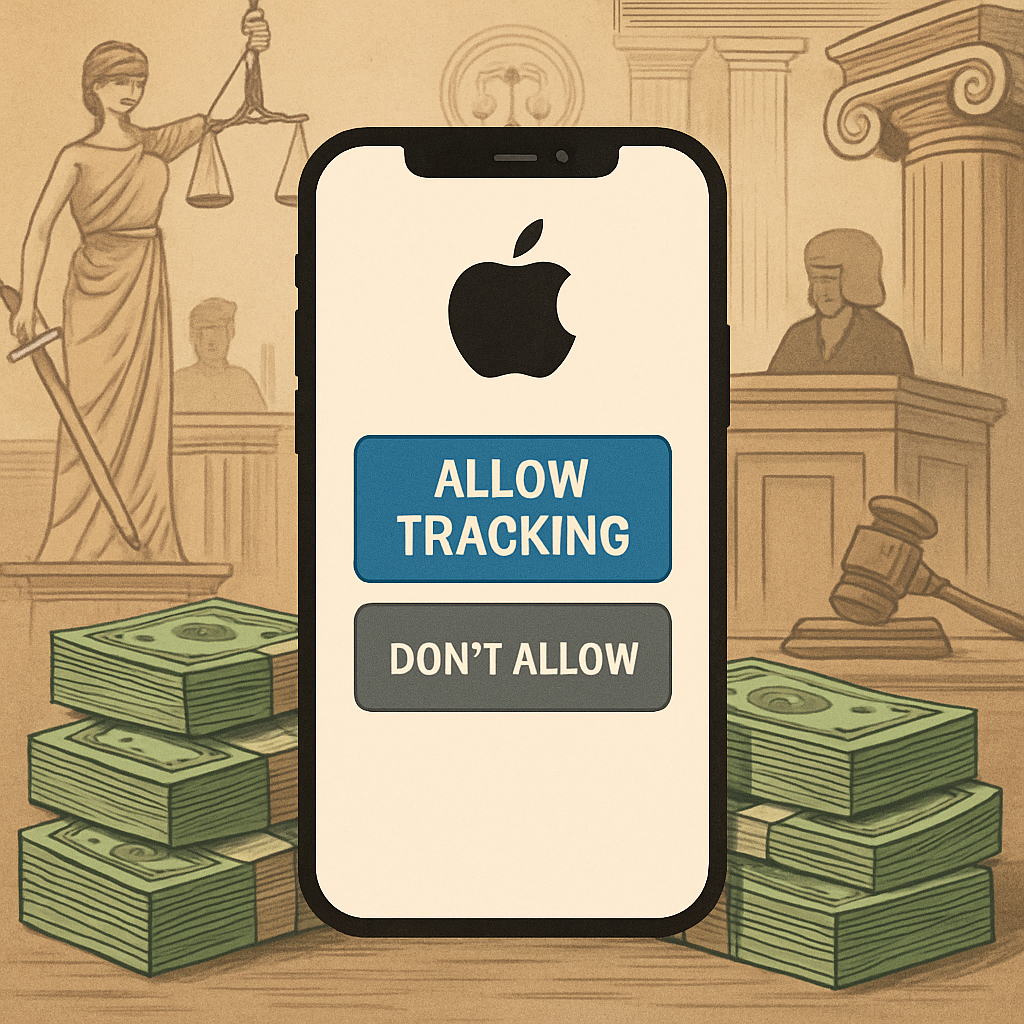
Apple faces a fresh legal challenge in the United Kingdom after a former senior director at the Competition and Markets Authority filed a $2.7 billion class action claim against the company. The lawsuit, lodged with the UK’s Competition Appeal Tribunal (CAT), alleges that Apple’s App Tracking Transparency (ATT) feature was crafted not primarily for user privacy, but to undermine third-party app developers and shore up Apple’s own dominance in mobile advertising.
What is App Tracking Transparency?
Introduced in 2021, ATT requires apps to prompt users—on first use—to decide whether they’ll permit tracking for targeted ads. If users opt out, the app must forgo collecting user data for ad purposes.
This policy shift reportedly had a massive financial impact early on: in the first six months after ATT was deployed, social platforms suffered revenue losses nearing $10 billion. Critics argue that while the rule burdens app developers, Apple’s own apps are exempt from these prompts—on Apple’s justification that its apps do not engage in advertising-based tracking. The lawsuit challenges the fairness of that distinction.
Legal precedents and regulatory action
This is not the first time ATT has drawn regulatory ire. France fined Apple under its privacy framework, though it has reportedly stopped short of mandating changes. Italy imposed a €110-million fine (approximately $115 million) in December 2025 and instructed Apple to modify how ATT operates. In Germany, regulators have called for more precision in the policy’s implementation, even while stopping short of ruling that the feature is unlawful.
What’s at stake and what happens now
Plaintiff Ann Pope contends that Apple uses ATT as a way to force app developers into a second-class status in terms of ad tracking rules, while Apple’s own apps are not held to the same standard. The lawsuit demands that ATT be applied evenly and argues this imbalance violates both competition norms and fair business practice.
How $2.7 billion was calculated isn’t immediately public, and the CAT has not yet set a hearing date. Observers point out that a previously filed iCloud antitrust case at the CAT is scheduled for a late-2028 hearing, suggesting lengthy timelines ahead for this case as well.
Apple has not publicly responded to this particular suit. However, its longstanding stance remains that its apps do not track users for advertising, and therefore do not require the ATT prompt. This position is at the heart of much of the criticism.
This case raises broader questions about how privacy tools intersect with antitrust concerns. ATT was designed to give users more control over how their data is used—but legal experts warn that sweeping protections can inadvertently undermine competitive neutrality if regulatory oversight isn’t consistent and transparent. The outcome could reshape how mobile platforms balance privacy, revenue, and fairness for smaller developers.