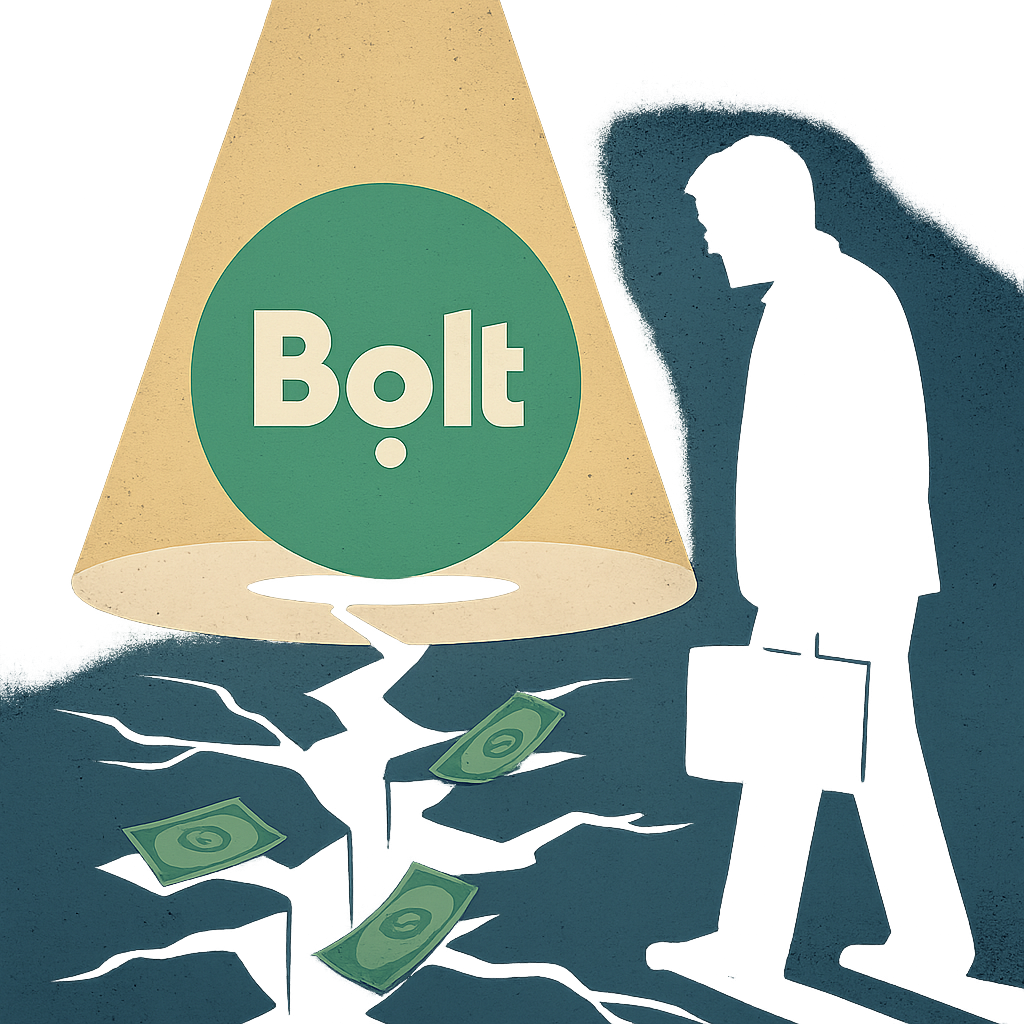
Bolt, the checkout startup co-founded by Ryan Breslow, is in the midst of raising up to $27 million through a pay-to-play bridge financing aimed at propelling the company toward its next major funding round and averting collapse. The funding round, structured as a convertible note, is open only to current backers, who risk losing significant equity if they opt out. This effort comes amid what may be a critical turning point for the fast-falling fintech company.
Background: From Billion-Dollar Valuation to Survival Mode
Founded in 2014, Bolt once boasted an $11 billion valuation in early 2022. Since then, its valuation has tanked — by approximately 97% — leaving it now worth roughly $300 million. Breslow returned as CEO in March 2025 after years away, during which the company faced both financial and investor disputes. According to the latest statements, Bolt is producing operational improvements and nearing profitability, though revenue has been shrinking for several years.
Details of the Bridge Round
The bridge round is being offered via convertible notes to existing investors. Those who decline to participate will suffer a punitive dilution of their equity — a common pay-to-play mechanism. The objective: capitalize on recent operational strides, settle ‘‘legacy obligations,’’ and ensure a clean transition while Bolt raises its full Series E2 round. Breslow did not lay out what those obligations are.
Breslow himself is investing $5 million into the round to signal confidence. Participation from other investors is expected to bring in at least another $15 million — though not all of Bolt’s roughly 100 existing backers are anticipated to participate. Breslow has not disclosed Bolt’s current cash reserves, but insists that the company is close to breaking even and resuming growth.
Past Setbacks, Present Hopes
Just two years ago, Bolt attempted a large $450 million raise at a $14 billion valuation. That deal unraveled amid lawsuits and controversy over alleged misrepresentations of lead investor commitments and misuse of non-cash “credits.” Though lawsuits were later dropped, Bolt has moved to ensure greater board and preferred shareholder buy-in for the current financing.
Under Breslow’s leadership, Bolt has also shifted strategy. The product known as Bolt Super App—which wraps in financial services, peer-to-peer payments, crypto, and credit cards under a one-click checkout—has become central to his vision. He also points to dramatic operational efficiency gains achieved through leveraging AI, saying the company is doing significantly more with far fewer resources. Bolt’s staff count has shrunk from about 900 in 2021 to 60 today, per Breslow’s remarks.
Despite these headwinds, Breslow is bullish about the firm’s future. He believes Bolt has a defensible advantage that would be difficult to replicate and rejects notions of walking away to start fresh—despite invitations to do so. He predicts Bolt can be the ‘‘Lyft to Stripe’s Uber’’.
Whether this bridge round will be enough to stabilize Bolt remains uncertain. The stakes are high: success could provide a runway to profitability and renewed momentum; failure may force a restructuring or worse. Investors’ responses in the coming weeks will be closely watched.