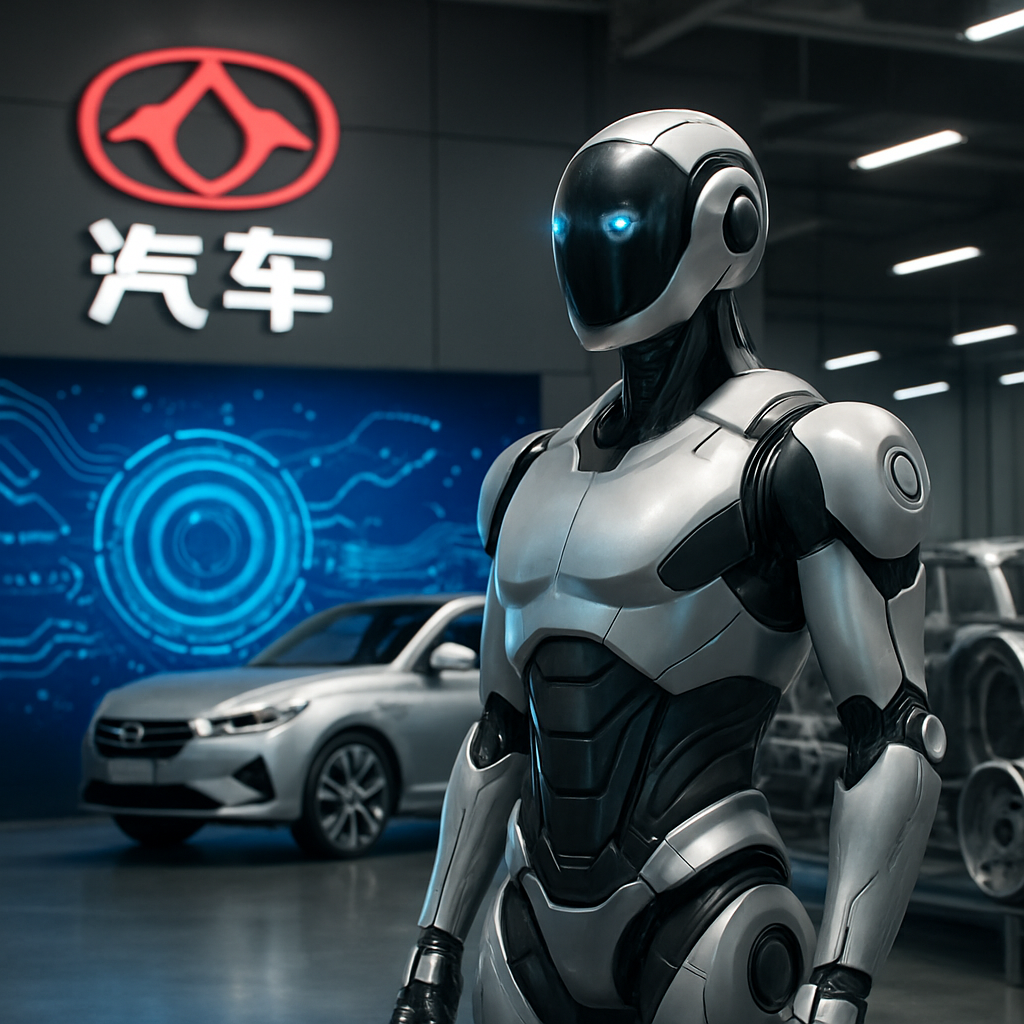
Chinese automakers are betting that humanoid robots represent a more profitable future than cars. Spurred by rapid advances in robotics and AI, companies like Xpeng, BYD, Chery, SAIC and others are pivoting toward “physical AI” – robotics built into physical machines. This shift echoes Tesla’s push with Optimus, but Chinese firms are leveraging manufacturing, supply chain scale, and local investment to fast-track commercialization.
Xpeng’s IRON: Core of China’s Humanoid Wave
Xpeng’s robotics arm recently closed a $900 million funding round, led by IDG Capital with participation from Tencent and Alibaba. Post-money valuation exceeds $6.3 billion. The raise, described as the largest private capital injection yet in China’s embodied AI space, is aimed at scaling hardware and software development, bolstering AI model training, mass-production preparation, and global expansion.
The company’s humanoid robot, IRON, is central to its physical AI strategy. With core hardware built in-house—including chips, motion modules, controllers and dexterous hands—Xpeng aims to blend its automotive-grade manufacturing with robotics. Mass production is targeted by late 2026, with initial deployments in Xpeng retail stores and company campuses. A wider commercial rollout in China and abroad is expected in 2027.
Other Automakers Join the Push
BYD has introduced a humanoid robot, reportedly called Xiao Di, engineered for dealership service. The robot is meant to greet customers, explain vehicle features and support demonstrations. While reports claim it’s about 1.61m tall, understands multiple dialects, and has many degrees of freedom, those spec details are largely unverified. What has been confirmed is its role in showrooms like BYD’s Di Space centers.
Meanwhile, Chery’s robotics unit, AiMOGA, is preparing for its IPO. Since its founding in early 2025, it has delivered over 3,000 robots globally, including more than 100 humanoid “police robots” handling tasks like crowd control and traffic guidance. The company expects deliveries to surge next year, with international expansion top of mind.
Other key players include Changan, GAC, SAIC, and Seres, all developing humanoid projects of their own. The rush points to a broader trend: integrating robotics into mobility and turning automakers into full-stack robotics firms.
Challenges on the Road Ahead
Despite enthusiasm, there are significant hurdles. Building walking, human-like robots is far more complex than fitting together EV hardware. Automakers must master AI model training, perception, motion control, safety, and real-world reliability. The AI side—where Tesla still leads—is the toughest catch-up.
Production and deployment timelines are tight. Xpeng aims for mass production of IRON by the end of 2026, but initial commercial units may only reach controlled environments (stores, campuses). BYD’s Xiao Di is already appearing in select showrooms. But broad consumer or factory use is much more difficult to achieve.
The push reflects larger economic realities: car profit margins are getting squeezed globally. Robots, meanwhile, offer new recurring revenue paths, software-rich models, and industrial applications. For Chinese automakers with scale in factories, batteries, supply chains, and AI-in-car R&D, the leap into humanoid robotics is a natural extension. What remains to be seen is which firms can deliver reliable robots that do useful work—and who’ll find buyers outside early adopter environments.