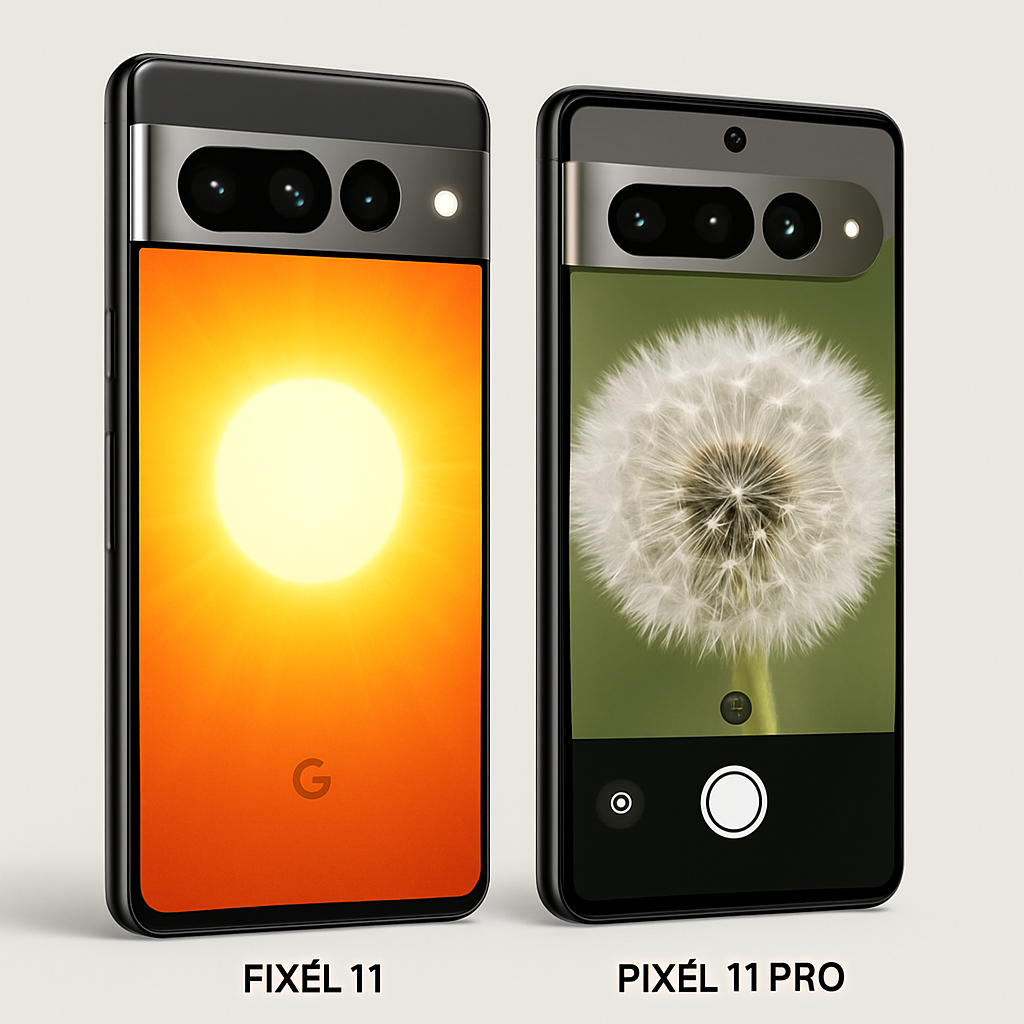
Google’s Pixel 11 and Pixel 11 Pro land with more similarities than ever before—but the distinctions still count. While both phones share a design language rooted in the Pixel 10, a few key upgrades on the Pro carve out its premium space. Here’s how they stack up.
Hardware & Display
Both models maintain a metal outer frame and glass camera bar, though on the base Pixel 11 this bar is slimmer and less protruding than on prior generations. The Pro version still has a noticeable camera bump, adding potential vulnerability unless you pick a well-fitting case. Display-wise, the Pixel 11 Pro features a higher resolution panel (1280×2856) and a full 1–120 Hz LTPO screen. The standard Pixel 11 drops down to 1080×2424 and operates at 60–120 Hz, with thicker bezels and less dynamic refresh. Peak brightness is outstanding across the line: around 3,000 nits for the regular model, rising to 3,600 nits for the Pro. Both use Gorilla Glass Victus 2, but the Pro adds an anti-scratch coating, offering much stronger scratch resistance.
Memory, Connectivity, & Extras
Memory configurations are close. The base Pixel 11 comes with 12 GB RAM and 256 or 512 GB storage. The Pro matches that at its entry level, but higher tiers (512 GB and 1 TB) earn 16 GB RAM. All models have UFS 4.0 storage, though Zoned UFS—that allows faster speeds—is locked behind higher storage options. In networking, the Pixel 11 Pro upgrades to WiFi 7 and includes Ultra-Wideband support and features a new rear notification LED dubbed “HiLight” that lights up in special modes. The base model gets HiLight only on certain flash functions, but loses UWB and the latest WiFi standard.
Software & Battery
Both phones run Android 17 with identical software features, including new AI tools. Innovations like Gemini Intelligence handle proactive tasks, while Gboard’s Rambler encourages smoother voice-to-text by omitting filler words. Both phones support “Edit with Ask Photos,” customizable Camera Looks, Creator Suite tools, and real-time 4K Portrait video. Battery capacities are nearly the same—4,985 mAh for Pixel 11 vs 4,850 mAh for the Pro—despite identical dimensions. Charging remains 30-W USB-C wired, moving to Qi2.2 wireless with 25 W support. Wireless charging is now 25–29 % faster versus the prior generation for those with compatible chargers.
Camera Showdown
The main camera on the Pixel 11 gets a major boost—a new 48 MP sensor replaces the lower-spec model from the year before, offering about 56 % better light capture. Ulrawide and 5× telephoto sensors are carried over. Super Zoom on the base now reaches 30× versus 20× previously. But the Pixel 11 Pro goes several steps further: its upgraded 48 MP telephoto pulls in 32 % more light and delivers up to 120× Pro Zoom, thanks to the newer Tensor G6 chip and imaging software. Photo-and-video feature parity is close; both phones offer Camera Looks, Magic Capture, Creator Mode, and video portrait blur. The Pro alone retains exclusive features like Instant Night Sight, Video Boost, and better Super Res zoom for video.
Which should you choose? The Pixel 11 closes the gap more than ever, giving most users a near-flagship experience with solid display, AI tools, and photo perks—if you’re comfortable with its lower refresh ceiling, simpler telephoto, and fewer extras. The Pro remains unmistakably premium: better optics, zoom capabilities, display finesse, and connectivity.
Pricing reflects that divide. The regular Pixel 11 starts at around $899 in the U.S., but the Pro jumps well past $1,000. With both models seeing price hikes and fewer standout differentiators, last year’s Pixels may provide better value. Trade-in offers and early deals will be worth exploring before deciding.
How to decide: prioritize what features matter most. If camera zoom, screen tech, or next-gen connectivity are high on your list, the Pro is the clear choice. If you want most of what Google offers at a lower cost, the standard Pixel 11 delivers unexpectedly close.
What this shows is a trend toward narrowing gaps between standard and Pro tiers. As features from premium models trickle down, the premium model must innovate more aggressively to justify its price. Watching how this plays out could redefine what people expect from smartphone lineups and what “Pro” really means.