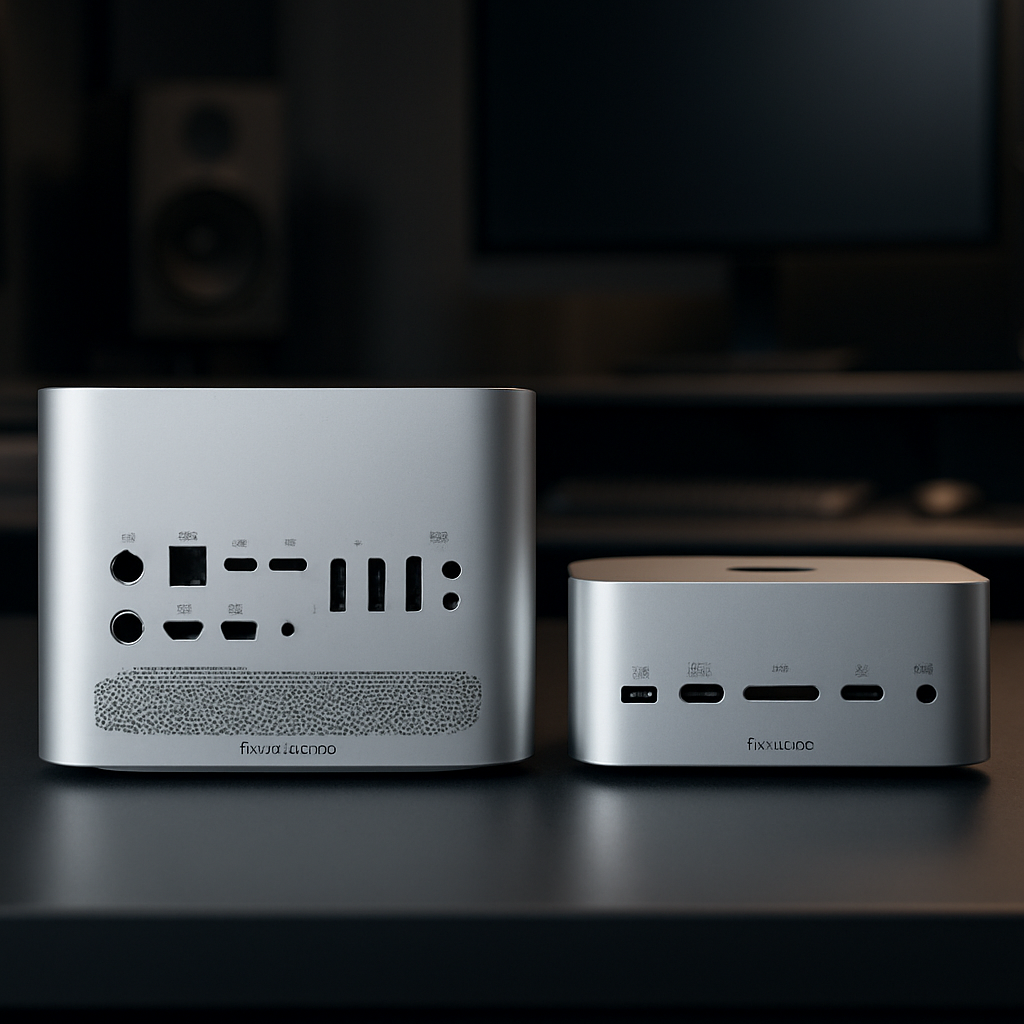
Apple has just unveiled updated Mac mini and Mac Studio models, packing in a host of features that tweak performance, connectivity, and pricing in meaningful ways. Among the updates are new chips, faster networking, and internal adjustments that will especially interest pros and creatives.
What’s New Under the Hood
The updated Mac mini line now includes M6 and M5 Pro chips, while Mac Studio gains M5 Max and M5 Ultra variants. These chips bring AI-boosted performance standards: the M6’s Neural Engine doubles its peak compute compared to prior versions, enabling swifter AI workflows. The Mac Studio’s M5 Ultra also features Apple’s Neural Accelerators for the first time, pushing AI compute to 4.3× that of the earlier M3 Ultra. Graphics performance has also been bumped—with the M6 Mac mini’s 12-core GPU offering up to twice the graphics speed of the M4 Mac mini.
Networking and external connectivity have been upgraded. These Macs add support for Wi-Fi 7 and Bluetooth 6, aligning with the latest iPhone standards—Wi-Fi 7 in particular delivers faster 6GHz speeds, lower latency, and better multi-band stability. On the wired side, Mac mini models now start with 2.5Gb Ethernet, with an optional jump to 10Gb, the standard for Mac Studio. Thunderbolt capabilities differ: the Mac mini keeps Thunderbolt 4, while the Mac Studio gets Thunderbolt 5.
Prices, Memory Options & Other Details
Expect to pay more. The base Mac mini now starts at $899—$300 more than the original price of the M4 Mac mini from October 2024. Mac Studio’s starting price is now $2,499, $500 higher than the M4 Max model introduced in March 2025. On the high end, a fully spec’d M5 Pro Mac mini with 18-core CPU, 64GB RAM, an 8TB SSD, and 10Gb Ethernet runs about $6,799. The top-tier M5 Ultra Mac Studio pushes toward $18,299 with 36-cores, 256GB RAM and a 16TB SSD.
Storage upgrades are costly. A 2TB SSD in the Mac mini costs more than the machine’s own base price; moving up to 4TB in a Mac Studio adds about $1,800. RAM options are more modest for now—Mac Studio supports up to 256GB of memory at launch, with a 512GB configuration coming in late October.
Also worth noting: the Macs now include genlock over USB-C—useful in video production to sync camera shutter and screen refresh without needing external gear. SSDs in Mac Studio have transitioned to PCIe Gen 6 for superior speed. The machines will ship with macOS Golden Gate pre-installed on September 22, with software updates expected the week of September 14. Pre-orders open today.
This marks Apple’s first August Mac announcement since the 27-inch iMac in August 2020.
These updates are more than incremental. They underline Apple’s push into AI, content creation, and connectivity—areas where workflows demand both raw power and low-latency networking. What to watch: real-world benchmarks of the Neural Engine, how Thunderbolt 5 improves external GPU or multi-display use, and whether high-end RAM and storage tiers deliver proportional value. For anyone invested in video, design, or heavy compute, these machines could reshape creative workflows; for typical users, the question will be whether the added cost matches the real-world gains.