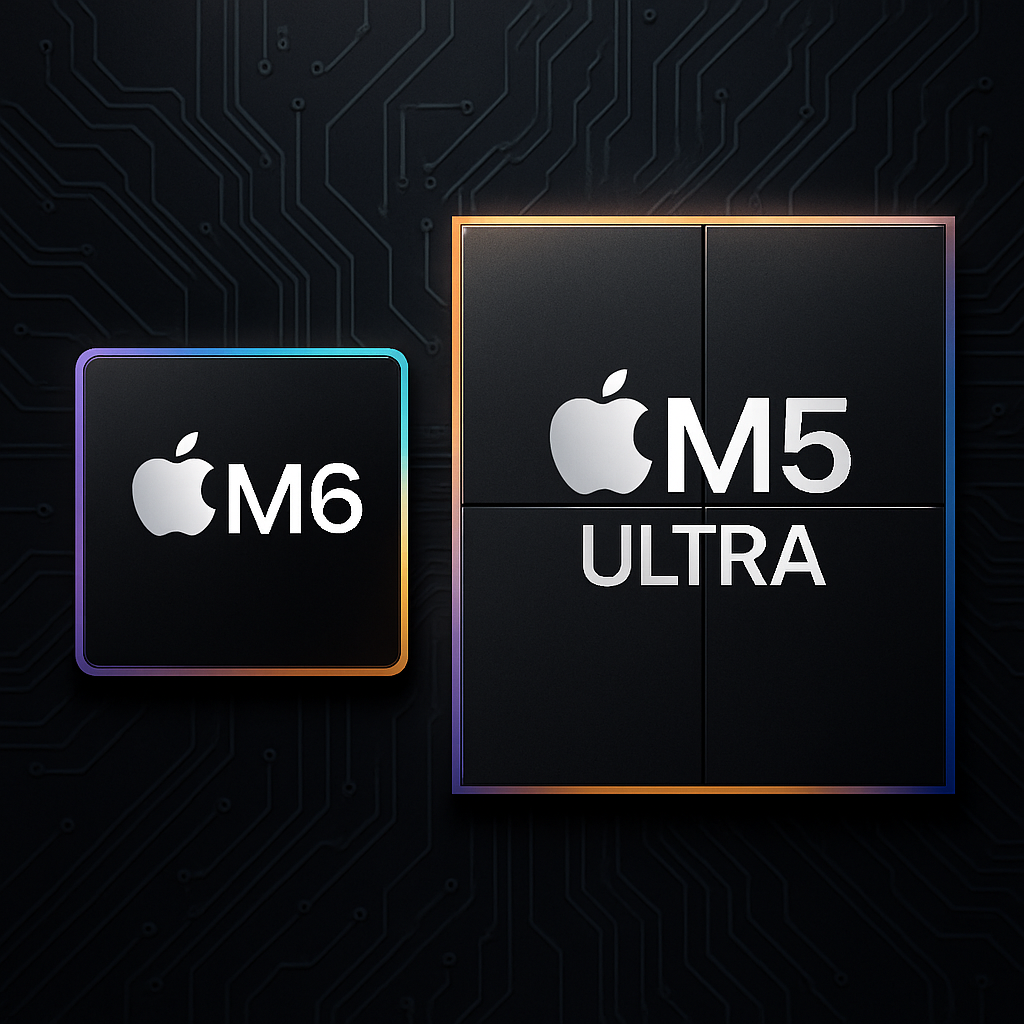
Apple has unveiled its most advanced Apple Silicon chips yet: the M6 and the M5 Ultra. Introduced on August 25, 2026, the new M6 powers the latest Mac mini and marks Apple’s first 2-nanometer processor. Meanwhile, the M5 Ultra debuts in the redesigned Mac Studio and represents Apple’s new performance benchmark. Both chips introduce major advances in CPU, GPU, AI acceleration, and memory design.
M6 Chip: Next-Gen Performance & Efficiency
The M6 marks Apple’s leap into 2nm process technology, delivering greater transistor density and efficiency without increasing die size. Its CPU architecture consists of 12 cores—comprising 2 super cores, 4 performance cores, and 6 efficiency cores—an arrangement that combines peak speed and multitasking strength. Apple claims the M6 offers “the world’s fastest single-threaded performance” along with multithreaded performance up to 1.2× higher than the M5.
On the graphics front, the chip includes a 12-core GPU, each core paired with a Neural Accelerator. That delivers a roughly 30% boost in AI compute performance compared to the M5. The updated shader core architecture, dynamic caching, and built-in ray tracing hardware further enhance graphical workloads. Memory support reaches up to 32 GB unified memory, with bandwidth of 170 GB/s—about 10% higher than its predecessor.
M6 also adds native hardware support for FP8 (8-bit floating point), which accelerates certain AI workloads and improves memory efficiency. Benchmarks show sizable gains: up to 1.2× multithreaded performance over M5, more than 8-fold improvement over M1 for AI compute, 50% higher geometry throughput, and a Neural Engine delivering twice the peak compute of prior generations.
M5 Ultra: Peak Power with Quad-Die Fabrication
At the high end, the M5 Ultra pushes Apple’s UltraFusion architecture forward by combining two dual-die M5 Max chips into a quad-die configuration. This gives the chip over 4.4 TB/s inter-die bandwidth, creating what Apple describes as its most powerful chip ever.
The CPU side of the M5 Ultra includes up to 36 cores—12 super cores and 24 performance cores—yielding approximately 1.25× better single-threaded and 1.3× better multithreaded performance than the prior M3 Ultra. For graphics and AI workloads, the GPU uses up to 80 cores (again with Neural Accelerators per core), offering up to 4.5× more peak GPU compute for AI than M3 Ultra and over 6× more than M1 Ultra. Additional features include advanced shaders, second-generation dynamic caching, mesh shading, and third-generation ray tracing.
The M5 Ultra also expands memory support to up to 512 GB unified memory, plus memory bandwidth up to 1.2 TB/s—a 50% leap over M3 Ultra. In graphics performance overall, Apple claims up to 40% faster graphics than its previous Ultra chip.
Both M6 and M5 Ultra become available today in Apple’s updated Mac lineup: the Mac mini now featuring M6, and the refreshed Mac Studio housing the M5 Ultra.
What this means is a clear pivot: Apple isn’t just iterating but redefining its position in silicon design. The M6 targets a balance of efficiency, AI, and single-threaded muscle for mainstream desktop users, while the M5 Ultra underlines Apple’s readiness to compete with desktop workstation powerhouses. What to watch next: software optimization (especially for AI workloads), thermals under heavy pro workloads, and how third-party developers adapt to FP8 and dynamic caching. The race for performance is heating up—and Apple just raised the bar.