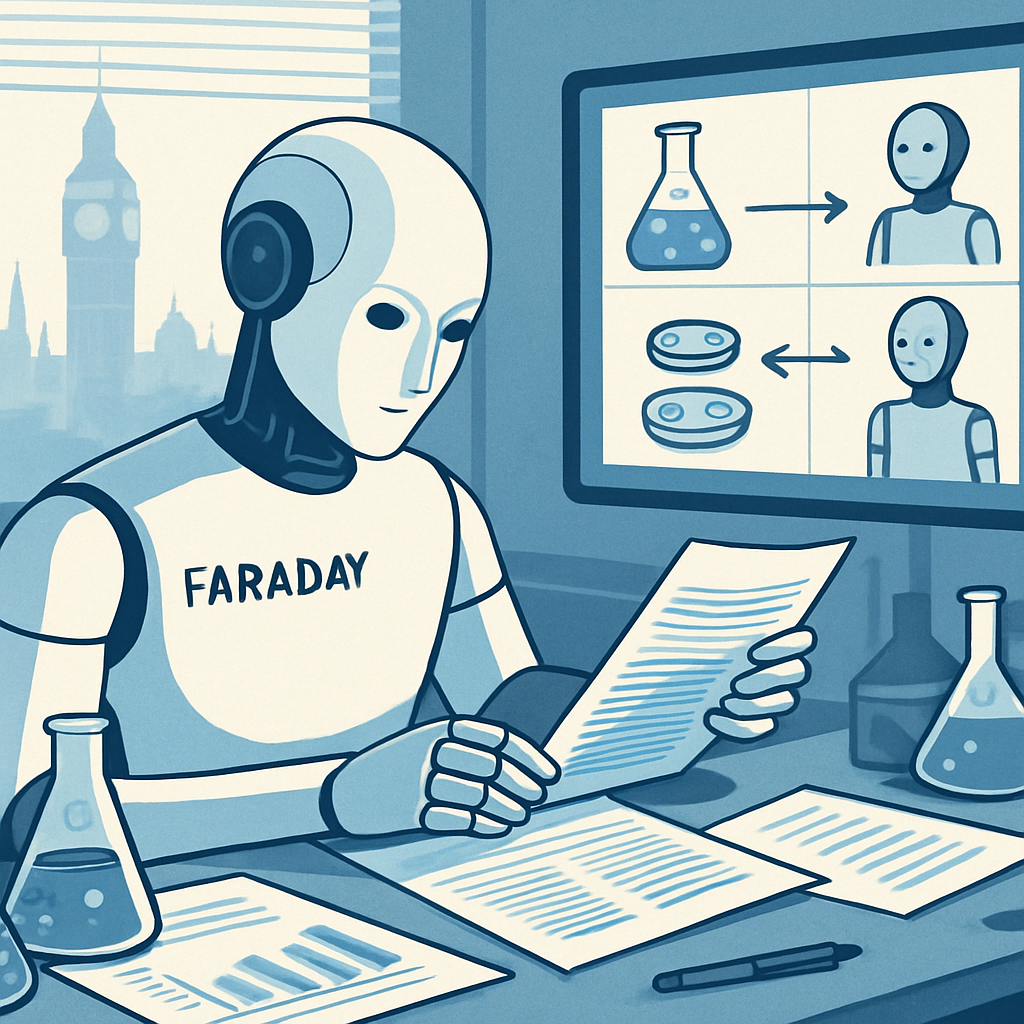
A new London-based AI startup called Inherent, founded by former DeepMind researchers, claims its agent Faraday just beat much larger models from Anthropic and OpenAI at replicating published scientific findings. Using just 27 billion parameters, Faraday took on tasks typically done by systems several times its scale with promising results. ([techcrunch.com](https://techcrunch.com/2026/08/22/inherent-founded-by-deepmind-alumni-says-its-ai-teammate-just-outperformed-anthropic-and-openai-at-replicating-research/))
Small Model, Big Tasks
Inherent revealed that Faraday, built on a relatively compact base model named Qwen 3.6 (27 B parameters), outperformed frontier models like Anthropic’s Claude Opus 4.8 and OpenAI’s GPT-5.5 in independent replication of scientific papers. Faraday wasn’t told the conclusions ahead of time — a stricter test than simple accuracy. The company also evaluated “research taste,” meaning the ability to judge which experiments are worthwhile and design them well. ([techcrunch.com](https://techcrunch.com/2026/08/22/inherent-founded-by-deepmind-alumni-says-its-ai-teammate-just-outperformed-anthropic-and-openai-at-replicating-research/))
Training, Culture, & Long-Term Vision
Faraday was trained using reinforcement learning, a strategy focused on outcome-based rewards instead of just rule-based teaching. Inherent believes this approach can generalize across many scientific domains. While Faraday’s core isn’t building its own software tools, it integrates existing tools — for example, it leverages OpenAI’s GPT-5.5 Codex for coding tasks, much as human scientists rely on off-the-shelf software. ([techcrunch.com](https://techcrunch.com/2026/08/22/inherent-founded-by-deepmind-alumni-says-its-ai-teammate-just-outperformed-anthropic-and-openai-at-replicating-research/))
Inherent was founded by former DeepMind employees, including Edward Hughes, and maintains a 12-person team working together in a London office in King’s Cross, a rising AI hub. The cofounders plan to expand to about 20-25 employees by year end. A challenge the team cites is “garden leave” obligations in the U.K., which restrict movement of staff between firms after departing jobs — something the U.S. doesn’t typically enforce. ([techcrunch.com](https://techcrunch.com/2026/08/22/inherent-founded-by-deepmind-alumni-says-its-ai-teammate-just-outperformed-anthropic-and-openai-at-replicating-research/))
Beyond demonstrating performance, Inherent emphasizes collaboration. Faraday is built to function not as a passive oracle but as a teammate: exploring results, asking questions, and engaging in experiment design. That mindset is mirrored internally, with strong emphasis on building a culture in which curiosity and rigor matter. ([techcrunch.com](https://techcrunch.com/2026/08/22/inherent-founded-by-deepmind-alumni-says-its-ai-teammate-just-outperformed-anthropic-and-openai-at-replicating-research/))
With its recent $50 million seed funding, Inherent is not just making noise in the lab — it’s setting up for scale. The company’s ambition is to eventually build “AI scientist” agents, not just validators — agents capable of contributing to new scientific discovery. Beating larger models on the replication task gives some credence to that vision, but scaling across fields (from biology to physics to social sciences) will be the real test. ([techcrunch.com](https://techcrunch.com/2026/08/22/inherent-founded-by-deepmind-alumni-says-its-ai-teammate-just-outperformed-anthropic-and-openai-at-replicating-research/))
Analytical Take: Inherent’s results suggest a shift in AI performance isn’t solely about model size. With carefully designed reward-based training and sharp evaluation criteria like taste and experimental design, smaller models can punch above weight on scientific tasks. What to watch next: How Faraday handles novel hypotheses, cross-domain research, and whether its way of evaluating “taste” holds up under broader peer review. If it does, this could alter how AI labs prioritize efficiency vs brute-force scaling — potentially redefining competitiveness in AI science roles.