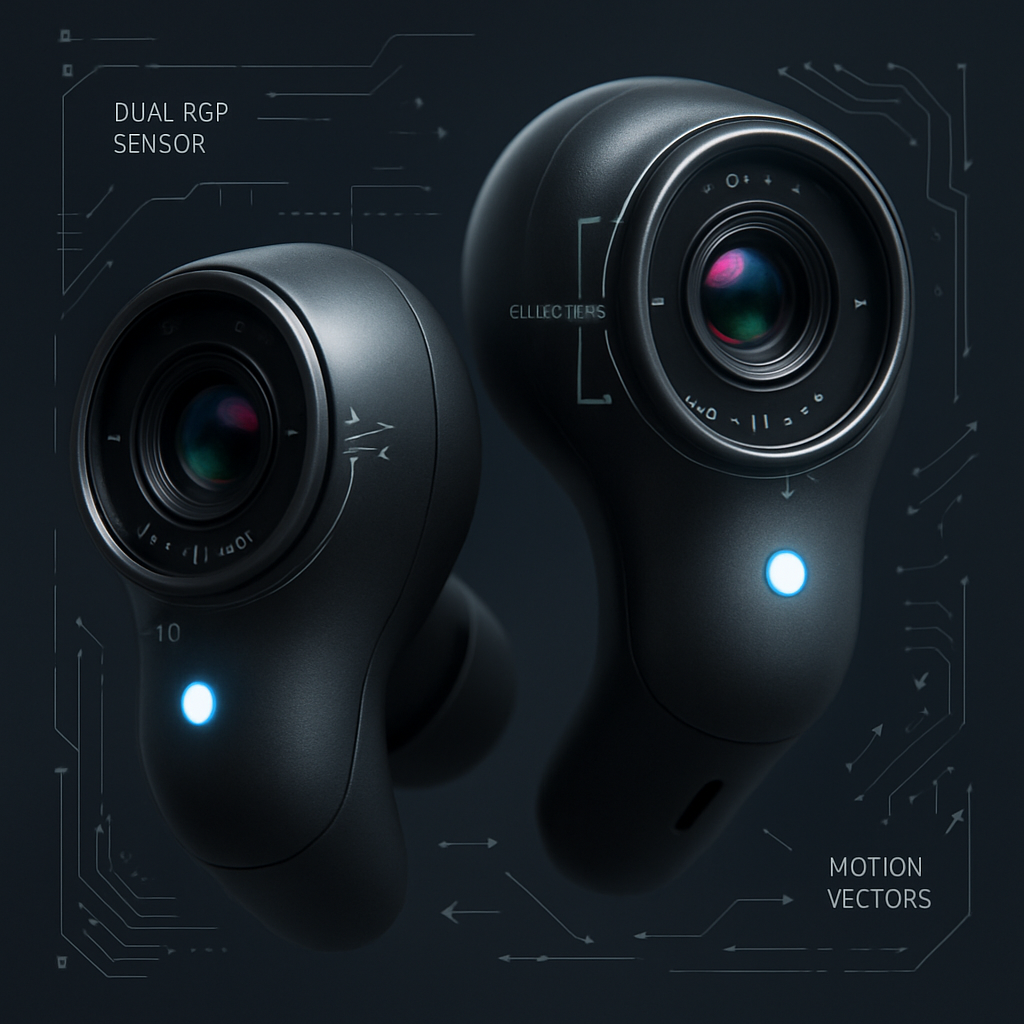
Software code unearthed in the macOS Tahoe 26.7 release candidate offers fresh insight into Apple’s long-rumored AirPods with cameras. Buried in a framework called “AccessorySensorManager”—responsible for handling sensor data when the earbuds are connected to a Mac—are compelling hardware details and usage notes that paint a clearer picture of what Apple is developing. While these features aren’t final, the code provides the strongest view yet into AirPods with imaging capability. ([macrumors.com](https://www.macrumors.com/2026/08/21/camera-airpods-code-reveals-hardware-details/))
What the Code Says
Each bud—left and right—appears to include its own color camera, delivering synchronized RGB stills rather than live video streams. The code references matching frame IDs across the two lenses, suggesting Apple intends to capture the same scene from different angles for “Visual Intelligence” processing. ([macrumors.com](https://www.macrumors.com/2026/08/21/camera-airpods-code-reveals-hardware-details/))
Two modes of image capture are described: “active” and “passive.” Active mode, likely triggered explicitly (for example, via Siri) by the user, collects stills at a higher fidelity. It captures raw frames at 640×640 pixels and outputs processed images at 1024×1024. Passive mode works in the background to monitor environmental cues and collects lower-resolution images—specifically 320×320 input, delivering either 320×320 or upscaled 512×512 output. ([macrumors.com](https://www.macrumors.com/2026/08/21/camera-airpods-code-reveals-hardware-details/))
“Passive” capture seems oriented toward situational awareness—detecting things like footsteps, speech changes, posture shifts, movement, rotation or changes in the audible environment. However, the code isn’t fully clear on what precisely triggers captures in all instances. Also built into the system: algorithms for lens distortion correction, dual-camera calibration, and continuous camera-to-motion sensor alignment. If motion or occlusion renders an image poor, the code can reject it outright. ([macrumors.com](https://www.macrumors.com/2026/08/21/camera-airpods-code-reveals-hardware-details/))
Privacy, LEDs & Product Status
Privacy seems baked in. Each earbud likely includes a capture-indicator light whose brightness can be controlled remotely by the system. This is presumably to let people nearby know when images are being taken. ([macrumors.com](https://www.macrumors.com/2026/08/21/camera-airpods-code-reveals-hardware-details/))
Some image inference happens directly on the earbuds themselves. The system could detect whether a person is in view without offloading everything to connected devices. ([macrumors.com](https://www.macrumors.com/2026/08/21/camera-airpods-code-reveals-hardware-details/))
The code appears connected to a now-canceled project. Apple demoed a camera-equipped version of AirPods Pro 3 under the codename B790. However, it’s believed that Apple killed that model in favor of pursuing a newer generation, called B798. ([macrumors.com](https://www.macrumors.com/2026/08/21/camera-airpods-code-reveals-hardware-details/))
Looking ahead, Apple is expected to launch the revised camera-equipped AirPods in 2027. Speculation suggests the true debut may align with the 20th-anniversary iPhone release. ([macrumors.com](https://www.macrumors.com/2026/08/21/camera-airpods-code-reveals-hardware-details/))
Because this is still code from an early framework, none of the detailed features should be considered definite final specs—Apple’s roadmap is subject to change. Nevertheless, these revelations show how deeply Apple is working to integrate environmental awareness and visual sensing into its wearable audio products. Privacy safeguards like dedicated indicator lights and local inference reflect an awareness of the complexities such hardware brings.
Why This Matters: Combining cameras with AirPods would represent a major shift for Apple’s wearables strategy. These aren’t just headphones—they could become portals into mixed reality or ambient computing. Embedded imaging could enable new assistive features, spatial awareness, even gesture recognition. But it also introduces hard questions around user trust, data processing, and consent. What Apple builds (and what it withholds) in this area will likely set precedents for wearables across the industry.