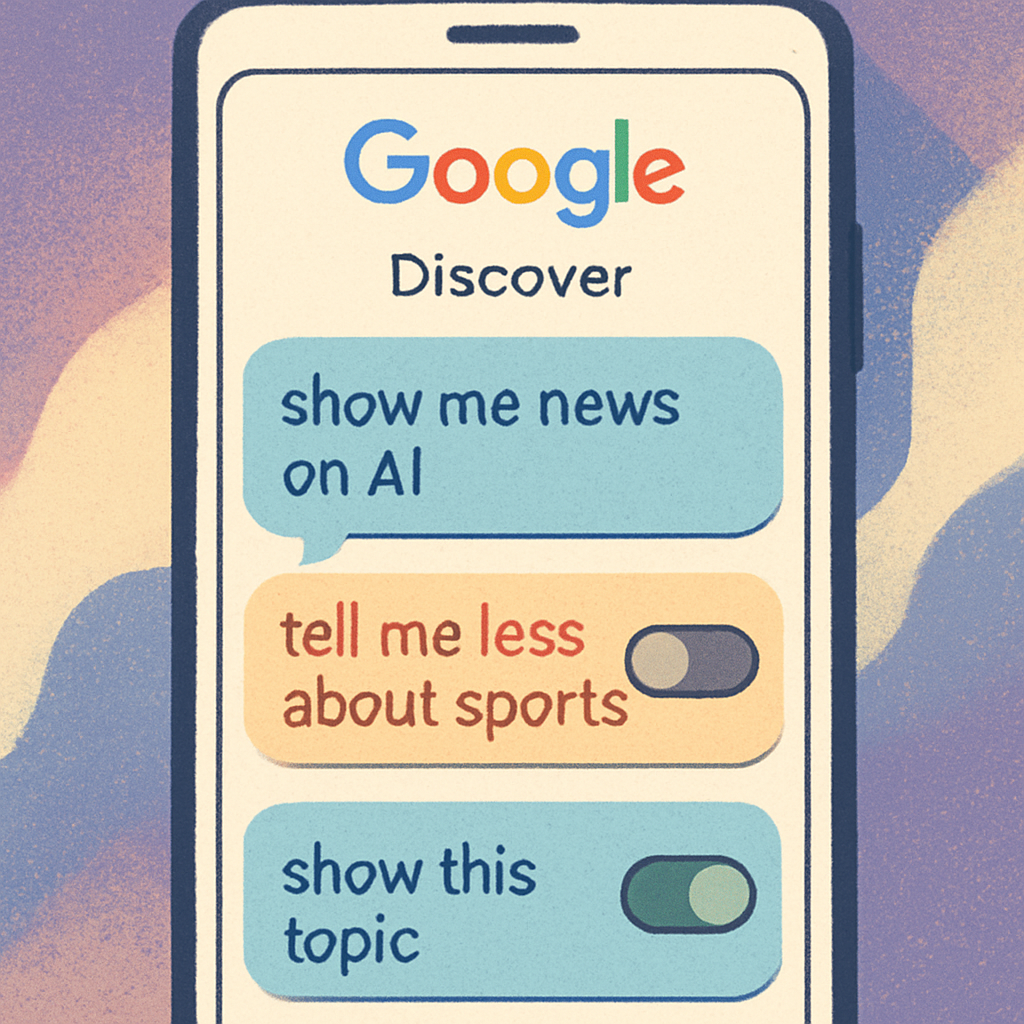
Google is bringing new tools to its Discover feed and News app to give users more control over what content they see. A freshly released feature lets people customize their Discover feed using prompt-based input—users can tell Google in natural language which topics or sources they want to see more (or less) often. The system can then ask follow-up questions to fine-tune the content. This personalization is designed to adapt immediately and remember preferences going forward. ([9to5google.com](https://9to5google.com/2026/08/20/google-discover-customize/))
Prompt-Based Customization in Discover
Once the update arrives on your device, you’ll see a way to trigger the customization flow via a card or the three-dot overflow menu on the Discover feed. The prompts let you speak in your own terms—no need to navigate endless toggles. Google started testing this feature as early as last year. The company says the rollout will continue in the coming days for more users. ([9to5google.com](https://9to5google.com/2026/08/20/google-discover-customize/))
More Detailed Controls in Google News & for Publishers
Alongside Discover’s upgrades, Google News is improving its daily audio briefing with more topic selection options. Users can now choose from broad categories like Headlines, Entertainment, Science & Technology, Sports, and drill down further—Entertainment, for example, includes Arts & Design, Movies, Music, Theater, and TV. ([9to5google.com](https://9to5google.com/2026/08/20/google-discover-customize/))
Publishers aren’t left out. There’s a new “Preferred Sources” button that websites can embed. Clicking it flags the publication as preferred and then sends readers back to the same spot on the publisher’s site where they left off. This setting influences how content from that source appears not just in Search’s Top Stories carousel, but also in AI Overviews and AI Mode. ([9to5google.com](https://9to5google.com/2026/08/20/google-discover-customize/))
These updates follow increasing demand for more relevant, personalized news and content experiences—users growing tired of seeing irrelevant stories or sources dominate feeds. With Discover’s new prompt system and News’ granular topic controls, Google aims to give users agency while preserving algorithmic relevance. For publishers, the Preferred Sources feature introduces a way to build loyalty and maintain site engagement in Google’s ecosystem.
Google’s fresh tools for Discover and News represent a shift toward real-time personalization based on user language and source preferences. As this rolls out globally, what to watch: how accurately Google interprets user prompts, whether the new audio briefing settings satisfy niche interests, and if preferred sources really help publishers retain readers instead of pushing them toward clicks on aggregated platforms.