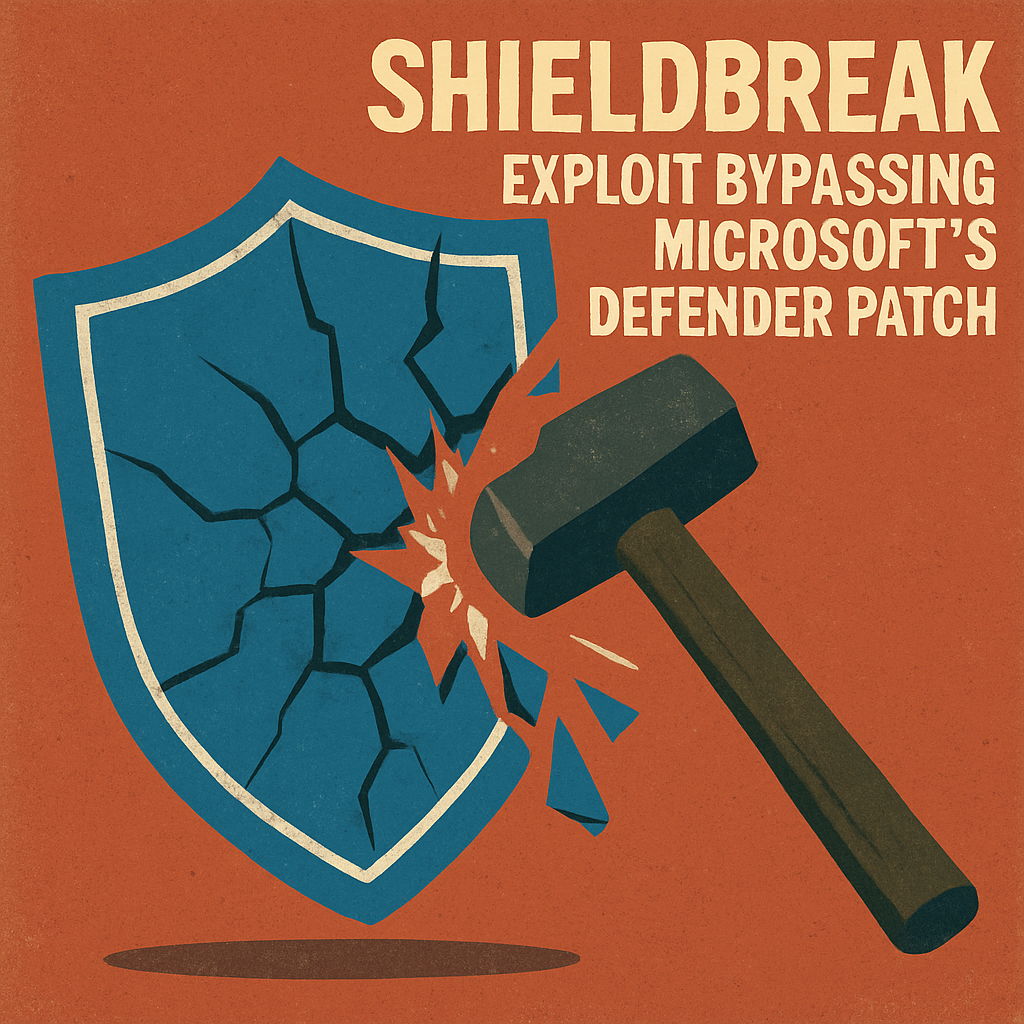
A security researcher known as Nightmare-Eclipse, also referred to as Chaotic Eclipse, has unveiled a new zero-day exploit named ShieldBreak. This exploit effectively circumvents Microsoft’s recent patch for the RoguePlanet vulnerability (CVE-2026-50656) in Windows Defender, indicating that the core issue within the Microsoft Malware Protection Engine remains unresolved.
The RoguePlanet vulnerability was initially identified as a race condition within mpengine.dll, the central scanning component of Windows Defender. This flaw allowed local attackers to exploit a timing window during file scans, potentially escalating privileges to NT AUTHORITY\SYSTEM. Microsoft addressed this issue in the July 2026 update, releasing Malware Protection Engine version 1.1.26060.3008.
However, Nightmare-Eclipse’s ShieldBreak exploit demonstrates that the patch only addressed a specific attack vector, leaving the broader race condition exploitable through alternative methods. The exploit involves registering a rogue cloud provider, attaching it to a crafted placeholder file, and manipulating Common Log File System (CLFS) logs alongside object manager symbolic links. This process deceives Defender’s scanning pipeline into locking a legitimate system file, such as phonefo.dll, while a malicious substitute is introduced, ultimately leading to the execution of a SYSTEM-level shell.
The proof-of-concept for ShieldBreak has been validated against Windows 11 25H2, including builds on the Canary channel, and Windows Server 2025, achieving a 100% success rate. While Windows 10 and its corresponding server editions are also considered vulnerable, the current proof-of-concept does not officially support them.
ShieldBreak is the latest in a series of exploits released by Nightmare-Eclipse, following previous disclosures such as BlueHammer, RedSun, UnDefend, GreenPlasma, YellowKey, MiniPlasma, RoguePlanet, and GreatXML. Many of these exploits specifically target Defender’s cloud file and remediation mechanisms, while others focus on degrading its signature updates without triggering health alerts.
Given that ShieldBreak exploits a gap in an already-deployed patch rather than introducing a new vulnerability class, organizations should not assume that installing the July 2026 Defender engine update fully mitigates their exposure. Security teams are advised to monitor endpoint detection tools for unusual cloud-provider registrations, object manager namespace manipulation, and unexpected CLFS log activity. Any SYSTEM-level shell spawned outside normal administrative workflows should be treated as a strong indicator of compromise until Microsoft issues a more comprehensive fix for the underlying Malware Protection Engine flaw.
This development underscores the challenges in fully addressing complex vulnerabilities within critical security components. It highlights the necessity for organizations to adopt a multi-layered security approach and remain vigilant for emerging threats, even after patches have been applied.