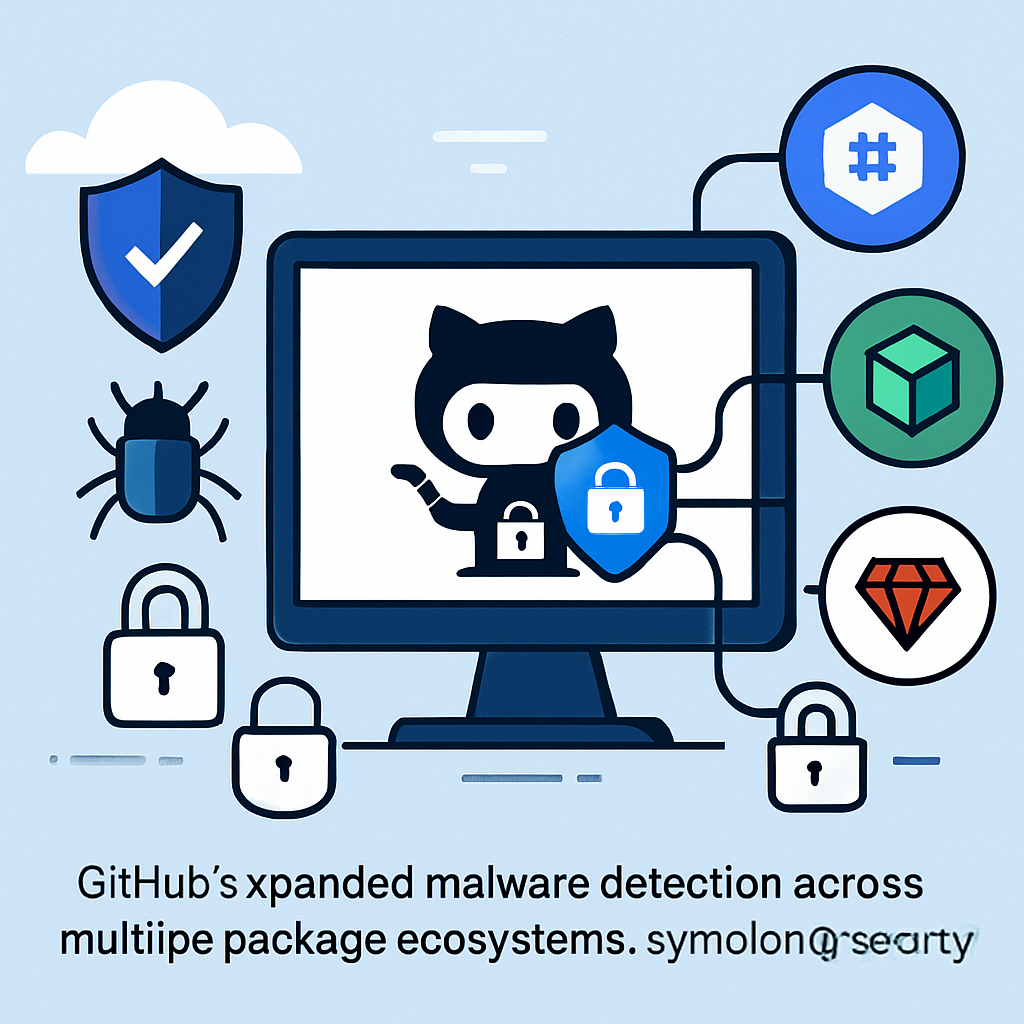
GitHub has broadened its malware detection capabilities beyond npm, now encompassing eight major package ecosystems: npm, PyPI, Maven, RubyGems, NuGet, Go, crates.io, and PHP Composer. This expansion enhances developers’ ability to identify and mitigate risks associated with malicious open-source packages.
Malicious packages can compromise systems by stealing sensitive information such as passwords, API keys, cloud credentials, cryptocurrency wallets, and source code immediately upon installation. Attackers often employ techniques like typosquatting, dependency confusion, compromised maintainer accounts, or embedding malicious prebuilt binaries to infiltrate trusted development workflows.
Earlier in 2026, GitHub introduced malware alerts specifically for npm dependencies. The recent expansion includes support for PyPI and extends coverage to other major ecosystems, leveraging data from the Open Software Security Foundation (OpenSSF).
Integration with OpenSSF’s Malicious Packages Repository
GitHub’s Advisory Database now incorporates reports from OpenSSF’s public malicious-packages repository, which, since its launch in 2023, has amassed over 15,000 malware reports in the Open Source Vulnerabilities (OSV) format. OSV provides a structured method for describing security issues affecting software packages, with contributions from community researchers, automated detection systems, and security organizations.
Instead of developing separate malware detection systems for each package registry, GitHub has implemented a unified importer for OpenSSF data. This importer scans the repository for changes, reads each OSV record, and validates mandatory fields before publishing them into the GitHub Advisory Database.
Ensuring Data Consistency and Accuracy
Validation is crucial due to inconsistencies in package information. For instance, OpenSSF may refer to the Python ecosystem as PyPI, while GitHub internally uses pip. The pipeline normalizes malware version data, ensuring that Dependabot can accurately match dependencies, regardless of how versions are listed or if they are unavailable.
The system also manages withdrawn reports. OpenSSF maintains retracted advisories in a dedicated folder when earlier malware reports are found to be incorrect. GitHub’s importer recognizes these records, allowing for the removal or correction of flagged packages if new evidence indicates they are legitimate.
To prevent duplicate advisories, GitHub filters out its own npm malware findings already contributed to the OpenSSF repository, avoiding re-imports and potential data loops. The importer checks OSV origin metadata and ignores records marked as ghsa-malware, indicating they originated on GitHub.
Safeguards Against Erroneous Data
Given that malware advisories can be published automatically, GitHub has implemented safeguards against erroneous upstream data. Each import run has a configurable batch limit; if a run attempts to create an unusually high number of advisories, it halts and alerts the security team. Every imported advisory records its source commit, providing traceability to specific changes in the OpenSSF repository. This allows GitHub to roll back entire batches if harmful or incorrect data is published, rather than manually removing individual records.
Malware alerts are opt-in. Developers can enable them in repository, organization, or enterprise security settings. Once activated, Dependabot checks project dependencies against malware advisories and can identify existing malicious dependencies through backfilled advisory data.
By expanding its malware detection capabilities across multiple package ecosystems and integrating with OpenSSF’s extensive repository, GitHub significantly enhances the security posture of developers. This proactive approach addresses the growing threat of supply chain attacks, providing a more robust defense against malicious packages infiltrating development workflows.