Today marks the 20th anniversary of Apple’s Mac Pro, a line of high-performance desktop computers that has been a cornerstone for creative professionals since its debut. This milestone comes just five months after Apple officially discontinued the Mac Pro, signaling the end of an era for the company’s most powerful workstation.
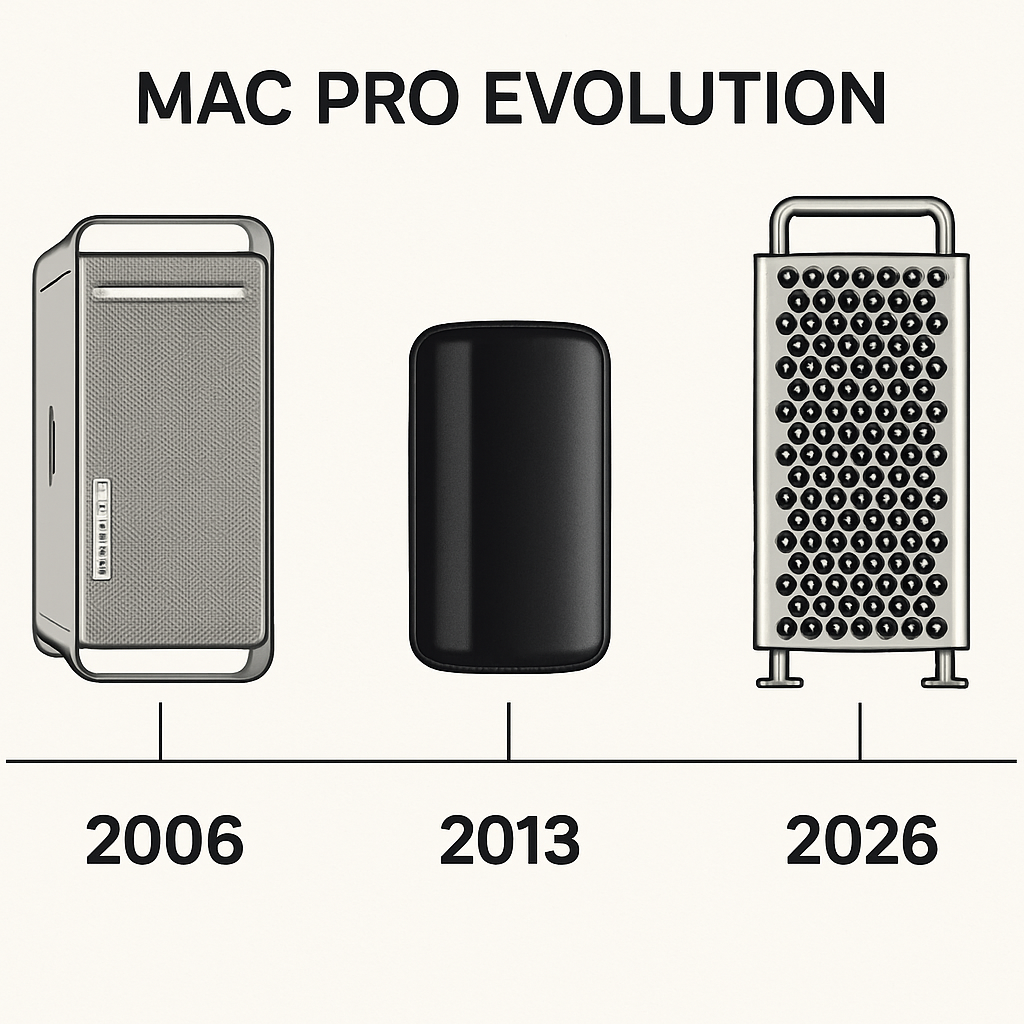
Introduced on August 7, 2006, the original Mac Pro was powered by dual-core 64-bit Xeon processors, offering performance up to twice as fast as its predecessor, the Power Mac G5. It featured PCI Express expansion slots and launched with a starting price of $2,499. The Mac Pro quickly became the preferred choice for video editors, audio engineers, and other creative professionals, thanks to its robust performance and expandability.
In 2013, Apple unveiled a radically redesigned Mac Pro with a cylindrical shape, often referred to as the “trash can” model. This design was built around a unified thermal core and aimed to provide a compact yet powerful machine. However, the lack of internal expandability and limited upgrade options led to criticism from the professional community. Apple acknowledged these shortcomings in 2017, admitting that the design had “designed ourselves into a bit of a thermal corner.”
Responding to user feedback, Apple released a more traditional tower design in 2019, featuring eight PCIe slots to accommodate the needs of professionals requiring extensive expansion capabilities. Despite this, the Mac Pro’s position in Apple’s lineup continued to erode, especially with the introduction of the Mac Studio, which offered comparable performance in a smaller and more affordable package.
In June 2023, Apple transitioned the Mac Pro to its own silicon, equipping it with the M2 Ultra chip. This move resulted in the loss of support for certain add-in cards, such as the Afterburner, leaving PCIe expansion as one of its few remaining advantages over the Mac Studio. With a starting price of $6,999, the Mac Pro struggled to justify its premium over other offerings in Apple’s lineup.
On March 26, 2026, Apple officially discontinued the Mac Pro, removing it from its website and confirming that no future models were planned. This decision marked the end of a significant chapter in Apple’s history, as the Mac Pro had been a symbol of the company’s commitment to professional users for two decades.
The discontinuation of the Mac Pro reflects a broader shift in Apple’s strategy towards integrating its own silicon across its product lines, emphasizing efficiency and performance. For professionals, this change underscores the importance of adaptability in an evolving technological landscape. As Apple continues to innovate, users will need to assess how new offerings align with their specific needs, particularly in terms of performance, expandability, and cost-effectiveness.