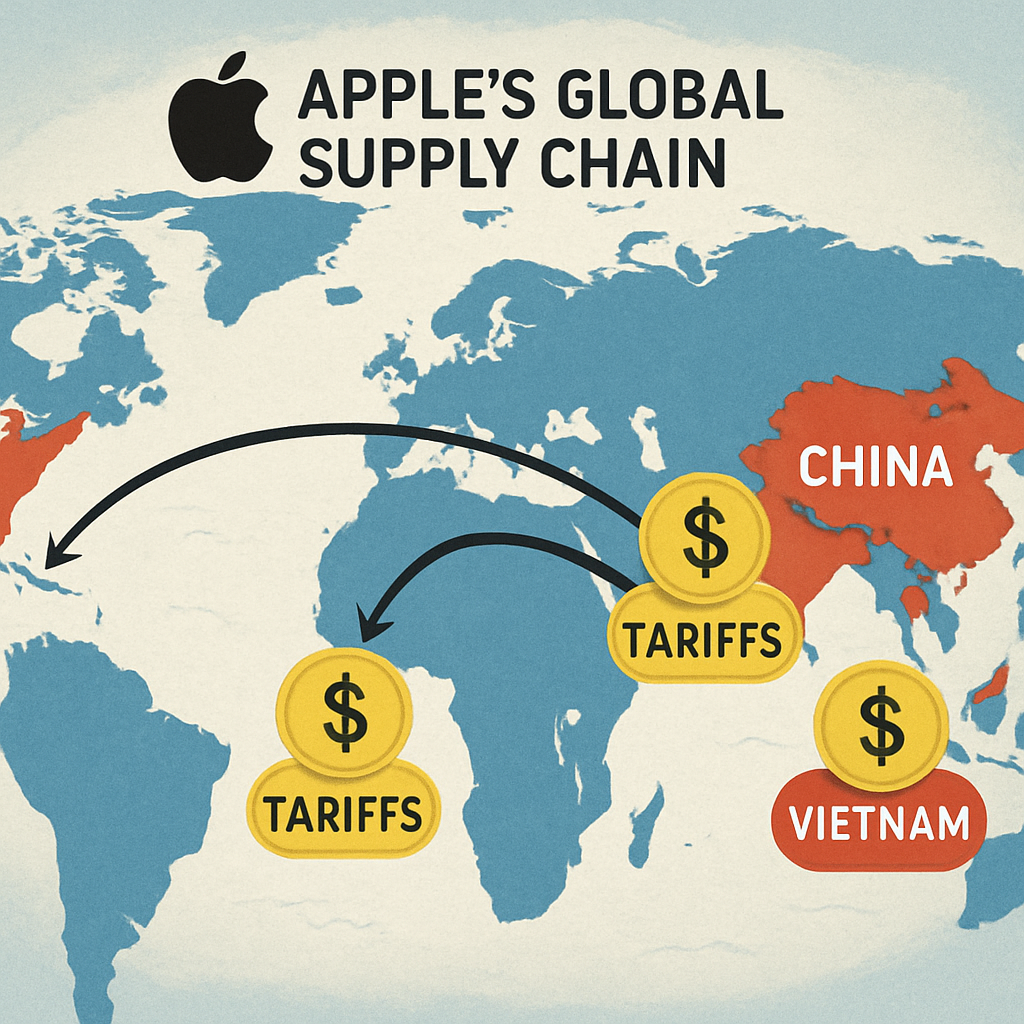
The United States has implemented new 10% tariffs on imports from 60 countries, including key locations where Apple assembles its products. This move, effective July 24, 2026, poses significant challenges to Apple’s global supply chain.
Apple’s manufacturing operations are heavily concentrated in countries now subject to these tariffs. For instance, China, India, and Vietnam are pivotal in assembling iPhones and Macs. The new tariffs could lead to increased production costs, potentially affecting product pricing and availability.
Historically, Apple has faced similar challenges. In 2025, the company absorbed approximately $800 million in tariff-related costs during the June quarter, with projections of a $1.1 billion impact in the following quarter. To mitigate these effects, Apple considered strategies such as raising iPhone prices and diversifying its manufacturing base.
Analysts have previously highlighted Apple’s vulnerability to escalating trade tensions. Despite efforts to diversify manufacturing to countries like India and Vietnam, these regions are also now affected by the new tariffs, complicating Apple’s supply chain strategy.
In response to past tariffs, Apple explored increasing iPhone production in India, aiming to reduce dependency on Chinese manufacturing. However, with India now subject to the new tariffs, this strategy’s effectiveness is uncertain.
Apple’s suppliers have also expressed concerns. Pegatron, a key assembler of Apple products, warned in 2025 that U.S. stores could face product shortages due to tariff-related uncertainties. The current tariffs may exacerbate these issues, leading to potential delays and limited product availability.
Given the lack of clear exemptions for Apple products, the company may need to reassess its pricing strategies. Previous reports suggested that tariffs could add $100 to $350 per device on iPhone models, potentially raising the base model price to between $899 and $999.
These developments underscore the broader impact of trade policies on the tech industry. Companies like Apple must navigate complex international relations, balancing cost management with maintaining product availability and consumer satisfaction.
As the situation evolves, stakeholders will closely monitor how Apple adapts its supply chain and pricing strategies to mitigate the impact of these new tariffs.