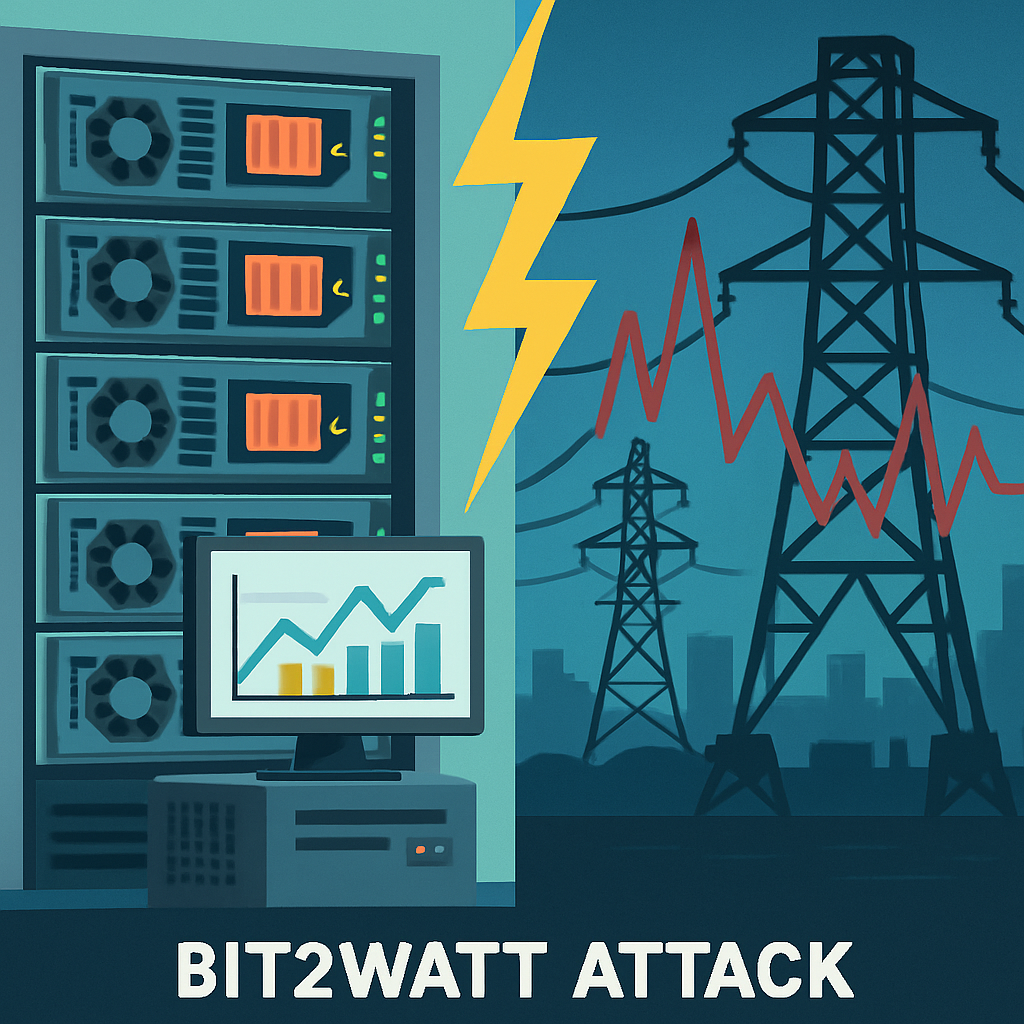
Recent research has unveiled a novel cyber-physical vulnerability termed ‘Bit2Watt,’ which allows malicious cloud tenants to destabilize power grids by manipulating GPU workloads. This method doesn’t require traditional exploits or unauthorized access, making it particularly insidious.
Traditionally, cyberattacks on power infrastructure involve compromising control systems or deploying malware. However, Bit2Watt operates differently. By executing specially crafted GPU workloads, an attacker can induce rapid fluctuations in a data center’s power consumption. These fluctuations can, in turn, destabilize the local power grid, especially in systems heavily reliant on distributed energy resources like solar panels.
Researchers from Zhejiang University in China detailed this technique in their paper titled “Bit2Watt: A Cyber-Physical Vulnerability Exploiting GPU Workloads Across Power and Computing Infrastructures.” They demonstrated that GPU loads could modulate power consumption at frequencies exceeding 6,000 Hz. Such high-frequency modulations can lead to voltage excursions, harmonic distortion, and reduced damping, all of which threaten grid stability.
In a simulated scenario involving a 1-MW local power grid with 90% reliance on distributed energy resources, the researchers found that coordinating 1,000 GPUs could elevate current total harmonic distortion to 46.8%. This level of distortion not only wastes nearly half of the electrical current but also generates approximately 20% more heat than usual. Such conditions can trigger protective mechanisms, leading to cascading failures and potential widespread blackouts.
Detecting this form of attack is challenging because it operates within authorized workload execution paths, making it likely to evade standard monitoring frameworks. To counteract this threat, the researchers advocate for coordinated defenses that span both cyber and physical layers. They emphasize the importance of monitoring workload behaviors, power electronics, and grid dynamics in unison. Additionally, implementing local energy buffering systems can help manage sudden spikes in power demand.
Beyond causing service disruptions, Bit2Watt also opens the door to side-channel attacks. The electrical and thermal stress induced by malicious workloads can lead to denial-of-service events and enable covert data exfiltration through power modulation. As a proof of concept, the researchers successfully recovered a 50-bit test sequence using frequency-shift keying encoding.
This discovery underscores the evolving nature of cyber threats, highlighting the need for comprehensive security measures that address the convergence of computing workloads and power infrastructure. As data centers increasingly rely on large-scale GPU clusters and on-site renewable energy resources, it’s imperative to develop defenses that consider both domains to ensure the resilience of critical infrastructure.
In light of these findings, cloud service providers and data center operators must reassess their security protocols. The potential for legitimate computational tasks to be weaponized against power infrastructure necessitates a holistic approach to cybersecurity. Monitoring tools should be enhanced to detect anomalous workload patterns, and collaboration between cybersecurity experts and power engineers should be prioritized to develop integrated defense mechanisms. As the digital and physical worlds become more intertwined, safeguarding our infrastructure requires vigilance and innovation.