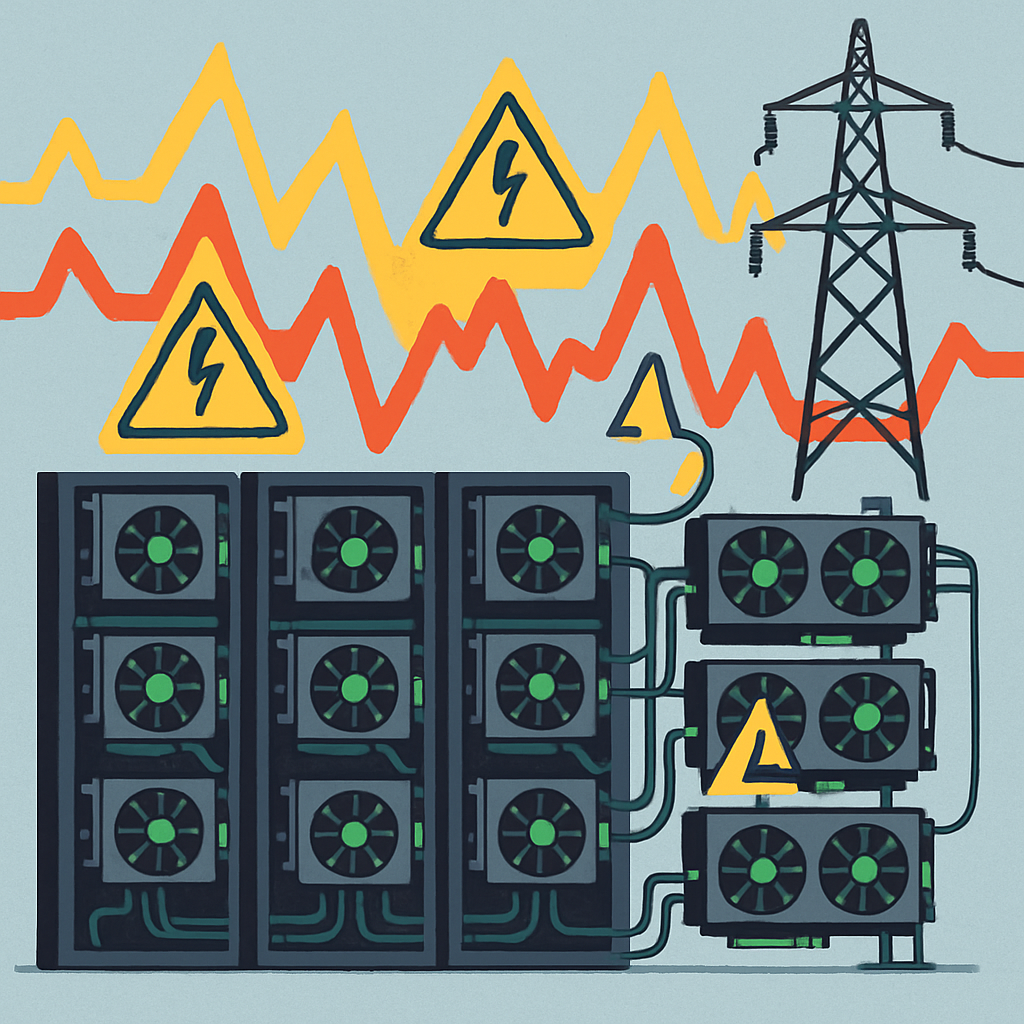
Recent research has unveiled a potential cyber-physical threat, termed Bit2Watt, which could allow malicious actors to exploit AI training jobs to destabilize power grids. Unlike traditional cyberattacks that involve malware or direct intrusion into grid controls, this method leverages legitimate GPU workloads to induce rapid and repeated fluctuations in electricity demand.
The core of this vulnerability lies in the increasing integration of large GPU clusters with power networks that heavily rely on renewable energy sources. When GPUs transition abruptly between intensive computation and lighter activities, the resulting power demand variations can propagate through data center infrastructure, potentially impacting the stability of the local power grid.
Researchers from Arxiv have identified this issue, describing Bit2Watt as a cyber-physical vulnerability. The study highlights that such activities might evade standard cloud monitoring systems, as they mimic legitimate computational tasks rather than overt security breaches.
Bit2Watt operates by manipulating the rapid power consumption changes of GPUs. An attacker with access to a substantial number of GPUs, whether rented or within an enterprise, could synchronize workloads to oscillate between high and low power demands, generating high-frequency electrical disturbances.
The researchers outline two primary methods for executing this attack. The first involves crafting specific GPU tasks designed to switch power states precisely. The second embeds the disruptive pattern within a standard large language model training pipeline, making the malicious activity appear as routine AI processing. This latter approach is particularly concerning because it doesn’t require administrative privileges, firmware manipulation, or direct control over electrical systems; the attacker only needs to manage training scripts, batch sizes, and job schedules.
Modern cloud scheduling practices, which often co-locate related AI jobs to enhance performance, could inadvertently amplify this threat. By concentrating synchronized GPU workloads in a single location, the resultant power fluctuations become more pronounced, rather than being diffused across a broader facility.
Simulations conducted by the researchers demonstrate that coordinated GPU workloads can lead to voltage variations, electrical noise (harmonics), and diminished system damping. In a modeled scenario involving 1,000 GPUs connected to a 1-megawatt local grid with significant renewable energy integration, current harmonic distortion reached 46.8%. While this represents a conservative, synchronized scenario rather than evidence of an actual blackout, it underscores the potential risks.
As AI workloads continue to grow in scale and complexity, it’s imperative for data centers and power grid operators to recognize and mitigate such emerging threats. Implementing robust monitoring systems that can detect and respond to unusual power consumption patterns is crucial. Additionally, fostering collaboration between cybersecurity experts and energy infrastructure professionals will be essential in developing strategies to safeguard against these sophisticated cyber-physical attacks.