As artificial intelligence (AI) systems become integral to security operations, business processes, and physical environments, the scope of penetration testing is evolving to address novel attack vectors. Traditional security assessments focused on infrastructure vulnerabilities, but the advent of AI introduces new avenues for exploitation that do not require direct system breaches.
Emerging Threats in AI Systems
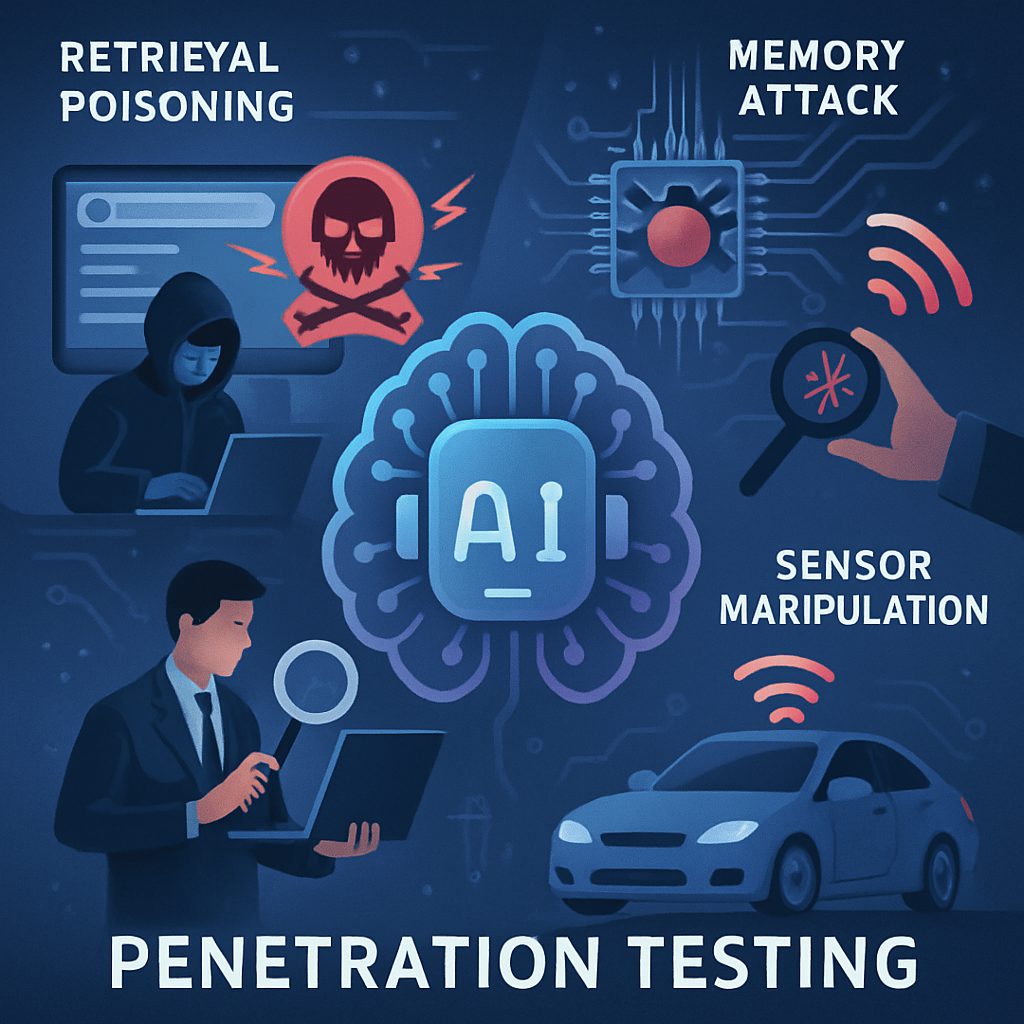
One significant concern is retrieval poisoning, where attackers embed malicious instructions within documents or web pages that AI systems access. When these systems retrieve and process such tainted information, they may execute unauthorized actions or make erroneous decisions. This vulnerability underscores the need for penetration tests to evaluate how AI systems handle and validate external data sources.
Memory attacks present another challenge. AI systems with memory capabilities can store and recall information over time. If an attacker injects harmful instructions into the system’s memory, these can be activated later without further intervention, leading to unintended behaviors. Penetration testing must, therefore, assess the resilience of AI memory functions against such manipulations.
In physical environments, sensor manipulation poses risks to AI-controlled systems. Altering inputs from cameras, microphones, or other sensors can deceive AI models, resulting in incorrect perceptions and potentially hazardous actions. Testing protocols should include scenarios where sensor data is compromised to evaluate system responses.
Redefining Penetration Testing Objectives
To effectively address these emerging threats, penetration testing must shift focus from solely protecting infrastructure to ensuring the operational integrity of AI systems. This involves:
- Defining clear operational objectives for AI applications, such as maintaining accurate incident triage or ensuring safe navigation.
- Mapping AI behaviors that influence these objectives and identifying all potential points of external influence, including prompts, retrieved documents, memory entries, and sensor inputs.
- Developing testing methodologies that simulate adversarial attempts to manipulate these inputs and observing the system’s responses.
By adopting this comprehensive approach, organizations can better safeguard their AI systems against sophisticated attacks that exploit behavioral vulnerabilities rather than traditional security flaws.
The expansion of AI into critical operational roles necessitates a reevaluation of penetration testing strategies. Security professionals must now consider how AI systems interact with and process external information, ensuring that these interactions do not compromise the system’s intended functions. As AI continues to evolve, so too must the methodologies used to secure it, emphasizing the importance of proactive and adaptive security measures.