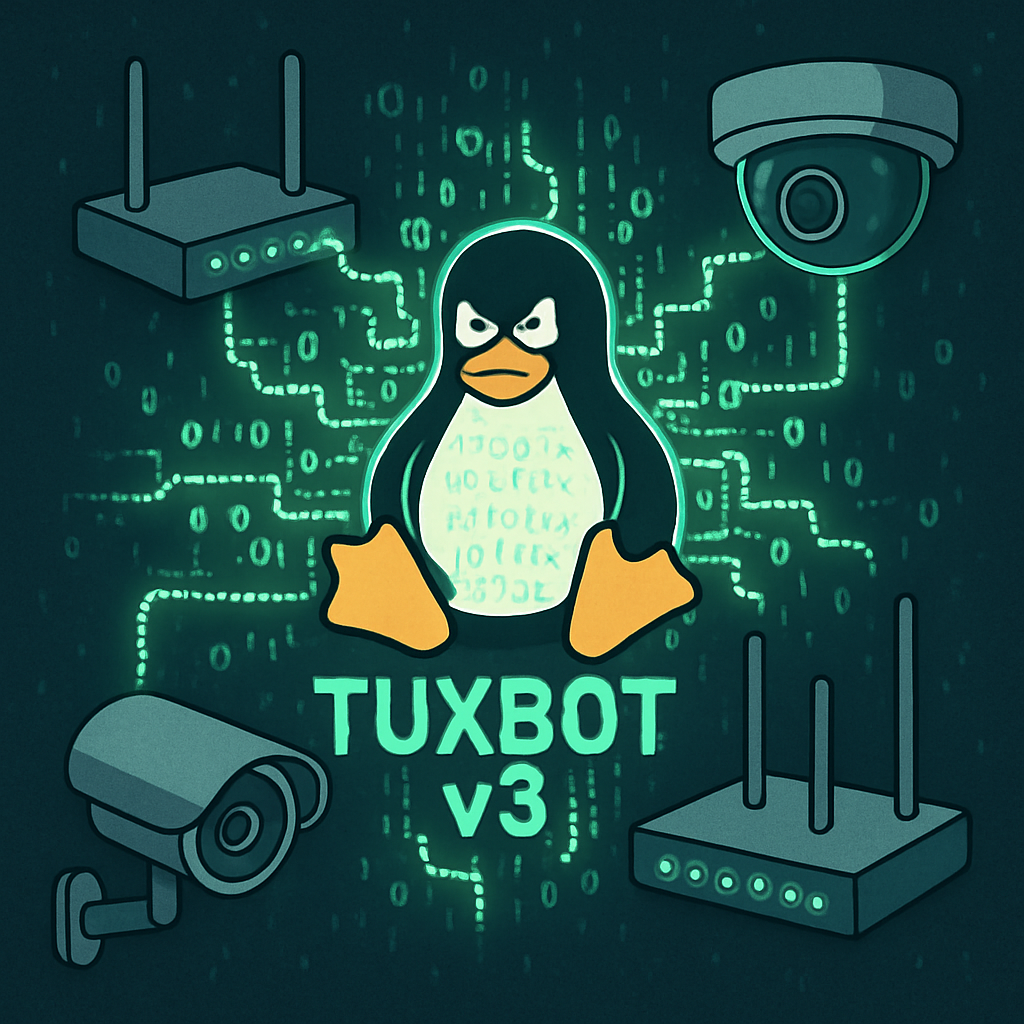
Cybersecurity researchers have uncovered a new Internet-of-Things (IoT) botnet framework named TuxBot v3 Evolution. This sophisticated malware leverages large language model (LLM)-generated code to compromise devices and orchestrate distributed denial-of-service (DDoS) attacks.
TuxBot v3 is designed to infiltrate a wide array of device architectures, including ARM, MIPS, PowerPC, RISC-V, and x86-64. This broad compatibility enables the malware to target various IoT devices such as routers and cameras, significantly expanding its potential impact.
Infection Methods and Persistence
The botnet employs multiple techniques to gain unauthorized access to devices. These include brute-force attacks on Telnet credentials, SSH scanning, HTTP probing, and exploiting vulnerabilities in Android Debug Bridge. Notably, its Telnet module utilizes a list of 1,496 username and password combinations, many of which are default or vendor-specific credentials commonly found on inadequately secured devices.
Once a device is compromised, TuxBot v3 implements several persistence mechanisms to maintain control. These include creating disguised system services, modifying cron jobs, altering shell profiles, and deploying hidden backup copies. Additionally, the malware can camouflage its process name and actively remove competing botnet infections from the same device.
Command and Control Infrastructure
TuxBot v3 features a modular architecture comprising a C-based bot client and a Go-based command-and-control (C2) server. This design allows operators to compile payloads for at least 17 different processor architectures from a single development environment. The botnet communicates with its C2 server over encrypted TCP channels, ensuring secure command transmission.
To enhance resilience, TuxBot v3 incorporates multiple fallback communication methods. These include a domain generation algorithm (DGA), peer-to-peer gossip protocols with Ed25519-signed commands, Internet Relay Chat (IRC), DNS TXT queries, and HTTP polling. Such redundancy ensures the botnet remains operational even if primary communication channels are disrupted.
AI-Generated Code and Associated Flaws
Analysis of TuxBot v3’s source code reveals significant reliance on LLM-generated code. This is evidenced by the presence of unremoved AI safety comments and internal reasoning within the codebase. While the use of AI has accelerated development, it has also introduced critical flaws. Researchers identified issues such as an encryption-key mismatch that disrupts multiple functions, a non-functional custom exploit virtual machine, and an authentication component mislabeled as Argon2id that does not implement the intended password hashing algorithm.
Despite these defects, TuxBot v3’s core functionalities—credential attacks, encrypted communications, persistence mechanisms, scanning capabilities, and various DDoS attack vectors—remain operational. The availability of the complete source code suggests that the botnet’s operators could swiftly address these flaws, potentially enhancing its effectiveness.
The emergence of TuxBot v3 underscores a concerning trend: the integration of AI-generated code in malware development. This approach can expedite the creation of sophisticated threats, even by individuals with limited programming expertise. As AI tools become more accessible, the cybersecurity community must remain vigilant, adapting defensive strategies to counteract the evolving landscape of AI-assisted cyber threats.