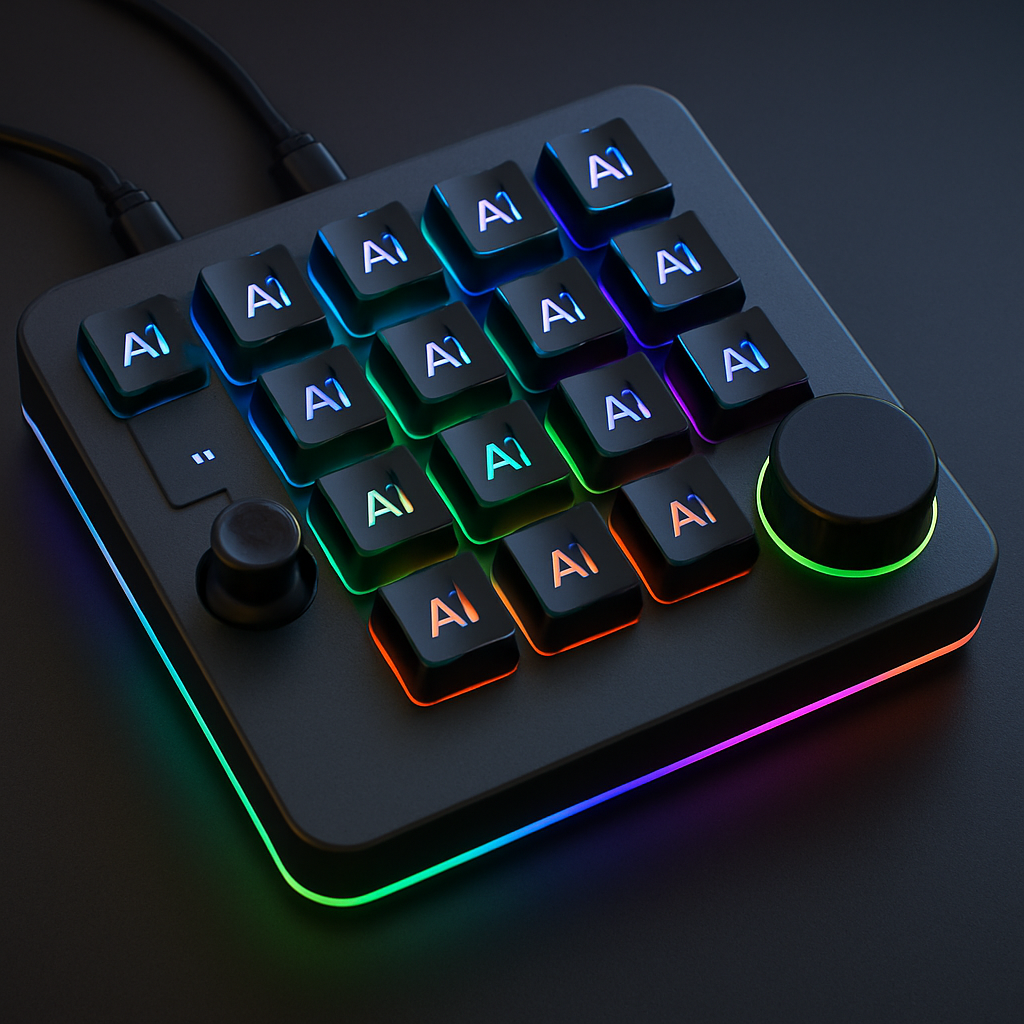
OpenAI has introduced the Codex Micro, a $230 desktop keypad developed in collaboration with hardware firm Work Louder. This device is designed to enhance user interaction with OpenAI’s Codex AI agents by providing customizable controls and real-time feedback.
The Codex Micro features programmable keys, a joystick, and a dial, all aimed at streamlining workflows involving AI agents. Users can assign specific Codex functions to these controls, facilitating tasks such as reviewing pull requests, debugging errors, and refactoring code. The joystick allows for quick activation of common workflows, while the dial enables on-the-fly adjustment of the AI’s reasoning intensity, balancing speed and depth of analysis.
A notable feature of the Codex Micro is its live RGB status indicators. Each key displays the current state of an AI agent—whether it’s processing, idle, or has completed a task—allowing users to monitor multiple agents simultaneously without switching contexts.
The device is available in two versions: one with clicky keys and another with silent keys, catering to different user preferences. This flexibility ensures that the Codex Micro can integrate seamlessly into various work environments.
OpenAI’s Codex platform has been instrumental in automating software development tasks, enabling AI agents to read repositories, write and edit code, run tests, and propose pull requests. The introduction of the Codex Micro represents a significant step in making these interactions more intuitive and efficient, particularly for developers and designers who manage multiple AI agents concurrently.
While the Codex Micro is tailored for professional use, it also raises considerations regarding security and the potential for unintentional command approvals. The physical buttons provide a convenient means to grant agents access, which could lead to accidental authorizations if not managed carefully.
In the broader context, the launch of the Codex Micro reflects a growing trend toward integrating AI more deeply into professional workflows. By providing dedicated hardware for AI agent management, OpenAI is acknowledging the increasing complexity and prevalence of AI in the workplace. This move parallels other industry developments, such as Microsoft’s addition of a Copilot key to Windows keyboards in early 2024, signaling a shift toward more interactive and sophisticated human-AI collaboration.
As AI continues to evolve, tools like the Codex Micro will likely become essential for professionals seeking to harness the full potential of AI agents. However, users must remain vigilant about security implications and ensure that such integrations are implemented thoughtfully to maximize benefits while mitigating risks.