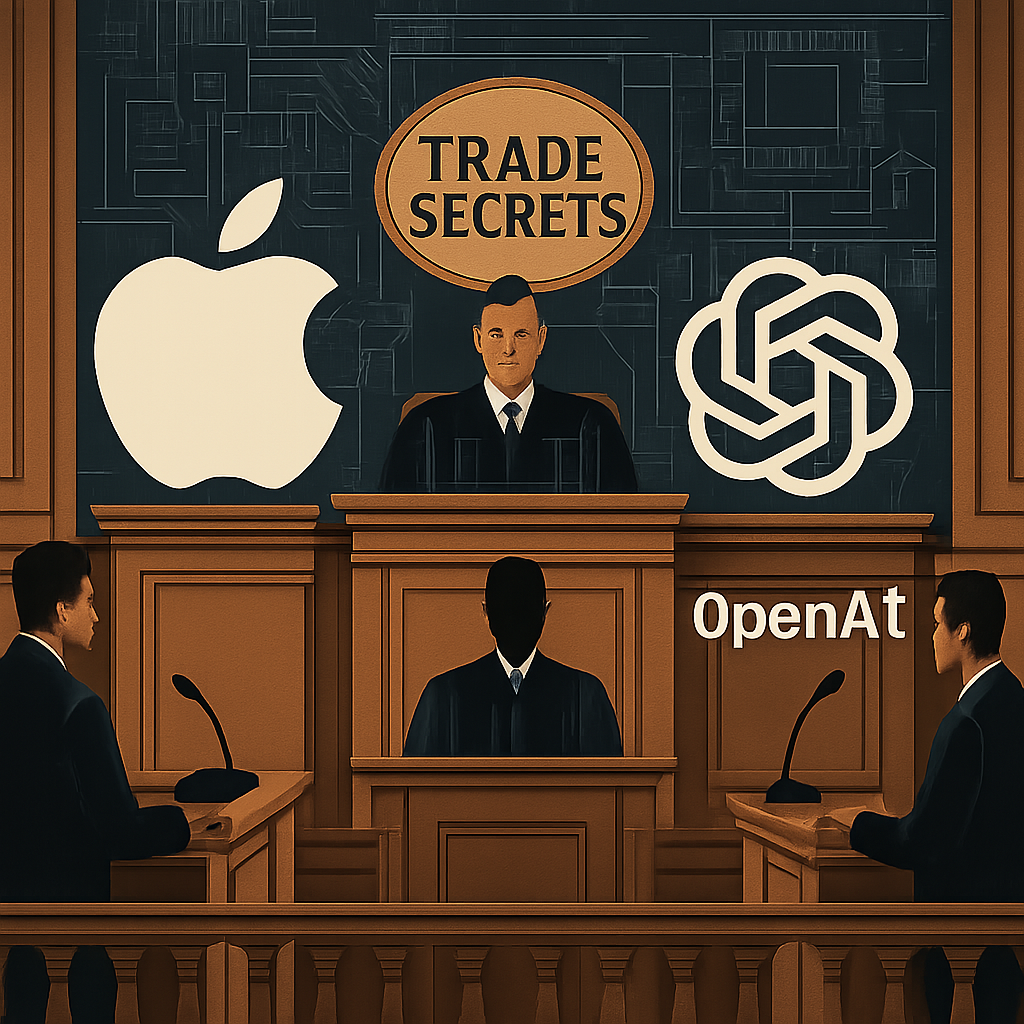
Apple has initiated legal proceedings against OpenAI, alleging that former Apple employees misappropriated trade secrets to benefit OpenAI’s hardware initiatives. The lawsuit, filed in the U.S. District Court for the Northern District of California, names OpenAI, its subsidiary io Products, and two former Apple employees—Tang Tan and Chang Liu—as defendants.
Tang Tan, previously Apple’s Vice President of Product Design overseeing iPhone and Apple Watch projects, departed the company in February 2024 to join io Products, a startup founded by former Apple Chief Design Officer Jony Ive. Chang Liu, who served as a senior system electrical engineer at Apple for eight years, left in January 2026 to join OpenAI.
Apple’s complaint asserts that these individuals exploited their access to confidential information about unreleased technologies, processes, and products. The company contends that this information was used to advance OpenAI’s hardware development efforts. Despite raising concerns with OpenAI in February and requesting an internal investigation, Apple claims it received no response, prompting the current legal action.
OpenAI’s hardware division has been under the leadership of Jony Ive since OpenAI’s acquisition of io Products in a $6.5 billion deal last year. This acquisition included over 50 engineers and developers, many with prior experience at Apple. Notably, Evans Hankey, who led Apple’s design team after Ive’s departure and left Apple in 2022, also joined io Products.
Apple’s lawsuit highlights a broader pattern of talent migration and alleged intellectual property misappropriation. In November 2025, reports surfaced that OpenAI was actively recruiting Apple hardware engineers, raising concerns about the potential transfer of proprietary knowledge. Additionally, in March 2026, the startup iyO amended its lawsuit against OpenAI’s io Products to include allegations of trade secret theft, further complicating the legal landscape surrounding OpenAI’s hardware ventures.
These developments underscore the intensifying competition in the technology sector, particularly in the realm of artificial intelligence and hardware integration. As companies like Apple and OpenAI vie for dominance, the protection of intellectual property becomes paramount. This lawsuit not only seeks to address specific grievances but also serves as a cautionary tale about the challenges of maintaining proprietary information in an era of rapid technological advancement and talent mobility.