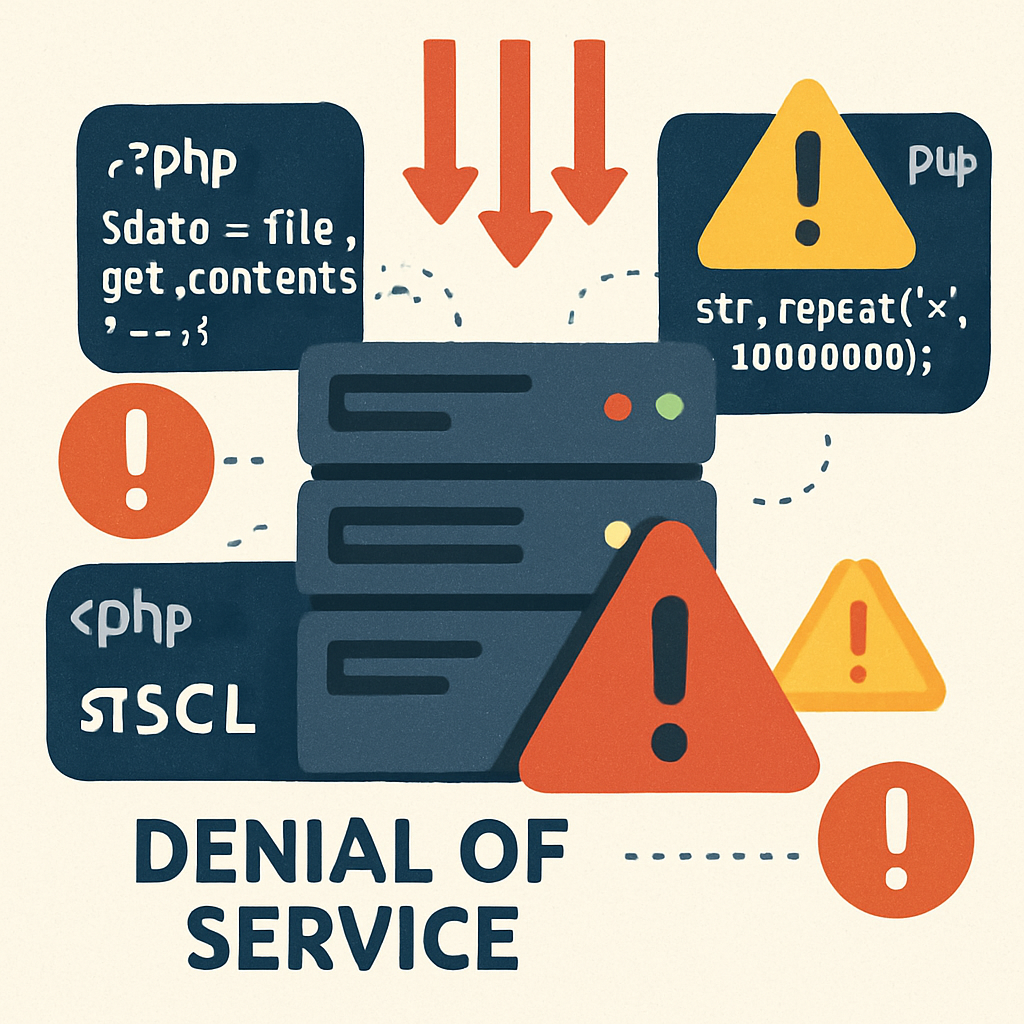
Recent analyses have identified multiple vulnerabilities within PHP, the widely-used server-side scripting language, that could be exploited to cause Denial of Service (DoS) attacks. These vulnerabilities span various PHP versions and components, posing significant risks to web applications reliant on PHP.
Key Vulnerabilities Identified
One notable vulnerability, designated as CVE-2021-21704, affects the PHP Firebird PDO driver. This flaw allows malicious Firebird database servers to send invalid responses that the driver fails to handle properly, leading to crashes and potential memory corruption. The issue arises from inadequate validation of server responses, resulting in out-of-bounds read and write operations.
Another critical vulnerability, CVE-2022-31628, involves the PHP phar wrapper’s handling of specific gzip files known as “quine” gzip files. In affected PHP versions, processing these files can trigger an infinite loop in the decompression code, leading to excessive CPU usage and potential service unavailability.
Additionally, CVE-2018-10546 highlights a flaw in PHP versions prior to 5.6.36, 7.0.30, 7.1.17, and 7.2.5. This vulnerability stems from the iconv stream filter’s failure to reject invalid multibyte sequences, resulting in an infinite loop that can cause a DoS condition.
Historical Context and Ongoing Challenges
PHP has a history of vulnerabilities leading to DoS attacks. For instance, in 2012, PHP 5.3.9 was released to address a hash collision vulnerability that could be exploited to cause DoS conditions. Similarly, CVE-2002-0717 involved a flaw in PHP’s handling of multipart/form-data POST requests, allowing attackers to crash the Apache daemon process.
These recurring vulnerabilities underscore the importance of continuous monitoring and updating of PHP installations. Developers and system administrators must remain vigilant, applying patches promptly and adhering to best practices to mitigate potential risks.
As PHP continues to evolve, the community must prioritize security to maintain the trust and reliability of web applications built on this platform. Regular code audits, comprehensive testing, and staying informed about emerging threats are essential steps in safeguarding systems against DoS attacks and other security vulnerabilities.