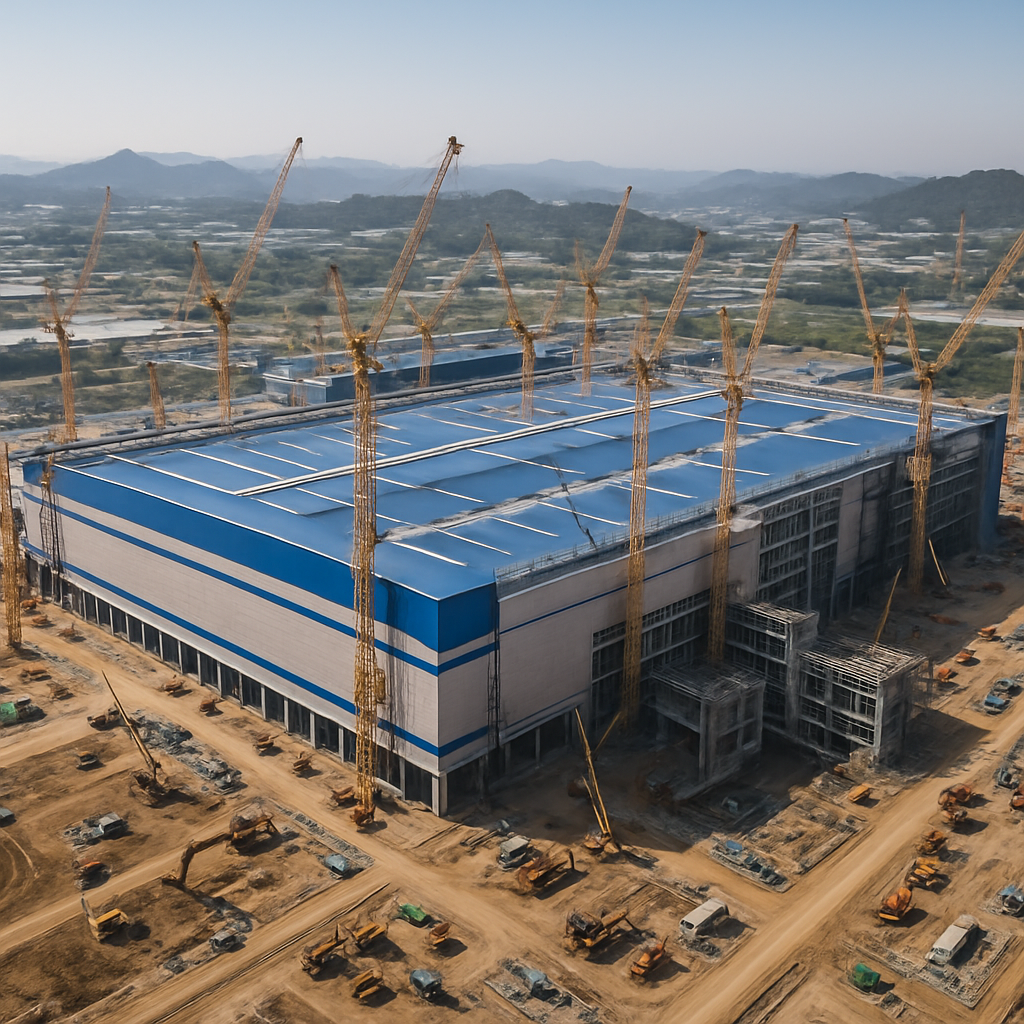
In a strategic move to combat the global memory chip shortage, often referred to as ‘RAMageddon,’ South Korea’s leading technology firms, Samsung Electronics and SK Hynix, have announced plans to invest approximately $518 billion (800 trillion won) in constructing four new semiconductor fabrication plants in the country’s southwestern region. This area has traditionally seen limited semiconductor investment, making this initiative particularly significant.
This substantial investment is part of a broader national strategy unveiled during a recent presidential briefing. The comprehensive plan encompasses several key components:
- Memory Chip Production: Allocation of $518 billion for the development of four new memory fabrication facilities in the southwest.
- High-Bandwidth Memory (HBM) Packaging: An additional $52 billion dedicated to establishing an HBM packaging hub in the central region.
- AI Data Centers: A commitment of $356 billion (550 trillion won) towards the construction of AI data centers by major Korean conglomerates, including SK, GS, and Naver, with a target completion by 2035.
Collectively, these investments amount to over $900 billion, underscoring South Korea’s ambition to solidify its position as a dominant force in the global AI and semiconductor sectors. President Lee Jae Myung emphasized the critical role of semiconductors, physical AI, and AI data centers as the foundational pillars for the nation’s next industrial era. He highlighted the urgency of this initiative, declaring 2026 as the pivotal year for South Korea to establish itself as an indispensable industrial power.
President Lee pointed out that existing semiconductor facilities in Yongin and Pyeongtaek, located just south of Seoul, have reached their operational limits. He urged companies to expedite investments in the southwestern region to distribute economic growth more evenly across the country. The President stressed the necessity of securing substantial production capacity in advance to meet future demands.
Addressing concerns about potential governmental pressure on companies to make these investments, President Lee clarified that the decisions were made based on the companies’ own assessments. He stated that the government’s role is to create an environment where companies can invest confidently, without incurring losses, and with promising prospects.
Samsung Electronics has outlined a decade-long investment plan totaling approximately $1.7 trillion (2,655 trillion won), with $425 trillion won allocated specifically for the Honam region in the southwest. The company identified factors such as anticipated incentives related to power, water, workforce availability, and living conditions as key considerations in selecting Gwangju, located about 300 kilometers south of Seoul, for a new semiconductor fabrication plant. Additionally, plans include the establishment of an AI data center in Haenam, situated at the southern tip of the peninsula.
These investments are set against the backdrop of a global surge in demand for memory chips, driven by the rapid expansion of AI technologies. Samsung and SK Hynix, along with U.S.-based Micron Technology, currently dominate the global memory chip market. The term ‘RAMageddon’ has been coined to describe the worldwide shortage of memory chips resulting from the accelerated development and deployment of AI infrastructure.
While the scale of South Korea’s investment is monumental, it aligns with global trends. For instance, major U.S. tech companies such as Alphabet, Amazon, Meta, and Microsoft are collectively projected to invest $650 billion in AI infrastructure within the current year alone.
In summary, South Korea’s aggressive investment strategy aims to alleviate the current memory chip shortage and position the nation as a central hub in the global AI and semiconductor industries. However, the success of this initiative will depend on the timely execution of these projects and the sustained global demand for memory chips and AI technologies.