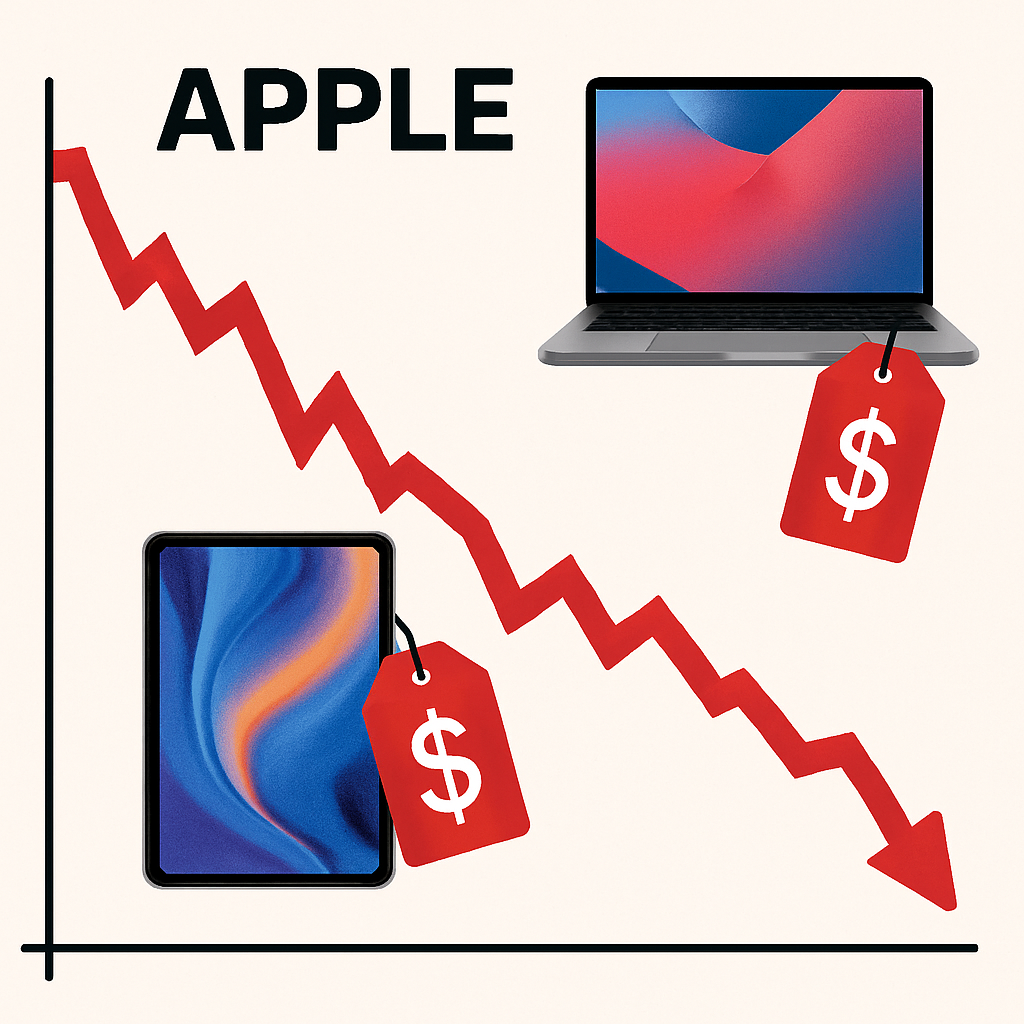
Apple Inc. recently announced mid-cycle price increases across several of its MacBook and iPad models, leading to a notable decline in its stock value. The company’s shares dropped approximately 4.8% in morning trading on June 25, 2026, following the announcement. Despite this immediate market reaction, financial analysts have largely maintained their existing ratings and price targets for Apple, indicating a steady outlook on the company’s long-term performance.
The price adjustments are substantial, with increases ranging from $100 to $300. For instance, the MacBook Pro 1TB model saw a $300 hike, bringing its price to $1,999, while the iPad Pro Wi-Fi 256GB model increased by $200 to $1,199. Entry-level products were also affected; the MacBook Neo rose by $100 to $699, and the iPad Air 128GB increased by $150 to $749. These adjustments are attributed to rising memory and storage component costs, which Apple has decided to pass on to consumers.
Apple’s CEO, Tim Cook, had previously indicated that such price increases were unavoidable due to escalating component costs. He emphasized the company’s efforts to mitigate these increases but acknowledged the challenges in absorbing the higher expenses without affecting product pricing.
In the broader market context, other technology stocks experienced mixed performances. Micron Technology, for example, surged 9.7% after reporting strong earnings and a positive forecast, alleviating some concerns over its recent stock rally. Qualcomm also saw a 3.1% increase, bolstered by raised long-term revenue targets driven by increased demand for artificial intelligence applications.
Despite the immediate dip in Apple’s stock price, the company’s fundamentals remain strong. The decision to adjust product prices reflects a strategic move to maintain profit margins amid rising component costs. While there may be short-term impacts on consumer demand, Apple’s brand loyalty and product ecosystem are likely to sustain its market position. Investors should monitor how these price changes affect sales volumes and whether competitors will follow suit, potentially influencing the broader tech market dynamics.