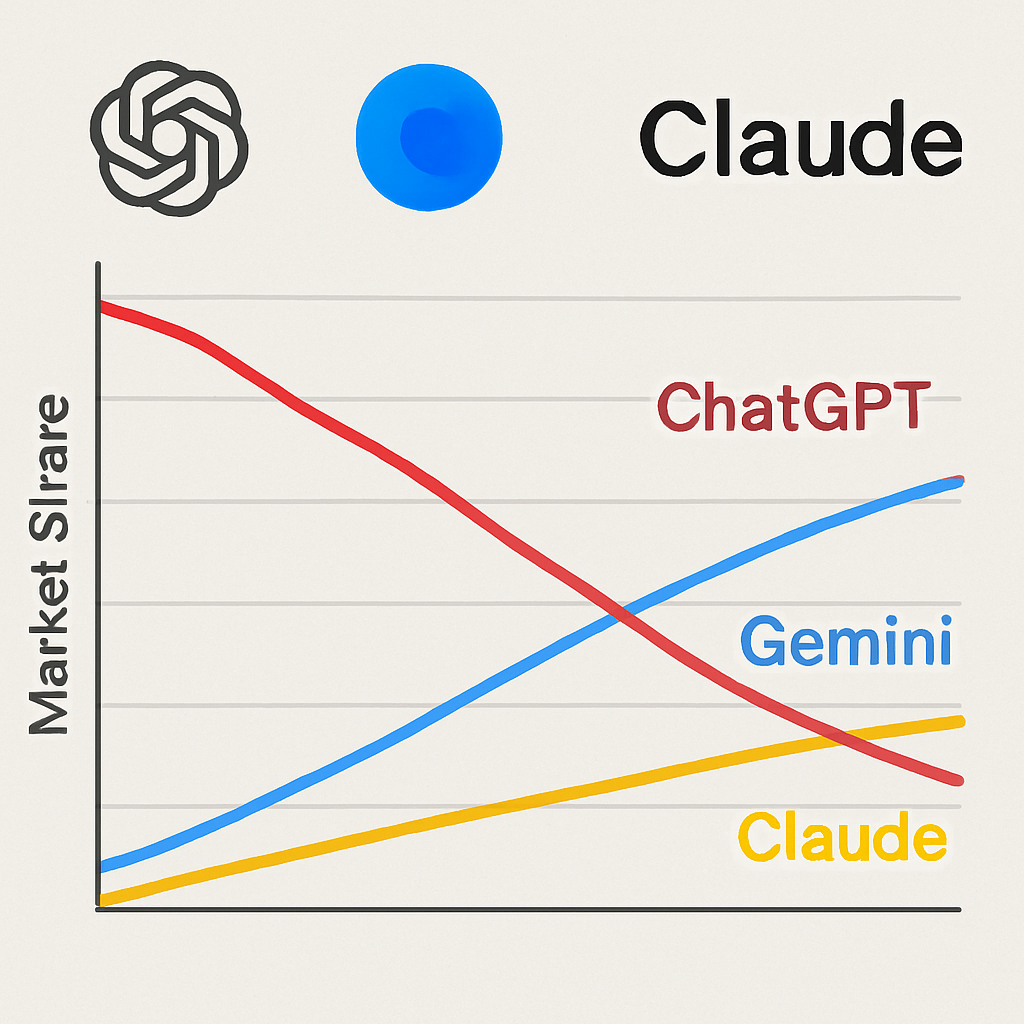
OpenAI’s ChatGPT, once the dominant force in the AI assistant market, has seen its global market share dip below 50% for the first time. This shift comes as competitors like Google’s Gemini and Anthropic’s Claude gain traction among users.
According to Sensor Tower’s State of AI Report for 2026, ChatGPT’s market share stood at 46.4% by the end of May, down from over 50% in January. In contrast, Gemini captured 27.7% of the market, while Claude held 10.3%. Other AI assistants, including xAI’s Grok, Perplexity, DeepSeek, and Meta AI, each accounted for less than 5%.
Despite this decline, ChatGPT remains the most popular AI assistant worldwide, boasting over 1.1 billion monthly users. Gemini follows with 662 million users, and Claude has 245 million. Notably, ChatGPT achieved the milestone of 1 billion monthly users faster than any other app, as reported by Sensor Tower.
User behavior indicates a growing willingness to switch between AI assistants. Specific events have influenced this trend; for instance, OpenAI’s agreement with the U.S. Department of Defense in February led to a noticeable increase in ChatGPT uninstalls, suggesting that users value brand trust and alignment with their values.
Gemini’s growth is largely attributed to its integration with Google’s suite of tools, enhancing its appeal to users already within the Google ecosystem. Meanwhile, Claude has built a strong reputation for productivity applications and is approaching ChatGPT’s user retention rates.
The AI assistant market is experiencing significant growth. In the first half of 2026, users are projected to download nearly 2.3 billion AI apps and spend over $4.2 billion on them, according to Sensor Tower estimates. This represents a substantial increase from $1.83 billion in spending during the first half of 2025. However, the growth rates for downloads and spending have slowed, indicating a maturing market.
Regionally, Asia saw a 3.3% decline in AI app downloads in the first quarter of 2026, driven by decreases in China and India. Despite leading in total downloads, Asia lags behind North America and Europe in terms of in-app spending. This disparity is crucial for companies strategizing on premium features and monetization efforts.
In the United States, users are increasingly turning to AI assistants for productivity tasks and are more willing to pay for premium features. Across platforms, the average revenue per user has risen industry-wide. Notably, 13% of Anthropic’s users have subscribed to a paid plan, leading the field in conversion rates. This metric is essential for investors assessing which AI businesses are building loyal, paying customer bases.
As the AI assistant market evolves, OpenAI faces the challenge of maintaining its leadership position amid intensifying competition. The company’s ability to innovate and align with user values will be critical in retaining and expanding its user base.