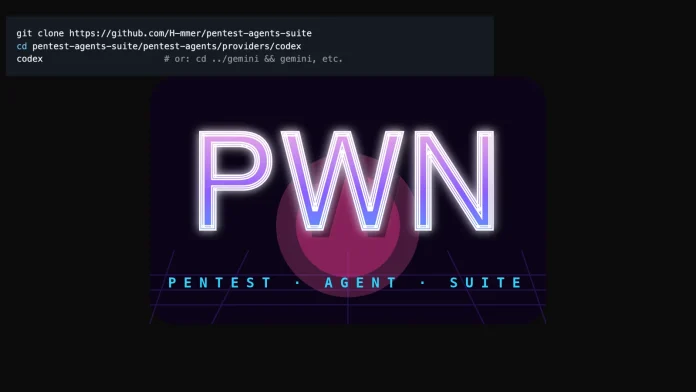
Pentest Agent Suite: Revolutionizing Bug Bounty Programs with AI-Powered Automation
In the rapidly evolving landscape of cybersecurity, the introduction of the Pentest Agent Suite marks a significant advancement in automated security testing. This open-source framework offers a comprehensive solution for conducting autonomous bug bounty assessments, integrating seamlessly with leading AI coding platforms such as Claude Code, OpenAI Codex, Google Gemini, Cursor, Windsurf, VS Code Copilot, and OpenClaw.
Comprehensive Integration Across AI Platforms
Developed by researcher H-mmer and available on GitHub, the Pentest Agent Suite is designed to function cohesively across multiple AI coding environments. It provides a unified security platform equipped with persistent memory, live integration with bug bounty platforms, and a FAISS-backed semantic search engine. This search engine enables agents to access and analyze prior vulnerability reports in real-time, enhancing the efficiency and depth of security assessments.
Structured Framework for Effective Security Testing
The suite is organized into three primary layers:
1. Specialized Agents: A collection of 50 agents, each tailored to identify specific security vulnerabilities.
2. Dual-Server MCP Infrastructure: This includes the bounty-platforms Model Context Protocol (MCP) server, which integrates with 16 bug bounty programs such as HackerOne, Bugcrowd, Intigriti, Immunefi, and YesWeHack. It offers tools like `list_platforms`, `get_program_scope`, `sync_program`, `draft_report`, and `submit_report`. Additionally, the writeup-search MCP server supports various search modes, including FAISS semantic search and SQLite keyword search, facilitating efficient retrieval of relevant vulnerability information.
3. Comprehensive Rules Library: A detailed repository containing 2,605 lines of attack patterns covering vulnerabilities like XSS, SSRF, SQLi, IDOR, OAuth, SSTI, JWT, LFI, prototype pollution, NoSQLi, and DeFi attack vectors.
Rigorous Validation and Quality Assurance
A standout feature of the Pentest Agent Suite is the 7-Question Gate, a validation pipeline managed by the `validator` agent. This process ensures that each identified vulnerability undergoes thorough scrutiny. Any negative response during validation triggers an automatic action—either terminating the process, downgrading the finding, or requiring further investigation. Only findings that pass this rigorous validation and achieve a quality score of 7 or higher proceed to the reporting and submission stages.
Adaptive Testing with Autopilot Mode
The suite’s `/autopilot` command introduces an adaptive testing mechanism that mandates multi-layered payload encoding. It ensures comprehensive assessment of attack surfaces by completing a full exhaustion matrix before declaring a target as fully tested. Users can configure this feature with checkpoint modes such as `–paranoid`, `–normal`, or `–yolo`, allowing customization based on the desired level of thoroughness.
Persistent Knowledge Management
The `brain.py` component maintains a persistent record of each endpoint per target, implementing circuit-breaker logic to manage consecutive error responses. It also synchronizes knowledge across engagements through incremental hash-based diffing, ensuring that the suite’s assessments remain informed and up-to-date.
Seamless Installation and Configuration
The suite includes an installer (`python3 -m tools.installer`) that generates native configuration formats for each supported tool, writing them to the appropriate Integrated Development Environment (IDE) directories. For IDEs lacking native subagent support, such as Cursor, Windsurf, and OpenClaw, the installer translates content into skill files and rules, ensuring compatibility and ease of use.
Diverse Agent Portfolio for Targeted Assessments
The Pentest Agent Suite boasts a diverse roster of agents, including:
– HackerOne Weakness Specialists: Agents like `xss-hunter`, `sqli-hunter`, `ssrf-hunter`, `rce-hunter`, `oauth-hunter`, and `llm-ai-hunter` focus on identifying specific vulnerabilities.
– SAST Pipeline Agents: An 8-agent Static Application Security Testing pipeline for comprehensive code analysis.
– Infrastructure and Reconnaissance Agents: Tools such as `cloud-recon`, `js-analyzer`, and `graph` assist in mapping and analyzing target infrastructures.
Enhancing Security Testing Efficiency
By automating and integrating various aspects of the bug bounty process, the Pentest Agent Suite significantly enhances the efficiency and effectiveness of security testing. Its comprehensive approach ensures that vulnerabilities are identified, validated, and reported with minimal manual intervention, allowing security professionals to focus on more complex tasks.
Conclusion
The Pentest Agent Suite represents a transformative advancement in the field of automated security testing. Its integration with multiple AI coding platforms, structured framework, rigorous validation processes, and diverse agent portfolio make it a valuable tool for organizations seeking to bolster their cybersecurity defenses. As cyber threats continue to evolve, tools like the Pentest Agent Suite will play a crucial role in proactively identifying and mitigating vulnerabilities, ensuring the security and integrity of digital assets.