Cybercriminals Exploit Fake Invitations to Steal Credentials and Deploy Malware
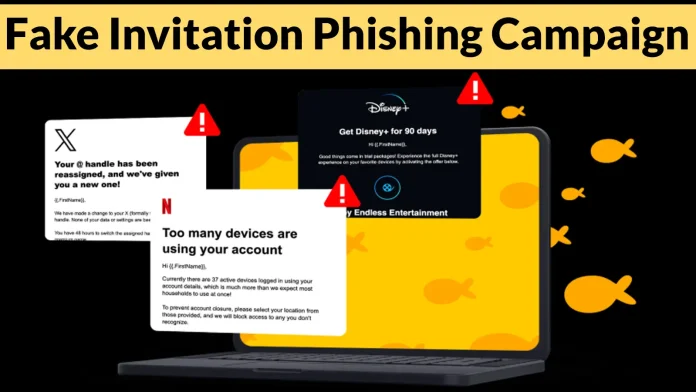
A sophisticated phishing campaign has been actively targeting U.S. organizations since at least December 2025, utilizing counterfeit event invitations to deceive recipients into divulging login credentials, intercepting one-time passwords (OTPs), or installing remote access tools. This operation has been meticulously designed to appear legitimate, making it particularly dangerous for unsuspecting users.
Campaign Overview
Researchers from ANY.RUN have been monitoring this large-scale operation, noting its reliance on a single phishing framework to mass-deploy event-themed lure sites. As of April 27, 2026, nearly 160 suspicious links associated with this campaign had been submitted to ANY.RUN’s sandbox, alongside approximately 80 identified phishing domains. Many of these domains are registered under the .de top-level domain and feature names related to parties, celebrations, and invitations.
The sectors most affected include Education, Banking, Government, Technology, and Healthcare. These industries are particularly vulnerable due to their frequent use of email communications and remote administration tools, making them attractive targets for cybercriminals.
Attack Methodology
The attack chain follows a consistent structure across all observed instances:
1. CAPTCHA Verification: Victims are first presented with a CAPTCHA check, often powered by Cloudflare, to create a sense of legitimacy and to bypass automated security measures.
2. Fake Invitation Page: After completing the CAPTCHA, users are directed to a counterfeit event invitation page that closely mimics legitimate platforms.
3. Credential Theft or Malware Deployment: Depending on the attacker’s objective, the user is either prompted to enter their login credentials or to download a file that installs remote access tools.
Credential Theft Tactics
When the goal is credential theft, the lure page prompts users to sign in using services like Google, Yahoo, AOL, or Microsoft. After entering their password, victims receive a fake Incorrect Password message, a tactic designed to capture a second attempt in case of a typographical error. The page then transmits the captured credentials via POST requests to server-side endpoints such as /processmail.php. Subsequently, an OTP interception form is presented, which submits verification codes to /process.php, enabling attackers to bypass two-factor authentication measures.
Malware Deployment Strategies
In cases where the objective is to deploy malware, victims are prompted to download a file under the guise of accessing event details or related documents. This file often contains remote access tools like ScreenConnect, granting attackers complete control over the victim’s system. Once installed, these tools can be used to exfiltrate sensitive data, monitor user activity, and deploy additional malware payloads.
Indicators of Automation and AI Utilization
The scale and consistency of this campaign suggest a high degree of automation. Some elements of the phishing pages indicate possible AI-assisted content generation, allowing attackers to rapidly create new lure sites with minimal effort. This automation not only increases the efficiency of the campaign but also makes it more challenging for security teams to detect and mitigate threats promptly.
Protective Measures and Recommendations
To safeguard against such phishing attacks, organizations and individuals should implement the following measures:
– Email Verification: Always verify the sender’s email address and be cautious of unsolicited invitations or unexpected event notifications.
– URL Inspection: Hover over links to preview the URL before clicking. Be wary of domains that appear suspicious or unrelated to the purported sender.
– CAPTCHA Scrutiny: While CAPTCHAs are commonly used for security, their presence does not guarantee legitimacy. Always assess the context in which a CAPTCHA is presented.
– Two-Factor Authentication (2FA): Enable 2FA on all accounts to add an extra layer of security. However, remain vigilant, as attackers may attempt to intercept OTPs.
– Software Downloads: Avoid downloading files from unknown or untrusted sources. If a download is necessary, ensure it is from an official and verified source.
– Security Training: Regularly educate employees and users about phishing tactics and the importance of cybersecurity hygiene.
– Incident Response Plan: Develop and maintain an incident response plan to address potential security breaches promptly and effectively.
Conclusion
The emergence of this sophisticated phishing campaign underscores the evolving tactics employed by cybercriminals to exploit human trust and technological vulnerabilities. By leveraging fake event invitations and employing advanced social engineering techniques, attackers can infiltrate organizations, steal sensitive information, and deploy malicious software. Vigilance, education, and robust security measures are essential in defending against such threats.