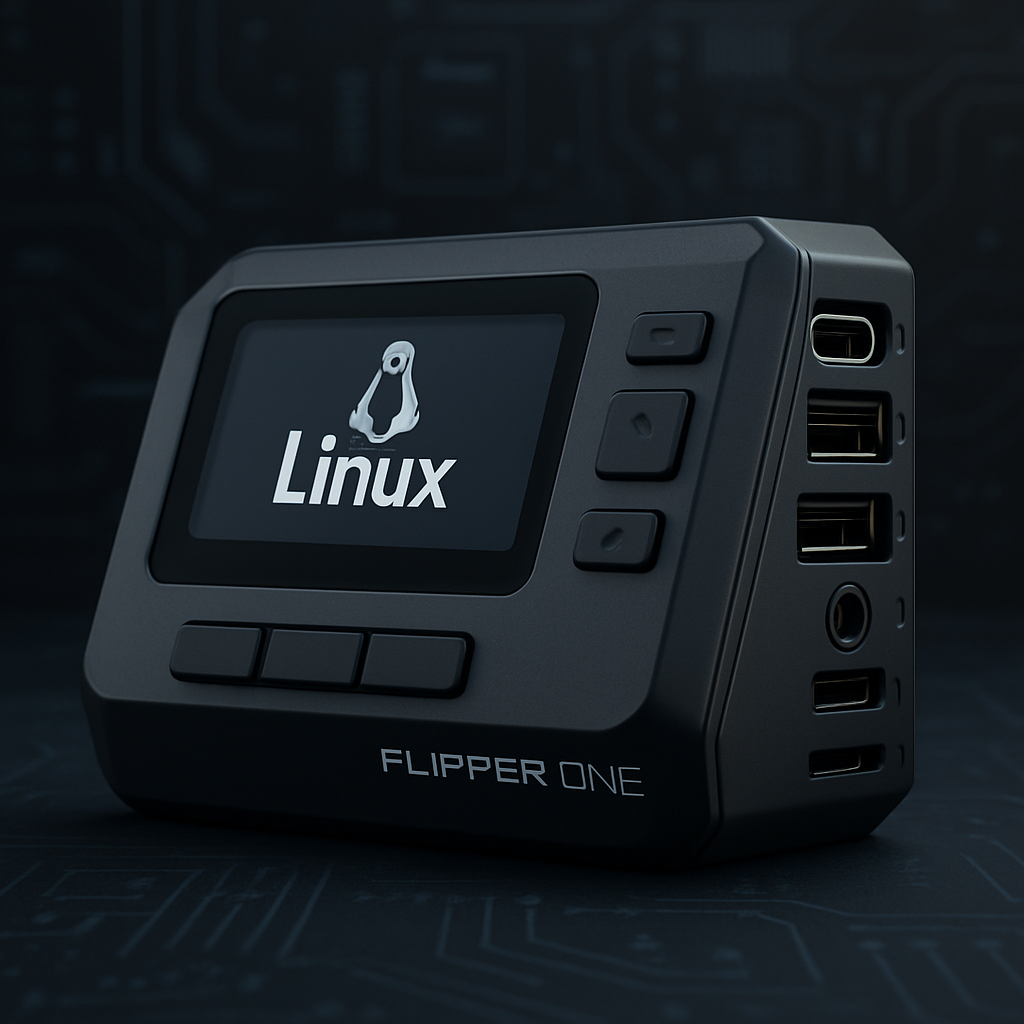
Flipper Devices has unveiled the Flipper One, a modular Linux cyberdeck designed to serve as an open, mainline-first ARM platform for hackers, researchers, and makers. Unlike its predecessor, the Flipper Zero, the Flipper One focuses on IP networking, high-performance computing, and hardware experimentation.
At the heart of the Flipper One is the Rockchip RK3576 processor, which supports an open Linux stack with full mainline kernel support, free from binary blobs or vendor-locked dependencies. Flipper Devices is collaborating with Collabora to upstream RK3576 support, aiming to enable users to boot directly from kernel.org software instead of relying on heavily modified vendor trees.
The Flipper One is designed with modularity in mind, featuring expansion interfaces such as PCIe, USB 3.0, SATA, and M.2 modules. This design allows for high-speed add-ons like SDR radios, SSDs, and cellular modems. The device can function as a router, VPN gateway, packet analyzer, or mobile Linux workstation. Connectivity options include dual Gigabit Ethernet ports, USB Ethernet at 5 Gbps, Wi-Fi 6E, and optional 5G via an M.2 modem.
Flipper Devices emphasizes that the Flipper Zero and Flipper One cater to different layers of the technology stack. The Flipper Zero focuses on offline access-control and radio protocols such as NFC, RFID, Sub-1 GHz, infrared, and wired interfaces. In contrast, the Flipper One is intended for IP-connected workflows involving Wi-Fi, Ethernet, 5G, and SDR-driven computing.
To foster community involvement, Flipper Devices has launched the Flipper One Developer Portal, a community-editable wiki that provides access to task trackers, architecture notes, and work-in-progress documentation. The project is divided into sub-teams covering hardware, mechanics, Linux software, MCU firmware, UI, documentation, and testing, with open tasks available for community contributors.
This transparent development approach aims to make the Flipper One not just a product but also a learning resource. For security professionals, the combination of open documentation, modular interfaces, and a mainline-first Linux platform makes the Flipper One an attractive tool for packet analysis, lab work, wireless research, and edge experimentation.
By introducing the Flipper One, Flipper Devices is expanding its product line to address the needs of users requiring a network-connected Linux platform for advanced computing and hardware experimentation. This move reflects a commitment to open-source principles and community collaboration, potentially setting a new standard for modular cyberdecks in the industry.
Source: CyberSecurityNews