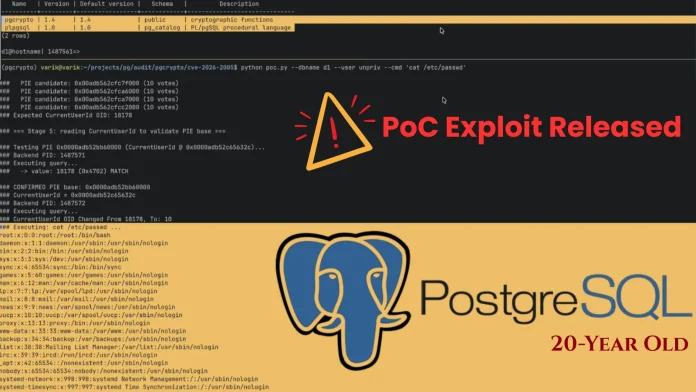
Critical 20-Year-Old PostgreSQL Vulnerability Exposed: Remote Code Execution Threat
A recently disclosed proof-of-concept (PoC) exploit has brought to light a critical remote code execution (RCE) vulnerability in PostgreSQL’s pgcrypto extension. This flaw, identified as CVE-2026-2005, originates from legacy code that has remained unnoticed for nearly two decades, underscoring the persistent risks associated with longstanding software vulnerabilities.
Understanding the Vulnerability
The core of this vulnerability lies in the PGP session key parsing logic within the pgcrypto module. By crafting a specific PGP message, an attacker can trigger a heap-based buffer overflow. This overflow allows for arbitrary memory read and write operations, which can be exploited to escalate privileges to the PostgreSQL superuser level and execute operating system commands.
Technical Breakdown of the Exploit
The exploit targets PostgreSQL instances compiled from a particular vulnerable commit. It leverages predictable memory offsets to circumvent security measures like Address Space Layout Randomization (ASLR). The attack initiates by corrupting heap memory structures, leading to a controlled pointer leak when PostgreSQL attempts to free the manipulated memory chunks.
This memory leak provides attackers with insights into the heap layout, facilitating arbitrary memory reads and the identification of executable memory regions. Security researcher Varik Matevosyan (var77) has published the PoC on GitHub, demonstrating a comprehensive exploitation chain from memory corruption to command execution.
The exploit proceeds by scanning the leaked memory for potential code pointers and calculating the base address of the PostgreSQL binary using symbol offset matching. Once the base address is confirmed, the attacker can overwrite critical internal variables, such as the CurrentUserId field.
By modifying this value to match PostgreSQL’s bootstrap superuser identifier, the exploit effectively escalates privileges within the database environment. This escalation allows the attacker to misuse features like COPY FROM PROGRAM to execute arbitrary commands on the host system under the PostgreSQL service account.
Prerequisites for Exploitation
The PoC requires a controlled environment where the PostgreSQL binary matches the vulnerable build, as variations in compilation may affect memory offsets and hinder successful exploitation. Additionally, the exploit depends on Python-based tools, including psycopg2 and pwntools, to interact with the database and deliver the payload.
Implications and Recommendations
The release of a working PoC significantly lowers the barrier for threat actors to weaponize this vulnerability. Systems exposing PostgreSQL services, especially those with the pgcrypto extension enabled, are at heightened risk if unpatched.
Organizations are strongly advised to:
– Review PostgreSQL Deployments: Assess current PostgreSQL installations to identify and mitigate potential vulnerabilities.
– Disable Unnecessary Extensions: If the pgcrypto extension is not in use, consider disabling it to reduce the attack surface.
– Apply Security Updates: Stay informed about and apply relevant security patches as they become available.
– Monitor Database Logs: Keep an eye on database logs for unusual PGP operations and unexpected error messages that may indicate exploitation attempts.
The disclosure of CVE-2026-2005 serves as a stark reminder that even mature and widely trusted software can harbor critical vulnerabilities for years. This situation emphasizes the importance of continuous security auditing and timely patch management to safeguard against potential threats.