First Public macOS Kernel Exploit on Apple M5 Achieved in Record Time
In a groundbreaking development, security researchers have successfully executed the first public macOS kernel exploit targeting Apple’s M5 silicon, effectively circumventing the company’s advanced hardware-level memory protections. This exploit, developed by a team from Calif comprising Bruce Dang, Dion Blazakis, and Josh Maine, demonstrates a significant advancement in offensive security research.
Exploit Development Timeline
The team identified two critical vulnerabilities on April 25, 2026. By April 27, they had collaborated to develop a working exploit, achieving a fully functional kernel local privilege escalation (LPE) exploit by May 1. This rapid development cycle underscores the evolving capabilities in the field of cybersecurity.
Technical Details of the Exploit
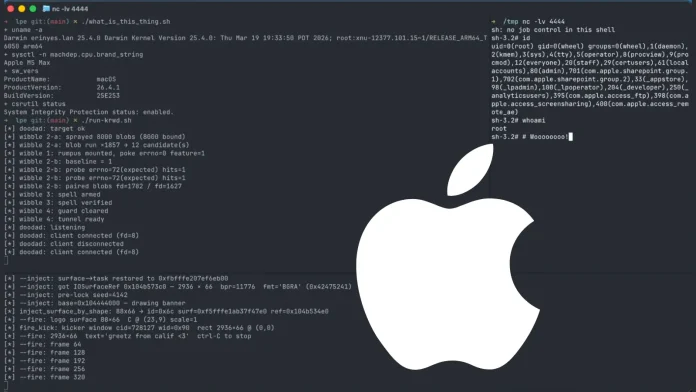
The exploit targets macOS 26.4.1 (25E253) running on native M5 hardware. It initiates from an unprivileged local user account, utilizes standard system calls, and successfully delivers a root shell, all while Apple’s Memory Integrity Enforcement (MIE) remains active. MIE, built on ARM’s Memory Tagging Extension (MTE) architecture, was designed to disrupt kernel memory corruption exploits. Apple invested five years and substantial resources into developing MIE to enhance system security.
Role of AI in Exploit Development
A pivotal factor in the swift development of this exploit was the utilization of Anthropic’s Mythos Preview, an advanced AI model. This AI assisted in identifying the vulnerabilities and played a crucial role throughout the exploit development process. Calif’s team noted that the model could generalize attack patterns across entire vulnerability classes once it understood a specific problem type. While the vulnerabilities were within known classes, autonomously bypassing MIE required significant human expertise, highlighting the potent combination of human intelligence and AI in cybersecurity.
Implications for Hardware Security
The successful development of this exploit in just five days, against a protection that took Apple five years to build, marks a significant milestone in AI-assisted offensive security research. Memory corruption remains a prevalent vulnerability across modern platforms, including iOS and macOS. Security mitigations like MIE are designed to increase the difficulty of exploitation rather than render it impossible. This research indicates that as AI models become more adept at identifying unknown bugs within known classes, even state-of-the-art hardware mitigations may face reduced effectiveness over time.
Future Outlook
Calif’s team describes this exploit as a preview of an impending AI bugmageddon era, where small, AI-augmented security teams can achieve feats previously possible only for large, well-funded organizations. This development suggests a shifting landscape in hardware security, emphasizing the need for continuous innovation and adaptation in defense mechanisms.
Apple’s Response
In an unconventional move, the researchers delivered a comprehensive 55-page report directly to Apple Park in Cupertino, bypassing standard bug bounty submission channels. This approach aimed to avoid the crowded queues typical during events like Pwn2Own. Full technical details of the exploit will be published only after Apple releases a patch. As of now, systems running macOS 26.4.1 on M5 hardware remain theoretically vulnerable to local privilege escalation via this unpublished exploit chain.
Conclusion
This development serves as a stark reminder of the evolving nature of cybersecurity threats and the critical importance of proactive defense strategies. The integration of AI in exploit development accelerates the discovery and exploitation of vulnerabilities, necessitating a corresponding evolution in security measures to protect against increasingly sophisticated attacks.