From AirPods to Heat Pumps: How an Ex-Apple Engineer is Revolutionizing Home Heating
In 2022, California set an ambitious goal: to install 6 million heat pumps by 2030. However, with only about 2.3 million units installed to date, the state faces the daunting task of averaging approximately 2,000 installations daily over the next five years. This challenge is compounded by the fact that a standard mini-split heat pump can take up to a day to install and costs between $4,000 to $6,000 per zone.
Recognizing the need for innovation, Mary-Ann Rau, co-founder and CEO of Merino Energy, is determined to transform the heat pump industry. We’ve got to do something different, Rau emphasized in a recent interview.
Merino Energy, operating discreetly until now, has unveiled its groundbreaking product: the Merino Mono. Priced at $3,800, this unit boasts a streamlined one-hour installation process, aiming to make heat pumps more accessible and affordable for homeowners.
Rau’s journey to this innovation is noteworthy. As a former Apple engineer, she played a pivotal role in introducing new AirPods. Her personal experience with home electrification in San Francisco exposed her to the prohibitive costs associated with heat pump installations. I had total sticker shock, Rau admitted. This realization spurred her commitment to developing a more affordable solution for the broader population.
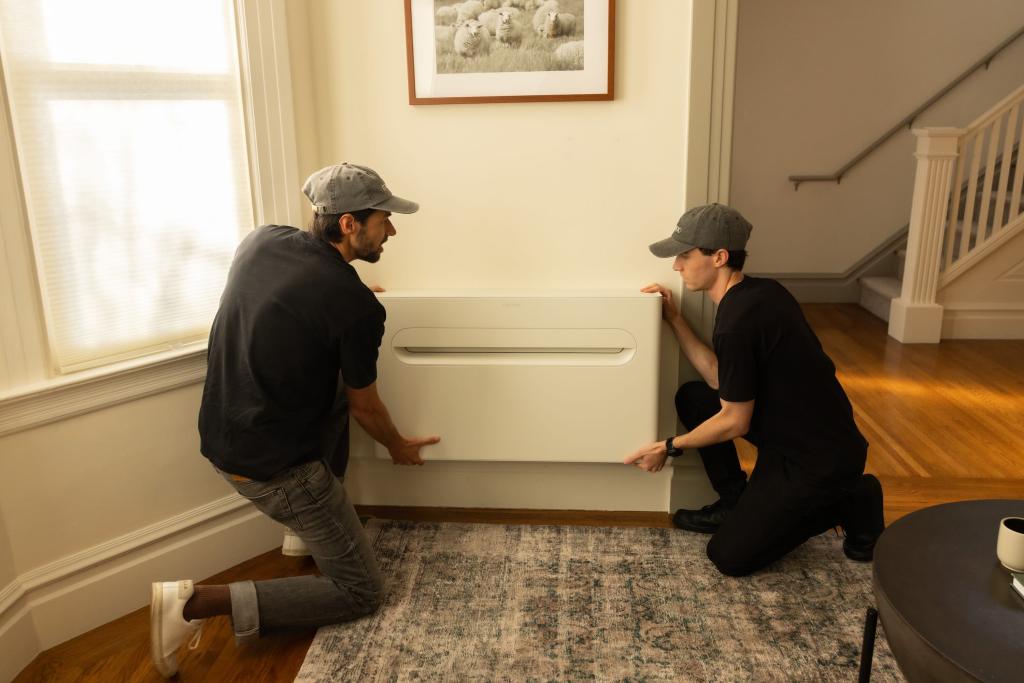
Traditional heat pumps consist of two components: an indoor heat exchanger and an outdoor condenser. The Merino Mono integrates these into a single unit, comparable in size to a standard radiator placed under a window. Designed for convenience, it plugs into a standard 120-volt outlet, eliminating the need for extensive electrical upgrades. Rau explained, If you can plug in a microwave and it works on that outlet, then the Merino Mono is gonna work on that outlet.
Beyond its compact design, the Mono is equipped with modern features expected in next-generation heat pumps. It offers Wi-Fi connectivity, occupancy sensing to adjust settings based on room usage, and the ability to coordinate with other units in the home for optimal efficiency and comfort. Notably, Merino Energy is developing an integration with Oura Rings, allowing the heat pump to adjust room temperatures during the wearer’s REM sleep for enhanced rest.
The installation process for the Mono is straightforward. Technicians create two wall openings: one for air intake and another for exhaust. Air circulates over condenser coils, transferring refrigerant to the heat exchanger, which then conditions the room’s air. Externally, only the intake and exhaust ports, along with a condensate pipe, are visible, preserving the home’s aesthetic.
By consolidating all components into a single indoor unit, Merino’s design simplifies installation significantly. Traditional systems often require intricate connections between indoor and outdoor units, involving tasks like brazing copper lines and charging with refrigerant. They’re very expensive from a labor perspective, Rau noted.
While the Mono’s compact design may result in a slight efficiency trade-off, making it more suitable for smaller living spaces, its SEER2 rating of 15.2 is commendable. In comparison, some two-zone systems achieve ratings up to 25. However, for applications such as apartments and condos in dense urban areas, the Mono’s indoor, streamlined design offers a practical solution. Rau emphasized, The Mono is a solution where the cost is proportional to the problem that we’re trying to solve.
Merino Energy is currently installing 48 Mono units at the Civic Center Apartments, a low-income housing development in Richmond, California. Initially focusing on the California market, the company plans to expand to states like Hawaii, Oregon, and Washington. With six installers already onboard in the Bay Area and Los Angeles, Merino is accepting preorders for deliveries scheduled later this year.
Rau envisions the Mono as a catalyst for widespread heat pump adoption. If we can reduce the amount of time and complexity of installing a heat pump, then we can scale adoption, she stated.