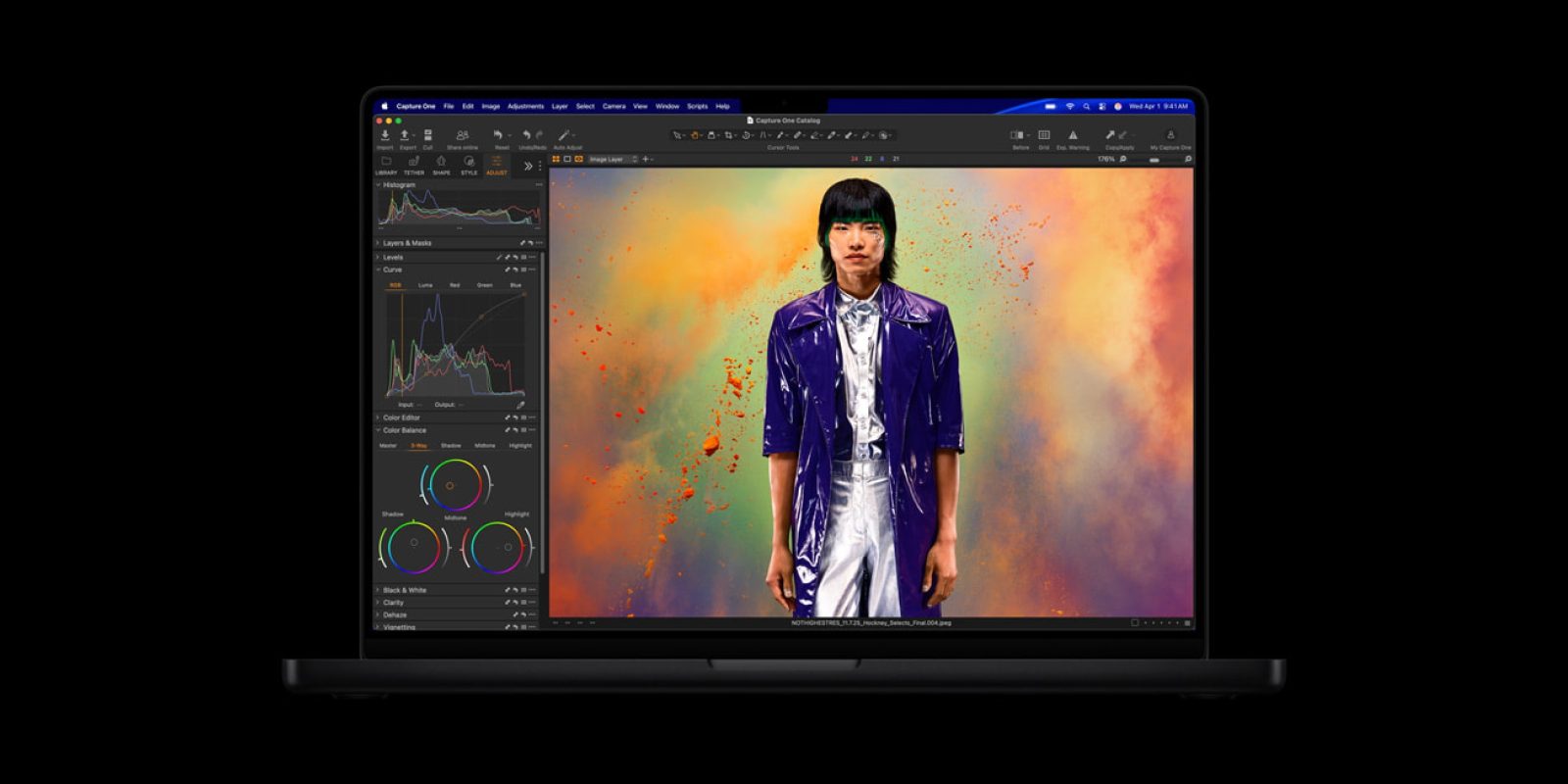
Unveiling the MacBook Pro with M5 Pro and M5 Max: A Leap in Performance
Apple’s latest MacBook Pro models, equipped with the groundbreaking M5 Pro and M5 Max chips, have set a new benchmark in laptop performance. These advancements cater to professionals seeking unparalleled speed and efficiency in their workflows.
Revolutionary Fusion Architecture
At the heart of these new MacBook Pros lies Apple’s innovative Fusion Architecture. This design integrates two third-generation 3-nanometer dies into a single system on a chip (SoC), enhancing both performance and energy efficiency. This architecture seamlessly combines the CPU, GPU, Media Engine, Neural Engine, unified memory controller, and Thunderbolt 5 capabilities, resulting in a cohesive and powerful computing experience.
Enhanced CPU Performance
The M5 Pro and M5 Max chips feature an 18-core CPU, comprising six high-performance super cores and twelve efficiency-focused performance cores. This configuration delivers up to 30% faster multithreaded performance compared to the previous M4 generation, and an impressive 2.5 times the speed of the M1 Pro and M1 Max. These enhancements make the MacBook Pro exceptionally capable of handling demanding tasks such as complex data analysis and high-resolution video editing.
Advanced GPU Capabilities
Graphics performance has seen a significant boost with the M5 Pro supporting up to 20 GPU cores and the M5 Max extending to 40 GPU cores. Each core now includes a Neural Accelerator, providing over four times the peak AI compute compared to their predecessors. This results in up to 50% faster graphics performance, with ray-tracing workloads experiencing up to a 35% improvement over the previous generation.
Memory and Storage Upgrades
The new MacBook Pros offer substantial memory and storage enhancements. The M5 Pro supports up to 64GB of unified memory with a bandwidth of 307GB/s, while the M5 Max supports up to 128GB with a bandwidth of 614GB/s. Storage options have also been upgraded, with base models starting at 1TB for the M5 Pro and 2TB for the M5 Max. Additionally, Apple claims that read/write speeds are up to twice as fast as the M4 generation, reaching up to 14.5GB/s.
Connectivity and Battery Life
Connectivity has been improved with the inclusion of Apple’s N1 wireless networking chip, bringing Wi-Fi 7 and Bluetooth 6 support. Thunderbolt 5 ports now have dedicated controllers, allowing all three ports to operate at full bandwidth simultaneously. The 16-inch MacBook Pro offers up to 24 hours of battery life, with fast-charging capabilities that can reach 50% charge in just 30 minutes using a 96W or higher USB-C adapter.
Pricing and Availability
The 14-inch MacBook Pro with M5 Pro starts at $2,199, while the 16-inch model begins at $2,699. For those requiring even more power, the 14-inch M5 Max model starts at $3,599, and the 16-inch at $3,899. Pre-orders commenced on March 4, 2026, with availability beginning on March 11.
Real-World Performance
Early reviews highlight the impressive performance gains of the new MacBook Pros. Benchmarks indicate that the M5 Max’s 18-core CPU outperforms even high-core-count competitors in certain tests. For instance, in Geekbench 6 benchmarks, the M5 Max surpassed the 96-core AMD Ryzen Threadripper Pro 9995WX in both single-thread and multi-thread tests. This remarkable performance is attributed to the efficient design of Apple’s super cores and the optimized memory subsystem.
Conclusion
The MacBook Pro models equipped with M5 Pro and M5 Max chips represent a significant advancement in laptop technology. With their innovative architecture, enhanced CPU and GPU performance, expanded memory and storage options, and improved connectivity, these laptops are poised to meet the demands of professionals across various industries. Whether for AI development, 3D rendering, or high-resolution video editing, the new MacBook Pros offer a compelling solution for those seeking top-tier performance in a portable form factor.