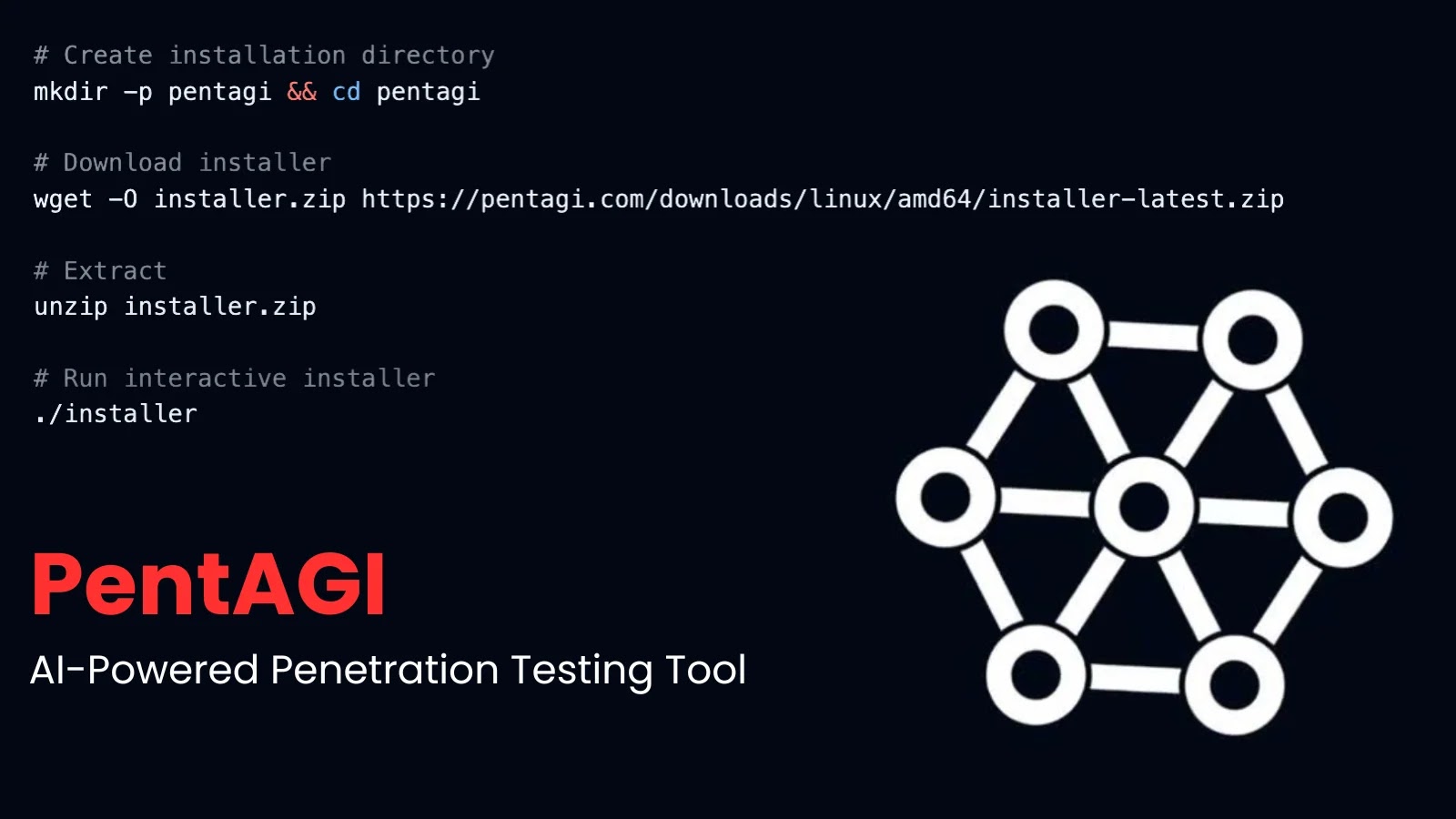
PentAGI: Revolutionizing Penetration Testing with AI-Driven Automation
In the rapidly evolving field of cybersecurity, the demand for efficient and comprehensive penetration testing tools has never been higher. PentAGI emerges as a groundbreaking solution, introducing an AI-driven approach that automates complex workflows, integrates over 20 professional security tools, and generates detailed reports, all within isolated Docker environments.
Introduction to PentAGI
Developed by VXControl and released on GitHub in early 2025, PentAGI is an open-source platform designed to empower security professionals. By leveraging artificial intelligence, it enables autonomous assessments, significantly reducing the manual effort traditionally associated with penetration testing.
Key Features and Capabilities
1. Autonomous AI Agents: PentAGI employs fully autonomous AI agents that dynamically plan and execute penetration tests. These agents integrate seamlessly with over 20 professional security tools, including:
– Nmap: For network discovery and auditing.
– Metasploit: For exploit execution and payload delivery.
– sqlmap: For database attack simulations.
2. Multi-Agent System: The platform’s multi-agent system comprises roles such as researcher, developer, and executor. This structure allows for orchestrated processes that leverage long-term memory to recall past successes and adapt strategies accordingly. This approach eliminates the need for manual scripting, enabling rapid identification of vulnerabilities and proof-of-concept exploits without compromising host systems, as all operations run in a sandboxed environment.
3. Integration with Leading LLMs: PentAGI’s intelligence is enhanced through integrations with leading large language models (LLMs) such as OpenAI, Anthropic Claude, Google Gemini, and local Ollama models. This flexibility allows for deployment across cloud APIs to on-premises inference, catering to various organizational needs.
4. Real-Time Web Intelligence: The platform integrates with external search APIs like Tavily, Perplexity, and DuckDuckGo to provide real-time web intelligence. Additionally, a built-in scraper gathers target-specific data securely, enhancing the depth and relevance of assessments.
5. Comprehensive Reporting: PentAGI produces detailed reports complete with exploitation guides. These reports are stored persistently in PostgreSQL with pgvector for semantic querying and are visualized via Grafana dashboards, allowing for effective monitoring of agent performance.
6. Advanced Summarization Mechanism: To prevent LLM context overflow, PentAGI employs a sophisticated chain summarization mechanism. This system preserves critical conversation history through configurable QA pairs and byte-limited sections, ensuring coherent multi-turn reasoning even in extended penetration tests.
Technical Architecture
At its core, PentAGI utilizes a microservices architecture comprising:
– Frontend: Built with React/TypeScript for a responsive and user-friendly interface.
– Backend: Developed using Go-based REST/GraphQL to handle complex operations efficiently.
– Asynchronous Task Queues: Implemented for scalability, allowing the system to handle multiple tasks concurrently without performance degradation.
The platform also incorporates knowledge graphs via Neo4j and Graphiti to track entity relationships, enhancing the contextual understanding of vulnerabilities. Monitoring stacks like OpenTelemetry, Jaeger, Loki, and VictoriaMetrics provide end-to-end observability, while Langfuse analyzes LLM traces to ensure optimal performance.
Deployment and Security
Deploying PentAGI is streamlined through Docker Compose:
1. Clone the Repository: Obtain the latest version from GitHub.
2. Configure Environment Variables: Set up the `.env` file with necessary API keys and configurations.
3. Launch the Platform: Execute a single command to start the services, accessible at `localhost:8443`.
For production environments, PentAGI supports horizontal scaling, OAuth integration (GitHub/Google), and worker nodes for air-gapped execution. Security features include network isolation, TLS encryption, and proxy support for LLM/search traffic, ensuring a secure and compliant operational environment.
Addressing Industry Challenges
As AI-driven penetration testing evolves, PentAGI addresses key industry challenges such as tool chaining and report automation. Its comprehensive integration of multiple tools and automated reporting positions it among the top open-source tools for 2026. Security teams can self-host PentAGI for greater data control, though users must manage LLM costs and rate limits, especially when utilizing services like AWS Bedrock.
Conclusion
PentAGI represents a significant advancement in the field of penetration testing, combining artificial intelligence with a robust suite of security tools to automate and enhance the assessment process. Its comprehensive features, flexible deployment options, and focus on security make it a valuable asset for organizations aiming to strengthen their cybersecurity posture.