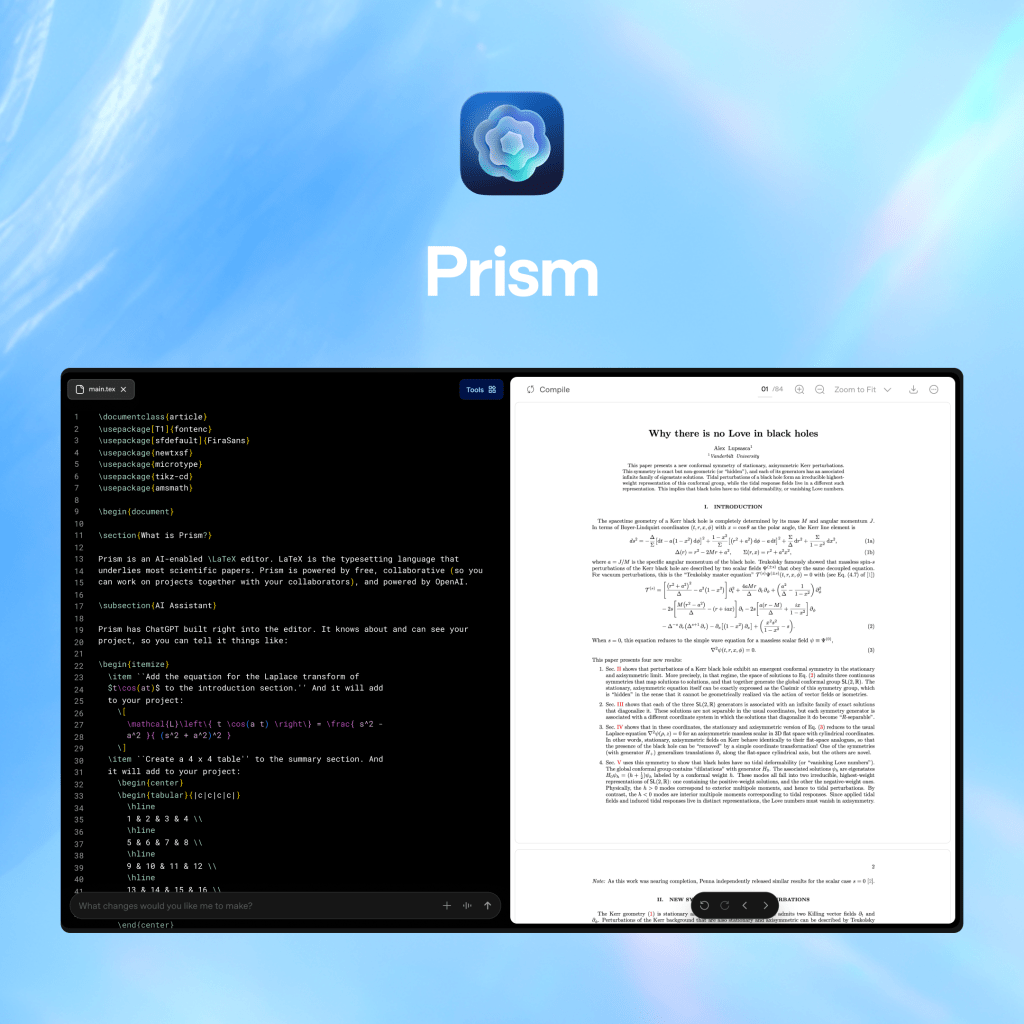
OpenAI has unveiled Prism, an innovative AI-powered workspace tailored for scientists and researchers. This free tool, accessible to all ChatGPT account holders, is designed to enhance the process of drafting and analyzing scientific papers by integrating seamlessly with OpenAI’s advanced language model, GPT-5.2.
Prism functions as an AI-enhanced word processor and research assistant, offering capabilities such as evaluating claims, refining writing, and conducting literature searches. Unlike autonomous research tools, Prism is intended to complement human researchers, accelerating their work without replacing the critical thinking and expertise that scientists bring to their fields. Kevin Weil, OpenAI’s Vice President for Science, highlighted this synergy, stating, I think 2026 will be for AI and science what 2025 was for AI and software engineering.
The development of Prism comes in response to a significant influx of scientific inquiries directed at OpenAI’s consumer products like ChatGPT. The company reports receiving approximately 8.4 million messages weekly on advanced scientific topics, underscoring the demand for AI tools in the scientific community.
AI’s role in scientific research is expanding, with notable applications in fields like mathematics. AI models have been employed to solve longstanding problems, such as several of Erdős’s conjectures, by reviewing existing literature and applying novel techniques. While the importance of these AI-derived proofs is still under discussion, they represent a promising step forward for AI-assisted research.
In December, a statistics paper utilized GPT-5.2 Pro to establish new proofs for a central axiom of statistical theory, with human researchers guiding and verifying the AI’s contributions. OpenAI praised this collaboration, suggesting it as a model for future human-AI partnerships in research. The company noted, In domains with axiomatic theoretical foundations, frontier models can help explore proofs, test hypotheses, and identify connections that might otherwise take substantial human effort to uncover.
Prism’s value is further enhanced by its integration with LaTeX, the open-source system widely used for formatting scientific documents. Beyond standard LaTeX functionalities, Prism leverages GPT-5.2’s visual capabilities, enabling researchers to create diagrams from online whiteboard sketches—a feature addressing a common challenge in scientific documentation.
A standout feature of Prism is its contextual awareness. When users interact with ChatGPT through Prism, the AI has access to the full context of the research project, resulting in more relevant and insightful responses. This depth of integration aims to streamline the research process, making it more efficient and effective.
OpenAI’s initiative with Prism reflects a broader trend of integrating AI into scientific workflows, aiming to enhance productivity and innovation. By providing a user-friendly interface that combines powerful AI capabilities with existing research tools, Prism is poised to become an invaluable asset for scientists seeking to leverage AI in their work.
As AI continues to evolve, tools like Prism exemplify the potential for technology to augment human intelligence, fostering new discoveries and advancements across scientific disciplines.