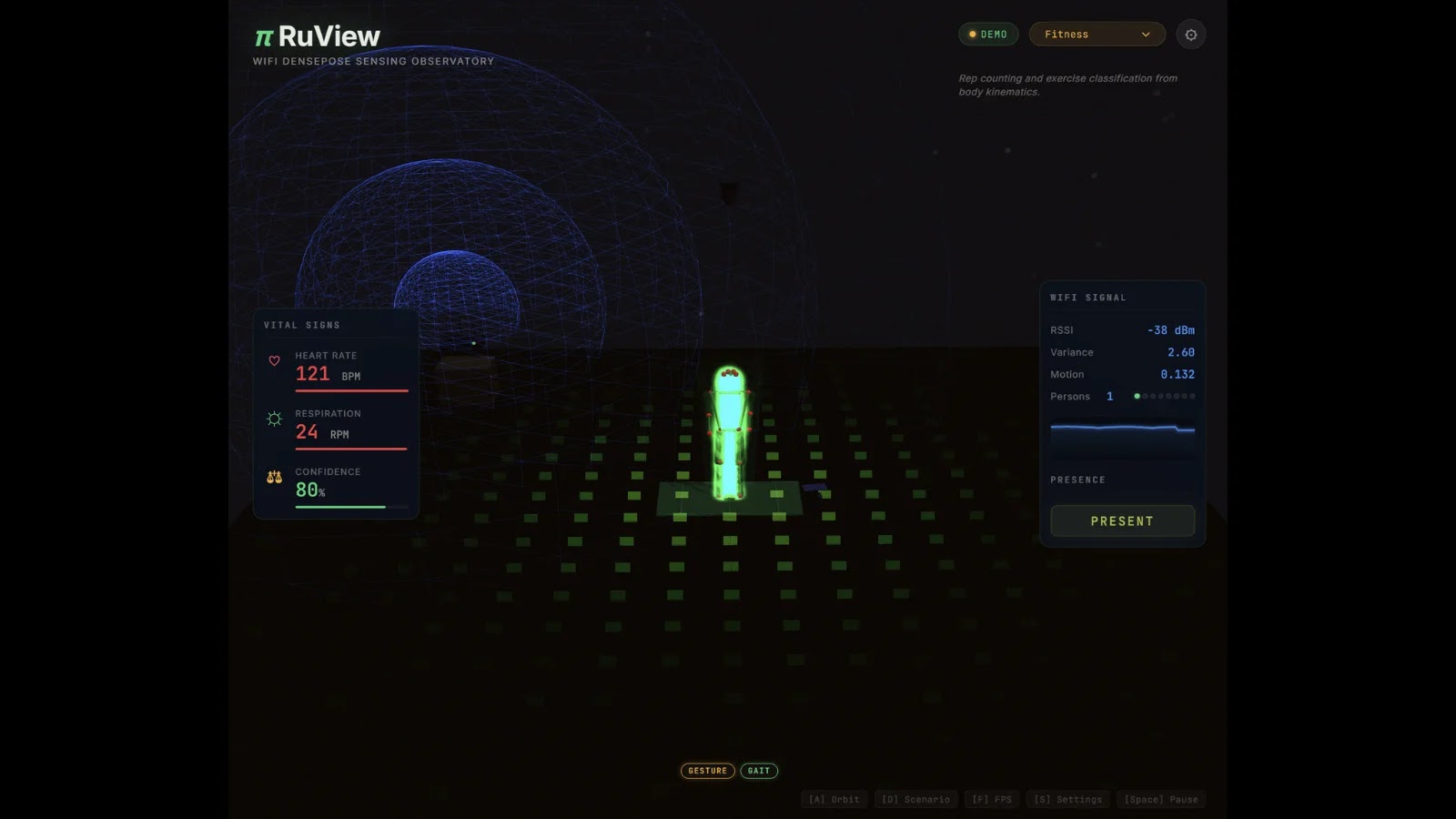
WiFi Signals Unveil Human Movements Through Walls: A New Era of Surveillance
In a groundbreaking development, the open-source edge AI system π RuView is transforming standard WiFi infrastructure into a sophisticated tool capable of detecting human body poses, vital signs, and movement patterns through walls—without the need for cameras. This innovation raises significant security and privacy concerns, as it enables passive surveillance in environments previously considered private.
The Mechanics Behind RuView
Developed by Reuven Cohen and available on GitHub, RuView implements WiFi DensePose, a technique initially pioneered by Carnegie Mellon University. This system reconstructs full-body human poses through walls using only standard WiFi signals.
At its core, RuView exploits Channel State Information (CSI) metadata that WiFi hardware collects to optimize signal transmission. When a human body moves within a wireless environment, it distorts signal paths across numerous Orthogonal Frequency-Division Multiplexing (OFDM) subcarriers. RuView’s signal processing pipeline captures these disturbances at 54,000 frames per second using Rust, extracts amplitude and phase variations, and processes them through a modified DensePose-RCNN deep learning architecture borrowed from computer vision.
The outcome is a real-time reconstruction of 24 body surface regions, including arms, torso, head, and joints, mapped to UV coordinates that mirror what a camera would see, but derived entirely from radio frequency (RF) signals.
Vital Sign Detection
In addition to mapping body movements, RuView can extract vital signs. By applying bandpass filtering at 0.1–0.5 Hz, it captures breathing rates ranging from 6 to 30 breaths per minute. Similarly, filtering at 0.8–2.0 Hz detects heart rates between 40 and 120 beats per minute. This capability allows for comprehensive monitoring of individuals’ physiological states without physical contact or visual observation.
Hardware and Deployment
One of the most alarming aspects of RuView is its minimal hardware requirements. The system deploys on ESP32 microcontroller nodes, each costing approximately $1, forming a multistatic sensor mesh. Deploying four to six nodes creates over 12 overlapping signal paths, providing 360-degree room coverage with sub-inch accuracy. Notably, the system operates entirely offline, with no dependency on cloud services, enhancing its stealth and reducing potential points of failure.
Through-wall detection extends up to 5 meters in depth, utilizing Fresnel zone geometry and multipath modeling. The system learns the RF fingerprint of each room over time, allowing it to subtract the static environment and isolate human motion. This persistent field model can also detect attempts to spoof signals, ensuring the integrity of the monitoring process. Presence detection latency is under 1 millisecond, enabling near-instantaneous tracking of movements.
Privacy and Legal Implications
Unlike traditional cameras, which are regulated under laws such as the General Data Protection Regulation (GDPR) and the California Consumer Privacy Act (CCPA), passive WiFi CSI sensing operates invisibly and requires no physical access to the target environment. This raises significant privacy concerns, as individuals may be monitored without their knowledge or consent.
Legal analyses have noted the difficulty in obtaining consent for passive sensing, as it is challenging to inform individuals in advance. While GDPR classifies WiFi tracking identifiers as personal data, CSI-based body pose extraction exists in a regulatory grey area with no specific controls. This lack of regulation could lead to widespread misuse of the technology for unauthorized surveillance.
Potential for Misuse
The potential for misuse of RuView is significant. A threat actor could plant a $5 ESP32 node in a building’s common area or near a WiFi access point, deploy RuView via Docker (`docker pull ruvnet/wifi-densepose:latest`), and begin silently mapping occupants’ movements, routines, and even biometric vitals through walls. This covert surveillance could be used for various malicious purposes, including stalking, corporate espionage, or unauthorized data collection.
Mitigation Strategies
To address the emerging threat of passive RF sensing, security teams should consider the following mitigation strategies:
– RF Shielding: Implement RF shielding in sensitive facilities to prevent unauthorized signal penetration.
– Device Monitoring: Monitor for rogue ESP32-class devices on network segments to detect unauthorized deployments.
– Regulatory Advocacy: Advocate for regulatory frameworks that extend surveillance laws to cover CSI-based human tracking before the technology outpaces policy entirely.
By proactively addressing these concerns, organizations can better protect individuals’ privacy and prevent the misuse of advanced surveillance technologies.