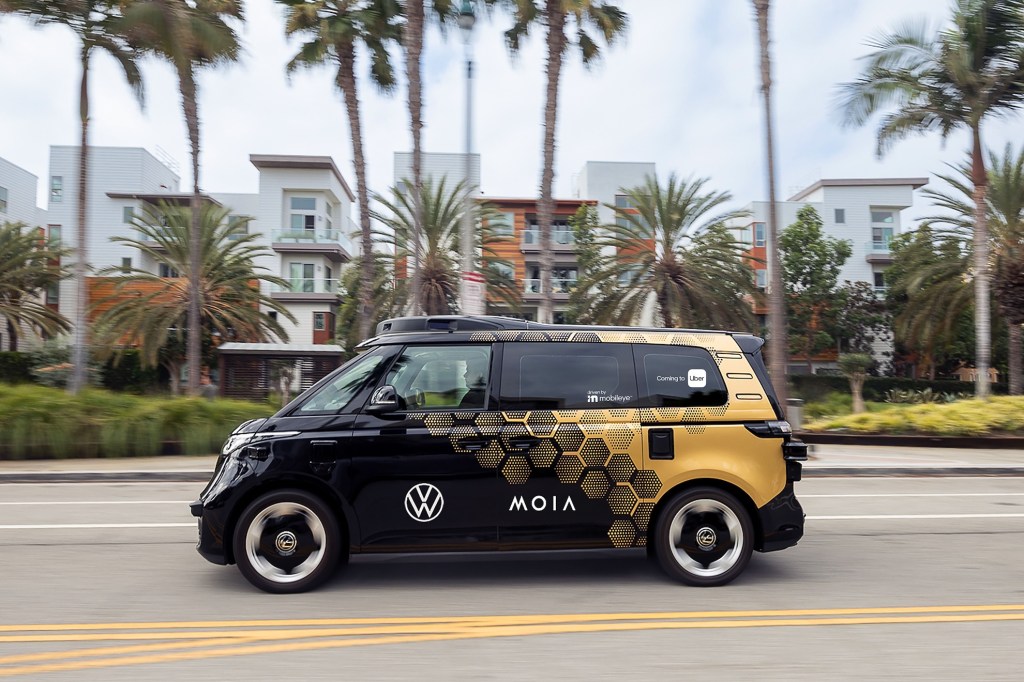
Volkswagen and Uber Initiate Testing of Autonomous ID. Buzz Microbuses in Los Angeles
Volkswagen’s subsidiary, MOIA America, in collaboration with Uber, has commenced testing autonomous microbuses in Los Angeles. This initiative marks a significant step toward launching a commercial robotaxi service by late 2026.
Background and Partnership
In April 2025, MOIA America and Uber announced an ambitious plan to introduce a commercial robotaxi service utilizing autonomous versions of Volkswagen’s electric ID. Buzz minivan across multiple U.S. cities over the next decade. Los Angeles has been selected as the inaugural city for this venture.
Testing Phase
The testing phase is set to begin in the coming weeks, featuring approximately 10 autonomous ID. Buzz vehicles navigating the streets of Los Angeles. These vehicles are designed to accommodate four passengers comfortably. Paul DeLong, President of Commercialization at MOIA America, emphasized Los Angeles’s suitability for this initiative, citing the city’s rich history in shaping car culture and its openness to new mobility technologies.
Operational Developments
Since the initial announcement, MOIA America and Uber have established a joint facility in Los Angeles to manage daily fleet operations. While the current test fleet is modest, Volkswagen plans to expand to over 100 autonomous ID. Buzz vehicles. Initially, these vehicles will operate with human safety operators onboard, with fully driverless operations anticipated to commence in 2027.
Sascha Meyer, Chief Commercial Officer for Volkswagen Autonomous Mobility, highlighted this development as a reflection of the strong momentum behind their strategy to bring autonomous mobility into real-world operation.
MOIA America’s Evolution
The rebranding to MOIA America in early 2026 signifies Volkswagen’s commitment to autonomous vehicle projects in the U.S. The MOIA brand, established in 2018, is renowned in Europe for operating ride-pooling services and testing autonomous vehicle technology in cities like Hamburg, Berlin, Munich, and Oslo. This name change aims to bridge the connection between Volkswagen’s U.S. and European entities.
Regulatory Considerations
Before deploying a commercial robotaxi service in California, MOIA America must navigate a comprehensive regulatory process. This includes obtaining permits from the California Department of Motor Vehicles, which oversees autonomous vehicle testing and deployment, and securing a ride-hailing permit from the California Public Utilities Commission.
Uber’s Autonomous Vehicle Strategy
Uber has been actively expanding its autonomous vehicle partnerships. The company has collaborations with over 25 entities applying autonomous vehicle technology across various sectors, including delivery, drones, ride-hailing, and trucking. Notably, Uber has partnered with Waymo in the U.S. and has agreements with Chinese companies to launch robotaxis in Europe and the Middle East, as well as with U.K.-based startup Wayve.
Recently, Uber entered into an agreement with Rivian to purchase 10,000 fully autonomous R2 robotaxis, with plans to roll them out in San Francisco and Miami by 2028. This deal includes an initial $300 million investment in Rivian.
Conclusion
The collaboration between Volkswagen’s MOIA America and Uber to test autonomous ID. Buzz microbuses in Los Angeles represents a significant advancement in the pursuit of commercial robotaxi services. As testing progresses and regulatory approvals are secured, this initiative has the potential to reshape urban mobility and set a precedent for future autonomous transportation solutions.