Innovative Chip Technology Aims to Eradicate Counterfeit Luxury Goods
The luxury goods industry faces a significant challenge from counterfeit products, resulting in annual losses exceeding $30 billion. Simultaneously, consumers in the burgeoning $210 billion second-hand market struggle to verify the authenticity of their purchases. Addressing these issues, Veritas, a pioneering startup, has developed a sophisticated solution that integrates custom hardware and software to ensure product authenticity.
At the heart of Veritas’s innovation is a hack-proof microchip designed to be impervious to tampering devices like Flipper Zero, a tool commonly used to manipulate wireless systems. Each chip is associated with a digital certificate, providing a reliable method to authenticate products.
Luci Holland, the founder of Veritas, brings a unique blend of artistic and technological expertise to the venture. Her background spans various artistic mediums, including mixed media painting and metal sculpture, as well as technical product management roles at Tesla and other tech companies and venture funds.
Traditionally, luxury brands have employed symbols or physical marks to authenticate their products. However, the increasing demand for luxury items has led counterfeiters to produce high-quality imitations, often referred to as superfakes, complete with convincing fake certificates. This has made it increasingly difficult for brands to distinguish genuine products from counterfeits.
Holland recounted discussions with established luxury fashion houses, known as maisons, where some locations ceased authenticating goods due to the sophistication of counterfeit items. Leveraging her experience in both the tech and art worlds, she sought to develop a solution to this pervasive problem.
As someone with a background in design and experience in technology, I saw this problem and considered various ways to address it, Holland explained. Our innovation lies in combining elements from both hardware and software to create a solution that helps protect brands and convey information effectively.
She emphasized the importance of safeguarding the heritage of iconic brands, many of which have been established for over a century. These brands deserve the most advanced protection to preserve their designs, she added.
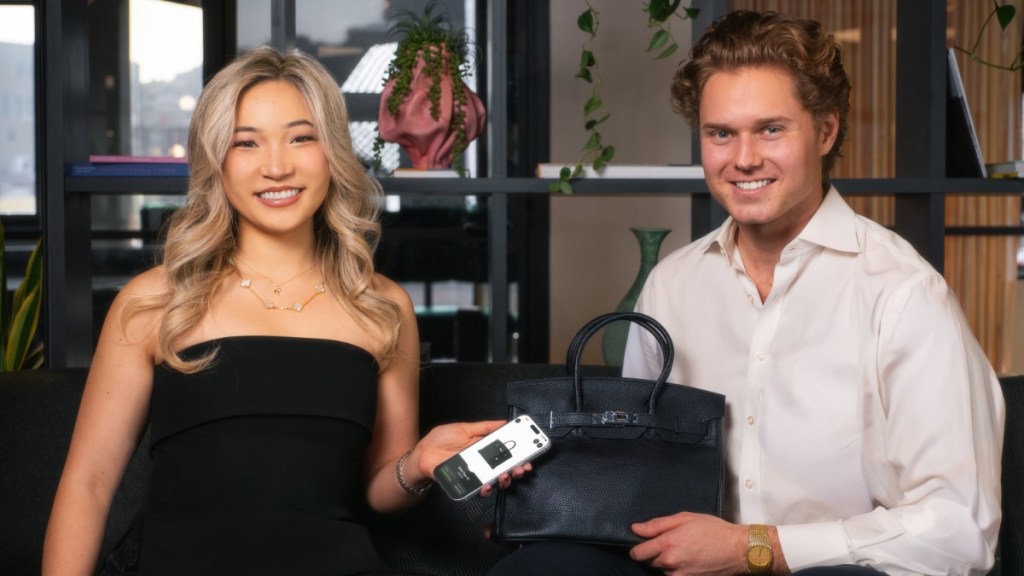
Veritas collaborated with designers to create a microchip that minimally disrupts the product creation process. The chip, comparable in size to a small gem, can be seamlessly integrated into products without compromising their integrity. Utilizing Near Field Communication (NFC) technology—the same short-range wireless communication used in contactless payments—the chip allows consumers to verify a product’s authenticity by simply tapping their smartphone on the item.
For enhanced security, Veritas developed a custom coil and bridge structure within the chip. If tampering is detected, the chip becomes dormant, concealing the product-related codes. On the software side, product information is linked to Veritas’s backend system, which monitors scanning behavior to prevent fraud. Additionally, the company creates a blockchain-based digital clone of the product, facilitating potential digital art gallery displays or metaverse activities.
While Veritas has not disclosed specific partnerships, the company offers a comprehensive software suite that enables brands to manage chipped products, add team members, and input product information and narratives. This platform also serves as a tool for brands to engage with their community, offering exclusive invitations or early access to new products.
Despite the vast counterfeiting market, Holland believes there is a need to educate the industry on the necessity of robust technological solutions. It’s shocking that some off-the-shelf solutions, like NFC chips used by brands, are so vulnerable and can be easily bypassed, she noted. Many people are unaware of this, and we aim to educate the ecosystem to adopt safer solutions.
Veritas recently secured $1.75 million in pre-seed funding, led by Seven Seven Six, with participation from DoorDash co-founder Stanley Tang, skincare brand Reys’ co-founder Gloria Zhu, and former TechCrunch editor Josh Constine. The funding will be used to expand the company’s two-person team.
Alexis Ohanian of Seven Seven Six expressed admiration for Holland’s combination of design sensibility and technological expertise. He acknowledged that brands are aware of the counterfeit problem and are continually seeking robust solutions.
It’s absolutely an arms race against counterfeiters, Ohanian stated. But we’re accustomed to fighting these battles and consistently winning in tech—luxury brands need all the help they can get.