Uber Unveils Premium Robotaxi in Collaboration with Lucid Motors and Nuro
At the 2026 Consumer Electronics Show (CES), Uber, Lucid Motors, and Nuro introduced their jointly developed robotaxi, marking a significant advancement in autonomous ride-hailing services. This unveiling follows Uber’s substantial investment of $300 million into Lucid Motors and a commitment to purchase 20,000 of Lucid’s electric vehicles (EVs). The robotaxi is currently undergoing public road testing, with plans to commence commercial operations in the San Francisco Bay Area later this year.
Design and Technology Integration
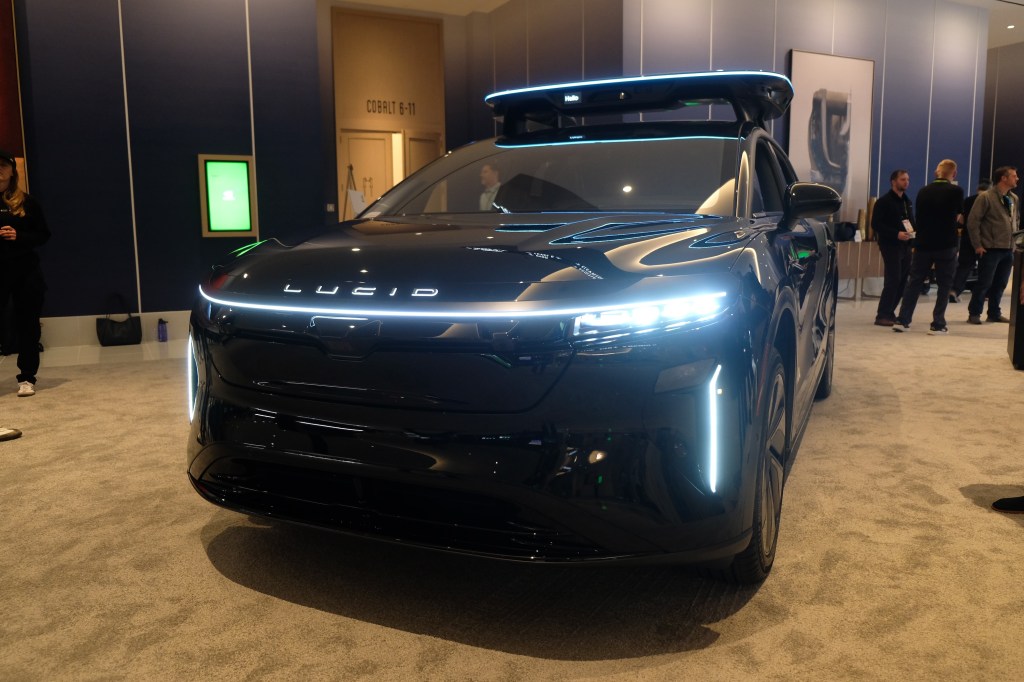
The robotaxi is based on Lucid’s Gravity SUV, renowned for its spacious interior and advanced features. It is equipped with a comprehensive suite of sensors, including high-resolution cameras, solid-state lidar, and radar systems, all seamlessly integrated into the vehicle’s body and a distinctive roof-mounted halo. This halo not only houses essential sensors but also features LED lights to help passengers easily identify their ride.
Powering the autonomous capabilities is Nvidia’s Drive AGX Thor computer, a state-of-the-art platform designed for complex AI computations required for self-driving operations. Notably, the integration of autonomous technology occurs during the vehicle’s manufacturing process at Lucid’s Casa Grande, Arizona facility. This approach streamlines production and reduces costs, contrasting with other methods that retrofit existing vehicles with self-driving hardware post-production.
User Experience and Interface
The collaboration has placed a strong emphasis on enhancing the passenger experience. Inside the robotaxi, riders will find an intuitive interface developed by Uber. A rear passenger screen provides an isometric graphical view of the vehicle’s journey, displaying nearby cars and pedestrians. This interface offers real-time information such as estimated arrival times, remaining ride duration, and controls for climate and music settings. Additionally, passengers have access to support features and can instruct the vehicle to pull over if needed.
Strategic Partnerships and Industry Impact
This initiative is part of Uber’s broader strategy to lead in the autonomous vehicle sector. Over the past two years, Uber has established partnerships with more than 18 autonomous vehicle technology companies worldwide, spanning ride-hailing, delivery, and trucking services. Notable collaborations include agreements with Waymo, May Mobility, Volkswagen, and Chinese firms like Momenta, WeRide, and Baidu.
For Nuro, this partnership signifies a pivotal shift in its business model. After facing financial challenges and multiple rounds of layoffs in 2022 and 2023, Nuro transitioned from operating its own fleet of delivery bots to licensing its autonomous driving technology to automakers and mobility providers. The collaboration with Uber and Lucid serves as a validation of this new direction, demonstrating the viability and demand for Nuro’s self-driving technology in the broader automotive industry.
Market Implications and Future Prospects
The introduction of this premium robotaxi service positions Uber in direct competition with other autonomous ride-hailing services, notably Waymo, which has been operating in cities like Austin and Atlanta. By leveraging Lucid’s high-end EVs and Nuro’s advanced autonomous technology, Uber aims to offer a distinctive and upscale experience to passengers seeking reliable and luxurious transportation options.
The choice of San Francisco for the initial rollout is strategic, given the city’s history as a hub for technological innovation and its existing infrastructure supporting autonomous vehicle testing. The success of this service in such a competitive and tech-savvy market could pave the way for expansion into other metropolitan areas.
Conclusion
The unveiling of the Uber-Lucid-Nuro robotaxi at CES 2026 marks a significant milestone in the evolution of autonomous ride-hailing services. By combining Lucid’s premium electric vehicles, Nuro’s cutting-edge self-driving technology, and Uber’s extensive ride-hailing network, this collaboration has the potential to redefine urban mobility. As the service prepares for its commercial launch in the San Francisco Bay Area, it will be closely watched as a benchmark for the future of autonomous transportation.