Trump’s AI Executive Order Aims for Uniformity but May Prolong Startup Uncertainty
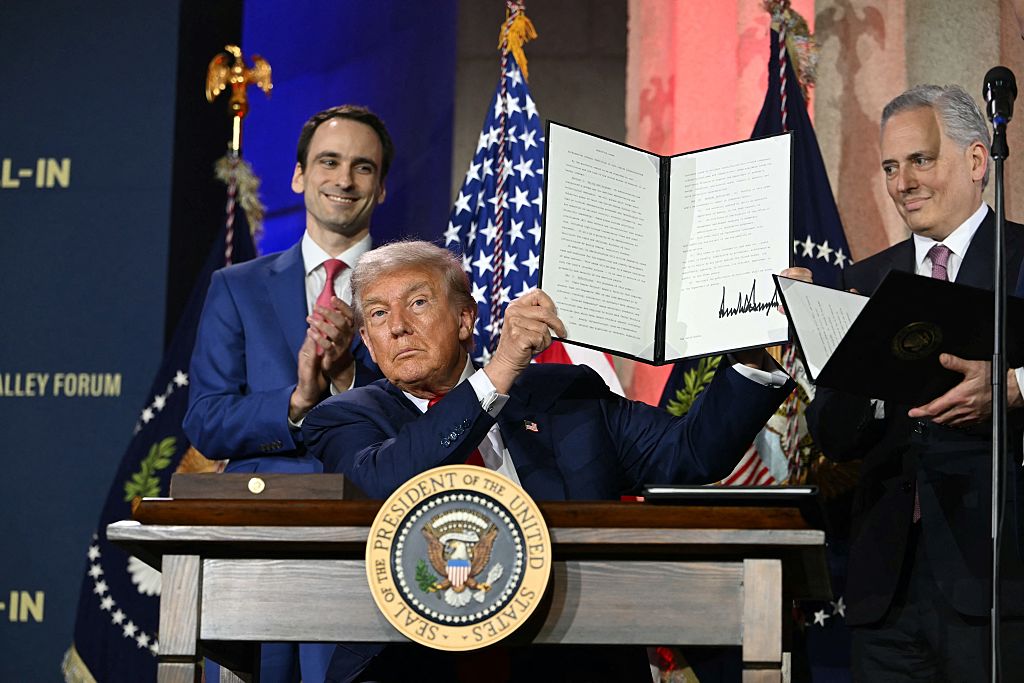
On December 12, 2025, President Donald Trump signed an executive order titled Ensuring a National Policy Framework for Artificial Intelligence, aiming to establish a cohesive federal approach to AI regulation. This directive instructs federal agencies to challenge existing state AI laws, asserting that a unified federal standard is essential for the burgeoning AI industry.
Key Provisions of the Executive Order:
– Department of Justice (DOJ) Task Force: Within 30 days, the DOJ is mandated to form a task force to contest specific state AI regulations, arguing that AI, as an interstate commerce issue, falls under federal jurisdiction.
– Commerce Department Review: The Commerce Department has 90 days to compile a list of state AI laws deemed onerous. States identified may face repercussions, including potential ineligibility for federal funding, such as broadband grants.
– Federal Standards Exploration: The order directs the Federal Trade Commission (FTC) and the Federal Communications Commission (FCC) to consider establishing federal standards that could override state regulations.
– Collaboration with Congress: The administration is tasked with working alongside Congress to develop a uniform national AI law.
Context and Implications:
This executive order emerges amidst a broader effort to streamline AI regulations across the United States. Previous attempts in Congress to halt state-specific AI laws have stalled, leading to a fragmented regulatory landscape. Proponents of a unified federal approach argue that a single set of rules would provide clarity and consistency for AI companies operating nationwide.
However, critics express concerns that the order may lead to prolonged legal battles between federal and state authorities. Michael Kleinman, head of U.S. Policy at the Future of Life Institute, criticized the order, stating it serves the interests of Silicon Valley elites seeking to evade accountability.
David Sacks, appointed by President Trump as the AI and crypto policy advisor, has been a prominent advocate for federal preemption of state AI laws. Despite the order’s intent to create a unified framework, it does not immediately establish one. State laws remain enforceable unless successfully challenged in court or voluntarily suspended by the states.
Impact on Startups:
The executive order introduces a period of uncertainty for AI startups. Legal experts anticipate that states will defend their regulatory authority, potentially leading to cases that could escalate to the Supreme Court. During this transitional phase, startups may struggle to navigate the evolving regulatory environment.
Hart Brown, principal author of Oklahoma Governor Kevin Stitt’s Task Force on AI and Emerging Technology recommendations, highlighted the challenges startups face in establishing comprehensive regulatory compliance programs, which can be both costly and time-consuming.
Arul Nigam, co-founder of Circuit Breaker Labs, emphasized the uncertainty surrounding self-regulation and adherence to open-source standards, noting that the current patchwork of state laws adversely affects smaller startups.
Andrew Gamino-Cheong, CTO and co-founder of AI governance company Trustible, warned that the legal ambiguity could hinder AI innovation. He pointed out that while large tech companies have the resources to manage regulatory complexities, smaller startups may find it challenging to do so, potentially leading to reduced trust and adoption of AI technologies.
Legal Perspectives:
Gary Kibel, a partner at Davis + Gilbert, noted that while businesses generally favor a single national standard, an executive order may not be the appropriate mechanism to override duly enacted state laws. He cautioned that the current uncertainty could result in either overly restrictive regulations or a lack of action, both of which could create a Wild West scenario favoring larger tech companies capable of absorbing risks.
Morgan Reed, president of The App Association, urged Congress to swiftly enact a comprehensive, targeted, and risk-based national AI framework, emphasizing that a patchwork of state laws or prolonged court battles over the executive order’s constitutionality are not viable solutions.
Conclusion:
President Trump’s executive order seeks to unify AI regulations under a federal framework, aiming to alleviate the complexities posed by varying state laws. However, the order’s implementation may lead to extended legal disputes, leaving AI startups in a state of uncertainty as they navigate the evolving regulatory landscape. The success of this initiative hinges on the ability of federal and state authorities to reconcile their differences and establish a clear, consistent regulatory environment for AI development and deployment.