Talat: The AI-Powered Notetaking App That Keeps Your Data Private
In an era where digital privacy is paramount, a new application named Talat is redefining the landscape of AI-powered notetaking by ensuring that all data remains securely on the user’s device. Unlike many existing solutions that rely on cloud-based processing, Talat operates entirely locally, offering users complete control over their information without the need for subscriptions or internet connectivity.
The Genesis of Talat
Talat is the brainchild of Nick Payne, a developer based in Yorkshire, England. Payne’s journey toward creating Talat was serendipitous, stemming from his exploration of existing notetaking applications and a desire to enhance user privacy. His initial encounter with Granola, a popular AI notetaking app, sparked his interest in the mechanics of audio recording on macOS. This curiosity led him to delve into Apple’s Core Audio Taps API, which facilitates access to a Mac’s audio streams.
To simplify the complexities associated with this API, Payne developed an open-source audio library named AudioTee. However, his quest for a fully local transcription solution remained unfulfilled until he discovered FluidAudio, a Swift framework that enables low-latency audio AI processing directly on Apple devices. This discovery was pivotal, as it allowed Payne to envision a product where audio data never leaves the user’s Mac, thereby addressing significant privacy concerns.
Collaborative Development
Recognizing the potential of his idea, Payne collaborated with his longtime friend and former colleague, Mike Franklin. Together, they transformed the concept into a tangible product, resulting in the creation of Talat. The application is a compact 20MB download, available for a one-time purchase, eliminating the need for user accounts or data sharing with external servers. This approach ensures that users retain full ownership and control over their data.
Key Features of Talat
Talat offers a streamlined set of features designed to enhance the notetaking experience while prioritizing user privacy:
– Real-Time Transcription: The app captures audio from the user’s microphone during meetings conducted on platforms such as Zoom, Microsoft Teams, and Google Meet. It transcribes the audio in real time, providing immediate access to the content discussed.
– Speaker Identification: Talat attempts to assign speakers during the transcription process. Users have the flexibility to reassign speakers as needed, ensuring accuracy in the notes.
– Editable Transcripts: Users can edit, delete, or split transcript segments, allowing for customization and refinement of the notes to suit individual preferences.
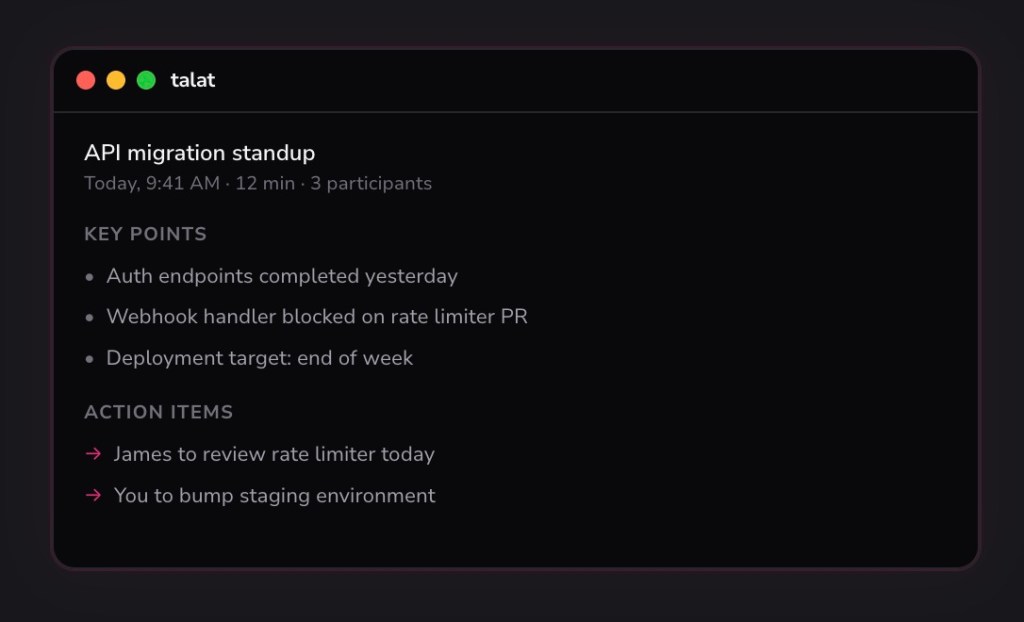
– Automated Summarization: Upon the conclusion of a meeting, Talat utilizes a local Large Language Model (LLM) to generate a summary highlighting key points, decisions, and action items. This feature aids in quickly reviewing the most critical aspects of the discussion.
– Searchable Content: All notes, transcripts, and summaries are searchable within the application, facilitating easy retrieval of information when needed.
Privacy-Centric Design
One of Talat’s most compelling attributes is its commitment to privacy. By processing all data locally on the user’s device, the application ensures that sensitive information remains secure and inaccessible to external entities. This design choice addresses growing concerns about data privacy and the potential risks associated with cloud-based services.
User Empowerment Through Configurability
Talat emphasizes user empowerment by offering a high degree of configurability. Users can control various aspects of the application, including data storage locations and processing preferences. This flexibility allows individuals to tailor the app to their specific needs and comfort levels regarding data management.
The Competitive Landscape
The market for AI-powered notetaking applications is burgeoning, with several players offering cloud-based solutions. For instance, Granola has gained popularity among tech industry professionals for its automated notetaking capabilities. However, Talat differentiates itself by providing a privacy-focused alternative that operates entirely offline, catering to users who prioritize data security over cloud-based convenience.
The Future of Talat
As Talat gains traction, its developers are committed to continuous improvement based on user feedback. Future updates may include additional features such as integration with other productivity tools, enhanced language support, and further customization options. The overarching goal remains to provide a robust, privacy-centric notetaking solution that meets the evolving needs of users.
Conclusion
Talat represents a significant advancement in the realm of AI-powered notetaking applications by offering a solution that prioritizes user privacy without compromising functionality. Its local processing capabilities, combined with a user-friendly interface and a one-time purchase model, make it an attractive option for individuals and organizations seeking a secure and efficient way to manage meeting notes. As concerns about data privacy continue to escalate, Talat’s approach may set a new standard for how digital tools handle sensitive information.