Addressing macOS Security Gaps in 2026: Strategies for SOC Teams
In 2026, macOS devices have become integral to business operations, especially among engineering, product, and leadership teams. This widespread adoption has elevated macOS security to a critical concern. Compromised Macs can lead to stolen credentials, exposure of sensitive internal data, unauthorized access to business systems, financial loss, operational disruption, and reputational damage.
The Challenge of macOS Threat Detection
Many Security Operations Centers (SOCs) have workflows optimized for more familiar platforms, leaving macOS threats harder to validate early and with confidence. When suspicious files or URLs involve macOS, teams may need extra steps, separate environments, or manual verification before they can confirm malicious activity. This leads to slower alert triage, delayed response decisions, limited visibility into real macOS threat behavior, more investigation friction for analysts, and a higher risk of missed or late detections.
Proactive Analysis for Early Detection
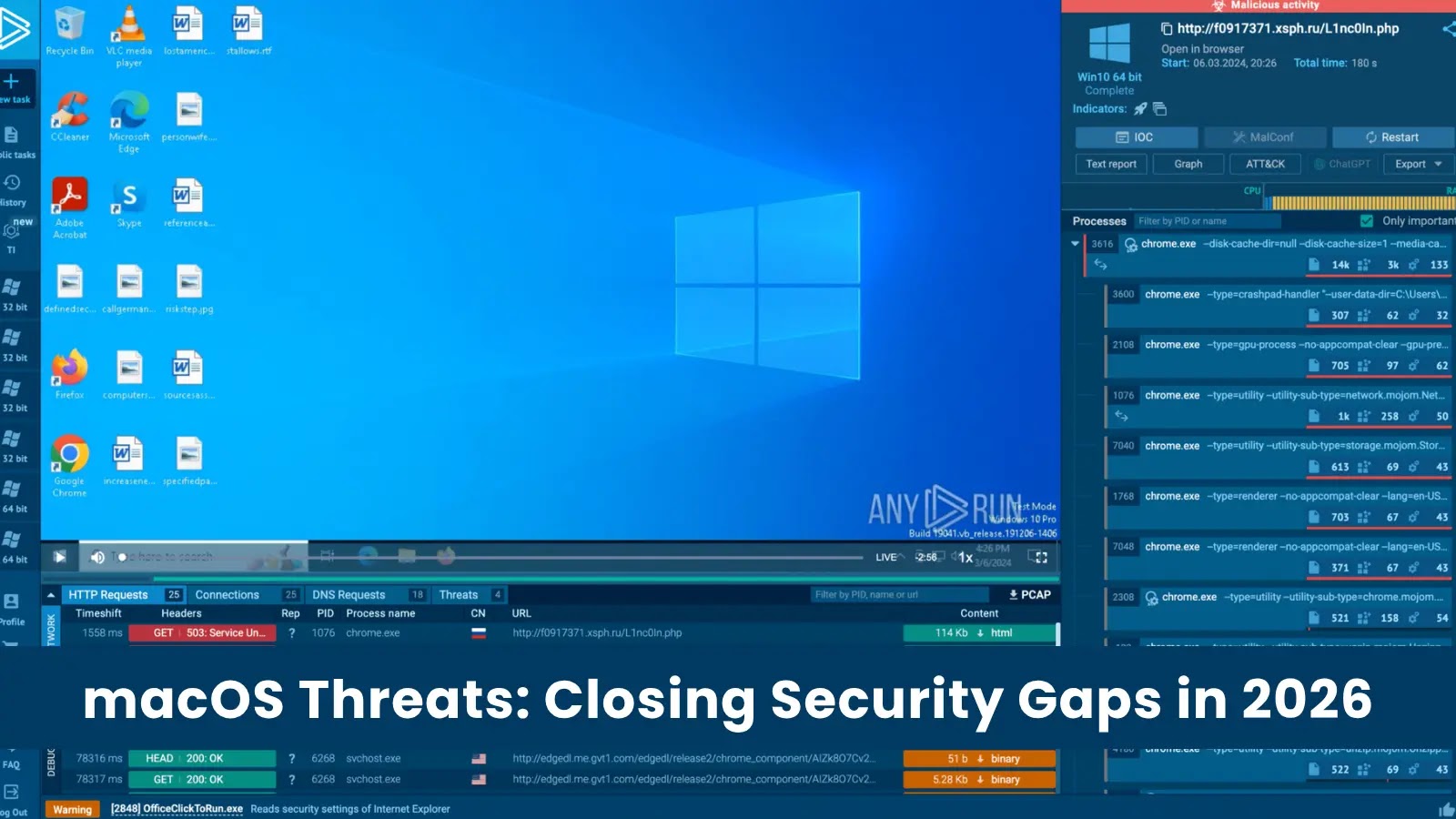
Modern SOC teams are increasingly using interactive sandboxes to detect macOS threats earlier and investigate them with more confidence. This approach is especially valuable in environments where security teams need to analyze threats across multiple platforms without switching between separate tools. For instance, ANY.RUN sandbox supports this approach with environments for macOS, Windows, Linux, and Android, helping teams investigate suspicious files and URLs within one workflow.
Case Study: Miolab Stealer
A pertinent example is the Miolab Stealer, a macOS credential stealer analyzed inside the ANY.RUN sandbox. The sample displays a fake system authentication prompt designed to closely resemble a legitimate macOS message, making it less likely to raise suspicion. Without a valid password, the malware does not continue its execution chain. Once authentication succeeds, it gathers system information, searches user directories for files, archives the collected data, and exfiltrates it to a remote server.
The interactive sandbox reveals this full behavior chain, including deceptive dialogs, AppleScript-based file collection, and outbound data transfer, giving security teams a clearer view of the threat’s intent and potential business impact.
Enhancing SOC Response with Early Detection
When security teams can investigate macOS threats early, they can make faster and more confident decisions during triage. Instead of relying on limited indicators or fragmented investigation steps, they gain direct visibility into how a suspicious file or URL behaves and what risk it poses to the business.
This improves operations in several important ways:
– Reduced Manual Effort for Tier 1 Teams: Automated analysis surfaces key behaviors faster, so analysts spend less time piecing together scattered signals or switching between tools.
– Faster, More Confident Triage Decisions: Interactive analysis provides clear evidence of malicious activity, enabling quicker and more accurate assessments.
– Improved Incident Response: Early detection allows for prompt containment and remediation, minimizing potential damage.
Implementing Proactive macOS Threat Analysis
To effectively close the macOS security gap, SOC teams should consider the following steps:
1. Integrate Interactive Sandboxes: Utilize platforms that support macOS environments to analyze suspicious files and URLs within a unified workflow.
2. Train Analysts on macOS Threats: Provide specialized training to help analysts recognize and respond to macOS-specific threats.
3. Develop macOS-Specific Playbooks: Create response procedures tailored to macOS incidents to ensure consistent and effective handling.
4. Monitor for Emerging Threats: Stay informed about new macOS vulnerabilities and attack vectors to proactively adjust defense strategies.
By adopting these measures, SOC teams can enhance their ability to detect and respond to macOS threats, thereby reducing business risk and safeguarding critical assets.