SEC Ends Four-Year Investigation into Faraday Future, Paving Way for EV Startup’s Growth
The U.S. Securities and Exchange Commission (SEC) has concluded its extensive four-year investigation into electric vehicle (EV) startup Faraday Future, opting not to pursue any enforcement actions against the company or its executives. This decision marks a significant turning point for the Los Angeles-based automaker, which has faced numerous challenges since its inception in 2014.
Background of the Investigation
The SEC’s probe, initiated in 2022, centered on allegations that Faraday Future provided false and misleading statements during its 2021 public listing via a special purpose acquisition company (SPAC) merger. Additionally, the commission examined claims that the company fabricated sales figures for its inaugural electric vehicles in 2023. These allegations were brought to light by at least three former employees who acted as whistleblowers.
Throughout the investigation, the SEC issued multiple subpoenas to Faraday Future and conducted depositions with several former employees and executives between 2024 and 2025. In July 2025, the company disclosed that it and several executives, including founder Jia Yueting, had received Wells Notices from the SEC. These notices indicate that SEC staff are recommending enforcement actions.
SEC’s Decision and Its Implications
Despite the staff’s recommendations, the SEC has chosen not to proceed with any enforcement actions. This decision aligns with a broader trend of reduced enforcement activities by the commission, which initiated only four cases against publicly traded companies in the 2025 fiscal year.
Faraday Future’s founder, Jia Yueting, expressed relief and optimism following the SEC’s decision. We can now put all our energy into strategy execution. Over the past five years, we had to spend a great deal of time, effort, and money on cooperating with the investigation, Jia stated. The company also confirmed that the SEC would not take action against any of its executives.
Faraday Future’s Journey and Challenges
Founded in 2014, Faraday Future aimed to revolutionize the EV market with innovative designs and technology. However, the company has faced a series of financial and operational hurdles over the years.
In its early years, Faraday Future announced ambitious plans, including a $1 billion investment in a manufacturing facility in North Las Vegas. However, construction was halted in 2016 due to financial instability. The company then shifted its focus to a former Pirelli tire plant in Hanford, California, aiming to produce up to 10,000 cars annually.
Financial struggles have been a recurring theme for Faraday Future. In late 2017, key executives departed over disputes related to financing and the company’s dwindling cash reserves. Founder Jia Yueting, who was also facing personal financial issues in China, took over as CEO and secured a $1 billion investment for a 25% stake in the company.
Despite these efforts, the company continued to face challenges. In 2018, Faraday Future received a $1.5 billion funding commitment from an undisclosed Hong Kong investor, with $550 million invested initially. However, disputes with investors led to layoffs and salary cuts. By the end of 2018, the staff was reduced by 40%.
In 2019, Jia Yueting filed for personal bankruptcy in the U.S., stepping down as CEO to assume the role of Chief Product and User Officer. He was succeeded by Carsten Breitfeld, former CEO of rival EV startup Byton.
Recent Developments and Future Prospects
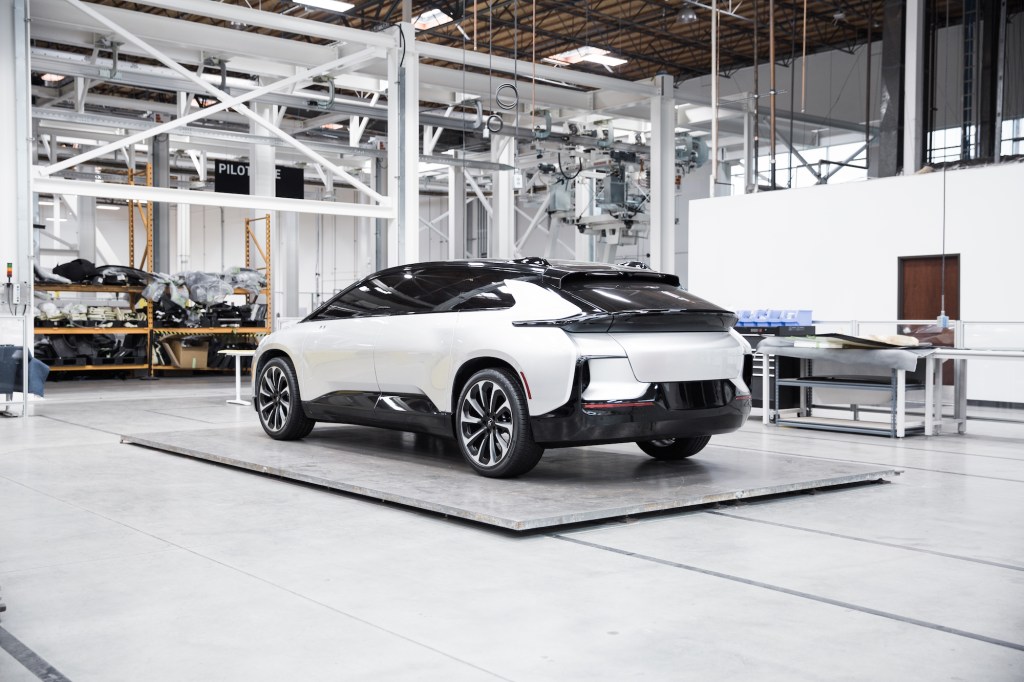
In 2023, Faraday Future began delivering its FF 91 Futurist Alliance vehicles, marking a significant milestone for the company. Notable figures, including actress and entrepreneur Emma Hernan, joined as owners and Developer Co-Creation Officers.
However, the company faced a setback in October 2025 when an FF 91 prototype exploded at their headquarters, causing significant damage to the facility. Fortunately, no injuries were reported.
With the SEC investigation now concluded, Faraday Future is poised to focus on its strategic goals without the overhang of regulatory scrutiny. The company’s ability to navigate past challenges and the recent clearance by the SEC may bolster investor confidence and pave the way for future growth in the competitive EV market.